Welcome all seeking refuge from dogmatic lifestyle advice!

Please check out the tabs below to learn more about the Asylum, its founding and purpose, and the inmate running this place. Take the light-hearted quiz to see if you should stay for a spell and join us over at the Meeting Rooms for some lively discussion.

align="middle" align="middle" align="middle" align="middle"
______________ last updated 6/28/11 _____________________ last updated 7/29/11 _____________________ last updated 6/25/11 ______________________ Come on Over! _________

Thursday, March 31, 2011

Fasting Insulin & Weight Loss
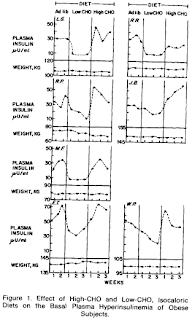
Some folks have been having a bit of a go at me over at Peter/Hyperlipid's blog.  I guess it all started by Peter taking some sort of offense to my post on his Potatoes and weight loss post entitled Insulin Caused Cerebral Stress.  My intent with my post was not to mock Peter.  It was to point out how so inconsistent with observations the carb/insulin hypothesis is, so as to elicit elaborate explanations such as the scenario Peter described to explain a simple phenomenon:  Voight lost weight eating potatoes by estimating his energy needs and eating a controlled amount of predominantly potato-derived calories.   Peter, himself, started that post discussing the time/pages he had spent developing his theory.  I don't question/contest that what he says regarding insulin, sensitivity, etc. may actually be true.  I do believe, however, it is irrelevant.  I say that because I just do not see consistent evidence to support his assertion that:

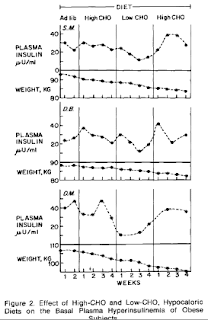
The ultimate determinant of weight loss is fasting insulin. ~Petro Dobromylskyj

Sunday, March 27, 2011

Me, Dieting, Low Carb and the LC Web

It's become apparent to me from various comments made about me elsewhere on the web that many have no idea where I'm coming from or what motivates me.  Realize that I can't possibly put in a short "about me" blurb everything, and I'm not the only blogger out there who hasn't paid much attention to whether that says all we think it should in an up to date manner.  

There's been some rather humorous comments over on Peter/Hyperlipid's Gourmand Rats post.  Apparently some think I'm a front for some community project on behalf of the interests of Big Agro.  Golly gee!  One particularly imaginative fella, who has probably spent too much time in the company of his dog rather than humans, has spun a tale of unrequited love for GT.  I dunno about the rest of you ladies, but really, Gary's just not my type. He's more the type I spent my single years fending off advances from.  For what that's worth ...  But I never heard of the man until after I'd lost my weight, and I'll take credit for doing that thankyouverymuch.  The number of people worshiping him for saving their lives will perplex me every time I see such fawning.

Thursday, March 24, 2011

Bacon, Eggs & Battery Acid

Dietary Animal and Plant Protein and Human Bone Health: A Whole Foods Approach

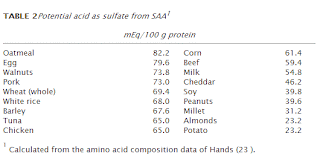
According to a reliable source, I should be very concerned about the following table:
Because:
Sulfuric acid is among the most powerful and potentially harmful acids known. Get even a dilute quantity in your eyes and you will suffer serious burns and possibly loss of eyesight. Ingest it and you can sustain fatal injury to the mouth and esophagus. Sulfuric acid's potent tendency to react with other compounds is one of the reasons that it is used in industrial processes like petroleum refining. Sulfuric acid is also a component of the harsh atmosphere of Venus.

Tuesday, March 22, 2011

Insulin Resistance ~ Taubes v. McGarry ~ Speaking of Banting ...


This post is fast fowarding to the final contribution to the field by JD McGarry.  I'll back track and be posting works in between in coming weeks.  According to this tribute to McGarry, he was quite ill by this point, and indeed he was unable to deliver the lecture, but was present at its delivery.  It is unfortunate that Taubes has misrepresented McGarry's work, because as I read more and more about this man and from this man, he really was a scientist in the vein of bucking conventional wisdom ... something that should have perked Taubes' interest.


Sunday, March 20, 2011

Why I Eat Low Carb ~ Response to Reader Email

I received the following email a couple of days ago:

I have spent about half an hour on your blog trying to find some kind of specific entries that explain why you, per your headline, don't buy what most of the low-carb community says about why it works, but you live it anyway.
Do you have a post or two that sort of sums it up?  Because I just got lost and it seemed that in order to understand what you were talking about I would have to commit to starting at the beginning and read everything, including all the links - AND I'd have to have the ability to understand it all, which I do not.
So... could you give me a hand in getting a grounding in how you seem to be pretty hostile to a whole lot of low-carb stuff while living low carb.
Much obliged for your help.

I've come to realize that I don't have such a post or two to point to, so I thank this reader (I'll let him/her ID themselves if they so desire) for bringing this to my attention.

Wednesday, March 16, 2011

Insulin Caused Cerebral Stress

What?

No, I haven't uncovered some damning study on this.  I was, however, directed to this post by Petro/Hyperlipid in a discussion on another blog:   Potatoes and weight loss (1)

Peter's post begins with:  "I tried and failed to produce a comprehensive post about weight loss on an all potato diet. It runs to too many pages. This is a brief simplification."  This indicates to me a fair amount of mental energy expended on this topic, hence my post title.

GCBC Reference Check ~ Part V of ? ~ Insulin Resistance: Taubes v. McGarry

"Over the years, prominent diabetologists and endocrinologists -- from Yalow and Berson in the 1960's through Dennis McGarry in the 1990's -- have speculated on this train of causation from hyperinsulinemia to Type 2 diabetes and obesity.  Anything that increases insulin, induces insulin resistance, and induces the pancreas to compensate by secreting still more insulin, will also lead to an excess accumulation of body fat.    
~Gary Taubes (p. 409 Sony ebook version of GCBC)


Now, before you click below and go on to read what I interpret this excerpt from GCBC to mean, and  some works of McGarry, write down what that statement means to you.

Sunday, March 13, 2011

A Sad SAD Commercial!

I just have to comment on this because this stupid Chunky soup commercial was just on the tube.  "What can you do with plain white rice?  When you pour Chunky Sirloin Burger soup over it, you can do dinner".  Complete with slender woman enjoying a dish that doesn't even look appetizing to me!


Saturday, March 12, 2011

Introducing My Library!

I've decided to start yet another blog just for the purposes those "bookmarking" posts I do from time to time.  Links to various journal articles I come across in my travels about the web that I haven't yet gotten around to blog on.  I doubt I'll get to blogging about even 1/10th of the links I'll probably put there, and some of the stuff is not necessarily "up my alley" but may be of interest to some of you.  I don't have comments on in that blog.  If you see something that peaks your interest and would like me to blog on, drop me a line through my profile.  I can't guarantee that I will be able to honor the request, but I'm always open to discussing what interests YOU.

The blog has been "live" for a while, and if Blogger would cooperate (export/import is not working properly), I plan to migrate all such posts from here to there.  


Diet, Cardio, Resistance Training & Insulin

Thanks to Mirrorball for "putting a bug in my ear" regarding the impact of exercise on insulin levels.  The basic thought being that if Taubes' theory that lowering insulin makes you lose weight, then exercise should be very effective, especially if you couple it with carbohydrate restriction.  Because, if you "overeat" protein and fat calories those don't impact body weight right?

So I found this study:


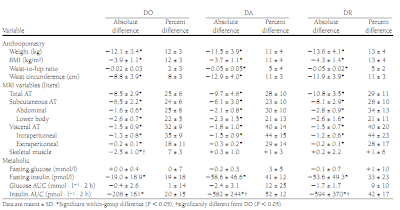
Basically they took three groups of men averaging 40-47 years of age, ~100kg weight, ~32 BMI and did 3 interventions: 

  1. DO = diet only
  2. DA = diet + aerobic exercise
  3. DR = diet + resistance exercise

Does exercise make you hungry?

Thanks to MM, I now have the full text of the following study.  I'm going to do a test for sharing this with y'all through Google Docs.  Please let me know if it doesn't work:


Acute compensatory eating following exercise is associated with implicit hedonic wanting for food  (I'm going to intersperse quotations from all over this paper)

The efficacy of exercise to promote weight loss could potentially be undermined by its influence on explicit or implicit processes of liking and wanting for food which in turn alter food preference. The present study was designed to examine hedonic and homeostatic mechanisms involved in the acute effects of exercise on food intake.

Friday, March 11, 2011

Exercise & Weight Management

I've been having a little discussion of this over at Taubes' forum based on his comments on the Dr. Oz show.  He basically regurgitated two points that he's never really offered up much scientific proof of:

1.  Exercise just makes you hungry, and
2.  You'll compensate for the increased activity during exercise by lazing around the rest of the day.

On point 1, Taubes loves to use the "have you ever heard the phrase working up an appetite" line.  At least he sounded a little less condescending asking that this time as compared to when he asked Jillian Michaels in his 2007 Larry King appearance.  

In a "I think I gotcha moment", one commenter posted this study as evidence of eating more:  (I only have the abstract for this one):

Wednesday, March 9, 2011

Why We Get Fat ... Lessons from Obese Humans & Cafeteria Rats

One of the more interesting things (to me) to come out of the "cafeteria rat study" is what the composition of the diet eventually chosen by the rats came out to be.  I'm just going to focus on the SC (standard chow) and CAF (SC + human snack foods) diets in this post.

To recap, the SC had a composition F/C/P of 10/64/26.  When offered this chow along with a rotating selection of three human snack foods from the following list, the rats only ate 15% of their diet as chow (the wording of this is unclear, but their total consumption is ultimately what's important).  The composition of the diet they ended up eating?  CAF was F/C/P of 44/46/10  (note: I've detected slight discrepancies in the numbers here that involve a 1-2% swing in either direction) .  One might think the rodies were only offered fatty snacks, but this is not the case as can be seen in the table below:

The Dr. Oz Show: Cholesterol and Gary Taubes

It may surprise many but I actually agree with GT in large part on what he says about cholesterol.  Problem with that part of GCBC was that he wasn't really saying anything new.    My first cholesterol test was back in the days when just total cholesterol was your basic test.  Mine was high - only moderately overweight at 20 or so years of age.  A few years later the LDL/HDL breakdown became more the norm and my HDL was high.  Now we all know the progression with particle numbers, sizes, etc that has developed over the years and with it less concern over some types, more over others.

So there's lots of moaning going on over at GT's blog and around the LC web over Taubes' appearance on the Dr. Oz TV show 3/7/12.   I'm no fan of Dr. Oz.  I don't watch any of that sort of TV on anything other than a passing basis in doc/dental waiting rooms and such   I did watch the YouTube videos of Dr. Oz with GT on Larry King back in 2007 (is there a part III?) and I'm well aware of Oz's relationship with Oprah.   I'm especially not fond of Dr. Oz after reading this post over at Yoni Freedhoff's Weighty Matters blog.

Tuesday, March 8, 2011

Why We Get (Sick) Fat - Lessons from a Cafeteria Rat

It seems fairly generally accepted that whatever the cause or progression, the so-called Metabolic Syndrome, Syndrome X and Type 2 Diabetes are associated with a dysregulation of adipose tissue metabolism, and fat tissue that is infiltrated with macrophages and secretes excessive amounts of inflammatory molecules called adipokines (e.g. TNF-α, IL-6).   A term has been coined, adisopathy, to describe this "sick fat".  

I've recently discussed the "Cafeteria Rat" study  as pertains weight gain in general.  But the other thing about this study is that it looked at the fat tissue with the different dietary interventions.  To recap, four groups of rats were fed ad libitum different diets:

Monday, March 7, 2011

Insulin, Weight & Fat Accumulation

Yes folks, if you go to any Biochemistry or Endocrinology text, you will find that insulin's action is to put fat into fat cells and suppress its release.  Therefore insulin makes us fat.  Lower insulin, lose weight.  Raise insulin, get fat.  Right?

I've recently posted on two rat studies (here and here) that demonstrate unequivocally that it is not so simple.  I've also previously addressed the study that is the focus of this post in my Insulin Wars series with Todd Becker.  But wanted to further highlight that study here in a separate post.  

Ketogenic Diet increases Fat Mass and Fat:Total Body Mass Ratio

Ketogenic diet-fed rats have increased fat mass and phosphoenolpyruvate carboxykinase activity


This study looked at body weight, fat mass, blood lipid and glucose levels and PEPCK (rate limiting enzyme in glyceroneogenesis pathway for G3P production for esterification of fatty acids - fat deposition) activity in the liver and fat cells.  Two ad libitum diets were compared, a control standard chow and a ketogenic zero carb chow.  This study was in normal, young (30 days old at start) Wistar rats and lasted 6 weeks.

The diet compositions are shown below:

Sunday, March 6, 2011

Free Fatty Acid Levels and Body Fat Mass

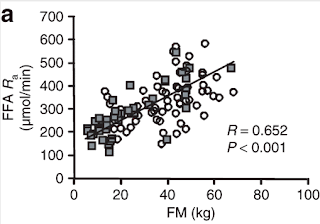
Relationship Between Body Fat Mass and Free Fatty Acid Kinetics in Men and Women  
{Hat tip MM, thanks!}
Alterations in free fatty acid (FFA) metabolism are involved in the pathogenesis of insulin resistance, diabetes, dyslipidemia, and cardiovascular disease (1,2). Excessive plasma FFA availability impairs the ability of insulin to suppress hepatic glucose production and to increase skeletal muscle glucose disposal (1,3). Plasma FFAs are also the primary source of fatty acids for hepatic very low-density lipoprotein–triglyceride (TG) production (4,5,6,7), and plasma very low-density lipoprotein–TG concentration is an important risk factor for cardiovascular disease (8,9). In addition, the accumulation of intracellular fatty acid metabolites stimulates the production of inflammatory proteins (10), which can also contribute to insulin resistance and atherosclerosis (1). Therefore, understanding the factors that affect FFA metabolism has important physiological and clinical implications.

Friday, March 4, 2011

Elevated NEFA Impairs Insulin Secretion in Non-Diabetics Genetically Predisposed to Develop Diabetes


Type 2 diabetes is characterized by defects in both insulin secretion and insulin action (1). Subtle defects in β-cell function and insulin resistance precede the development of hyperglycemia in individuals at high risk of developing type 2 diabetes

Thursday, March 3, 2011

Another Hormone Involved in Lipid Mobilization? Atrial Natriuretic Peptide

This article is a bit heady, and I won't go into a detailed analysis but will try instead to present some relevant excerpts to the gist of this post.   That being, adipocyte metabolism, the continual cycling of fats in and out of adipose tissue, the continual cycle of esterification and hydrolysis, is mediated by more than just insulin.


According to the save date on my computer, I found this one a year ago.  Ever heard of atrial natriuretic peptide?  Me neither.  

According to Wikipedia, ANP is:
.... a powerful vasodilator, and a protein (polypeptidehormone secreted by heart muscle cells.[1][2] It is involved in the homeostatic control of body watersodiumpotassium and fat (adipose tissue). It is released by muscle cells in the upper chambers (atria) of the heart (atrial myocytes), in response to high blood pressure. ANP acts to reduce the water, sodium and adipose loads on the circulatory system, thereby reducing blood pressure.[1]

Tuesday, March 1, 2011

Insulin Wars IV.2a: The Discussion with Todd Becker/Getting Stronger continues

If you haven't read the discussion thus far, or just to recap, here are the links:
Insulin Wars IV: Todd Becker of Getting Stronger blog
Insulin Wars IV.1: Todd Becker of Getting Stronger blog responds
More Todd Becker (Getting Stronger blog) on Insulin (this last one links to his piece on his blog)
{Todd quoted the relevant prior exchanges in his email, so most can probably follow along just with this post}

I've been putting off posting this for too long, mostly because in its entirety it is very lengthy (15 pages!) and I haven't had the length of uninterrupted time to devote to a thorough point by point response to the entire email.  So I decided to break this installment (IV.2) up into parts (a,b..., however many) so we can keep this discussion alive and continuing.  I'm also likely to address some topics out of order from Todd's email response.   Eventually it will all get up here :-)  I very much appreciate all the hard work Todd put into his response and our continuing discussion.  Please do bear with us, as we'll no doubt get a bit repetitive at times.   I do hope you'll enjoy the complete exchange.  I appreciate any heads-up on dropped links etc. that may have occurred with my C&P.    Thanks again to Todd Becker!


1. Causal role of Insulin in fat accumulation.
Found something helpful today? Please consider a small donation. Thank you!

Where to now?

align="middle" align="middle"

align="middle" align="middle" align="middle"