Welcome all seeking refuge from dogmatic lifestyle advice!

Please check out the tabs below to learn more about the Asylum, its founding and purpose, and the inmate running this place. Take the light-hearted quiz to see if you should stay for a spell and join us over at the Meeting Rooms for some lively discussion.

align="middle" align="middle" align="middle" align="middle"
______________ last updated 6/28/11 _____________________ last updated 7/29/11 _____________________ last updated 6/25/11 ______________________ Come on Over! _________

Thursday, April 28, 2011

Flashback! Da Bomb that started it all

Anthony Colpo, bless his carb-loaded heart, linked recently to the first post of mine that went *semi* viral.

Glyceroneogenesis v. Taubes

I thought I'd bump that up for those who have just stumbled upon my little neck of the low carb webwoods.  Also, the original link to the lecture no longer is active.  But it is on Youtube and I'll post the links below:

Gary Taubes Dartmouth Lecture Part 1 of 7
Part 2 of 7
Part 3 of 7
Part 4 of 7
Part 5 of 7
Part 6 of 7
Part 7 of 7

Oh, listening to this lecture again .... sooooooooo much more material there....

Just two:

  • Pima ate beans and wheat and corn!  Oh my!
  • We need to lock people up in metabolic wards and see what happens when they eat this nutrient or that nutrient.  Oh, double my!  

Love you all my dear readers :D
Wednesday, April 27, 2011

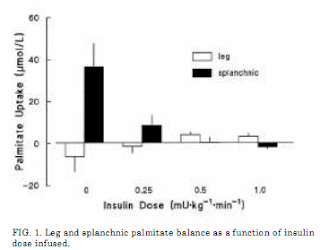
Regional Differences in Fat Tissue Fatty Acid Regulation by Insulin

Insulin Regulation of Regional Free Fatty Acid Metabolism

Alternate Title:  Why I had a fatter ass before low carb?  :-)

This study involved 26 healthy young (21-38) non-obese (BMI 18-27) individuals split evenly by gender.  Excluded were any medications known to influence FFA metabolism.  Radiolabeled palmitate was used as a tracer for FFA's.  

All studies were initiated in the 12 hour overnight fasted state and palmitate was infused for the duration of the study.  Patients received insulin infusions of different doses (3M & 3F per group) for 150 min following baseline determinations.  Controls received a saline infusion.  Blood samples were obtained from femoral vein and artery (leg) and hepatic (liver) vein.  This was to assess systemic (whole body), leg and visceral (splanchnic) rates of appearance of FFA's  (release from adipose tissue).

Tuesday, April 26, 2011

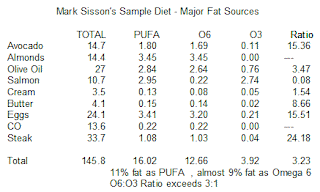
PUFA's, the Primal Blueprint and Low Carb diets

It's sort of a funny thing in low carb circles.  Atkins followers - or those who have fashioned their plans by tweaking Atkins - remain the majority of adherents to this lifestyle, despite the surging popularity of Paleo-styled plans.  

I admit to not knowing or caring a thing about Omega 6 vs. Omega 3 and all that jazz until sometime in 2009 after I'd found the LC web.  Atkins was a big fish oil pusher (if memory serves he had his own line of supplements) and fan of the O3, but he certainly didn't spend much time addressing the dreaded O6 fats.  The root of all evil in the minds of many.

I have his original book, and many recipes contained good old  fashioned industrial mayo made from soybean oil or other veggie oil.  There was no shunning of veggie oils that's for sure, or commercial salad dressings containing them so long as no carbs went along for the ride down the gullet.  Chicken may not have been as highly touted as the more luxurious ribeye, but it certainly had its place.  And when climbing the rungs, nuts were big.  Macadamias preferred, but not because of the O6:O3 ration, but because they happen to be the lowest in carbs.  I just threw out an expired Atkins shake I used to use sometimes in place of cream in my coffee (mocha coffee, yum!) - sunflower oil!  Let's not go into fats in the various "product" around, although many of the newer moose turd look-alike offerings no longer contain these in the name of paleolithic purity.

Sunday, April 24, 2011

Fatty Acid Trafficking

Here's an interesting recent study that LynMarie Daye of Adipo-Insights blog brought to my attention a while ago.  The link below is to the full text I'm sharing through GoogleDocs.

Downregulation of Adipose Tissue Fatty Acid Trafficking in Obesity, A Driver for Ectopic Fat Deposition?

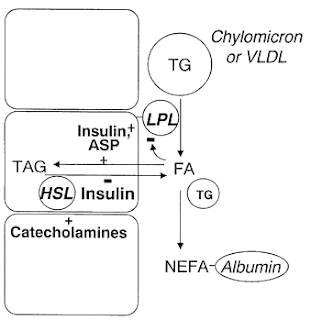
Fats are continually being cycled in and out of our fat cells.  In the obese, circulating free fatty acids (or non-esterified fatty acids), NEFA, are often elevated.  These are often accompanied by deposition of fat in non-adipose tissues, aka ectopic fat deposition.  This ectopic fat is implicated in various impairments of cell function and even cell death (apoptosis) that result in insulin resistance, beta-cell dysfunction, etc.  This is often referred to as lipotoxicity.  

This study sought to determine if this lipotoxicity is due to excessive release of NEFA from adipose tissue or from impaired trapping by adipose tissue of the NEFA released from dietary fat.  This work is from Keith Frayn's group.  It might be worthwhile to read my blog post on Frayn's paper on adipose tissue as lipid buffer.

Saturday, April 23, 2011

Adiposopathy

Presented without comment on the content per se:

Role of the Adipocyte, Free Fatty Acids, and Ectopic Fat in Pathogenesis of Type 2 Diabetes Mellitus

This is probably the most exhaustively referenced review article I've ever come across on the etiology of MetS and T2 Diabetes and the role of adipose tissue.  Too extensive to quote w/o copying the whole darned thing, although I may revisit it at some point to do a bullet point summary type post.  

Friday, April 22, 2011

Exercise v. Diet for Weight Loss

In recent months, mainly sparked by Mr. Exercise Only Makes You Hungry's appearance on the Dr. Oz show, there seems to have been some renewed interest in the LC community in the role of exercise for weight loss.  Most studies show little effect of exercise only, but, as the authors of this study I'm about to share state,  "these conclusions are drawn from studies in which individual energy intake and expenditure were not rigorously controlled or accurately measured" .  When it has been controlled, the calorie deficits created through exercise alone were not sufficient to produce significant weight loss.


This study was done in weight stable (6+ months prior to study) obese (BMI >27) men with waist circumferences over 100 cm (~39").    The men were sedentary, non-smokers, non-light drinkers, and had normal lipids and glucose tolerance.

Tuesday, April 19, 2011

Gary Taubes' Diet Doctor

I wasn't going to say anything.

Really ... I tried.

Lordy knows I don't need any more accusations about hatred for the LC Messiah.  And I wouldn't want to cause ol' Gary to lose any more sleep over my troublesome stalking habit.

So, really really ... I did try.

But this falls in that *too good to pass up* category, complete with a Fat Head sized helping of *you can't make this stuff up*.  

As I'm sure many are aware, Gary Taubes finally had his cholesterol tested and posted the results on his blog.   His fan boys and girls are all rah rah over this.  I'm happy to see a low carber looking svelte (as he did on Oz) and having such a good lipid profile.  

Insulin & Weight/Fat Loss ~ The Long and the Short of It

In the comments of my recent post, On Cherry Picking & Debunking, my "Insulin Warring" partner Todd Becker posted a multi-point commentary.  I'll get to the rest over in the comments section in that post when I get a chance, but one of his points hit on something just a little different as it goes to the core of my issue with the insulin hypothesis. (And I'm reminded I'm long overdue for an installment on the IW exchange with Todd)

In any case, here was what I said:
G&K demonstrated absolutely no correlation between fasting insulin and weight change. Therefore fasting insulin is not a factor in determining weight loss.
Todd challenged:  
Your claim that there is "no correlation" between insulin levels and weight looks only at the instantaneous correlation. But fat loss may be a delayed response, as the Woodhouse paper I linked to you indicates. Figures 1 and 2 in G&K suggest that weight either dropped or plateau'd after a slight lag in the few cases where insulin levels approached 10 uU/ml. That the weight loss continued in some cases even after insulin levels begin to increase suggests that weight regain may be a delayed metabolic response.
And
The G&K protocol used "fasting insulin" as a surrogate for basal insulin. These are not the same thing. Fasting insulin was measured twice weekly at 7-8 a.m. after a 12 hour overnight "fast". But fat loss may depend on how much of the day insulin levels remain very low. Truly low basal insulin levels may take many weeks to establish.

Thursday, April 14, 2011

On Cherry Picking & Debunking

A repeated response - in the comments here and over at Weighty Matters - to my recent post, Calories, fat or carbohydrates? Why diets work (when they do) ,  included two criticisms.

  1. That I am guilty of the same cherry picking that I accuse Taubes of, and
  2. That my conclusions are somehow misguided, or whatever,  because they are not what the original authors concluded or were studying.  
OK.  So to the first point, what is cherry picking?  Well, there are two types:
a.  Including only references that support one's theories and ignoring those that refute it, or
b.  Selecting phrases or data from a single source while ignoring other phrases or data that contradict one's thesis.

Sunday, April 10, 2011

A Dose of Reality ...

... courtesy of Anthony Colpo.

Why Most People are Overweight, Out of Shape & Likely to Stay that Way

It comes to mind that it requires a fair amount of discipline to adhere strictly to a low carb or Paleo or whatever-free diet.  It also requires a fair amount of taking an interest in one's health/fitness to do even the most minimal of exercise programs.

So I wonder sometimes over the seeming animosity so prevalent in such circles towards those who manage their weight and health through other disciplined means.

Ok last one really

test

Saturday, April 9, 2011

Stolen content alert

I recently googled for my blog (since I was in Google search anyway) and lo and behold up pops the following website:


This is a verbatim copy of my own blog post by the same title:  Does Eating Carbohydrates Cause Diabetes? without attribution.  

I post this here to alert others of this website that seems to contain a TON of blog content by who knows how many writers out there.  Some of my readers with their own blogs may want to google some of their phrases to make sure they're not having their content swiped.

UPDATE: Label Change for GCBC Fact Check

Since he has the new book out, I've decided to use a new label to categorize posts that refute various Taubesianisms:  Gary Taubes Fact Check.  Taubes hasn't disappointed from the get go with Why We Get Fat (WWGF) - that thanks to a benevolent reader, I now have a copy of!

I hope any who find this place from links to my old label will see this post and check out the new label link below for more updated information.  Cheers!

Gary Taubes Fact Check

GCBC Reference Check ~ Part IV of ? ~ Kipnis

In a recent post, following up on discussion of Grey & Kipnis as  in the Fasting Insulin & Weight Loss post,  I noted that G&K was  but one study (of many) where calories were controlled that demonstrated definitively that it was calories, and only calories, and not carbohydrates or any hormonal effect thereof, that determined weight loss/stability.

Taubes made the slanderous claim on his blog:
... the value of controlling variables in a scientific experiment is something that a reasonably well-educated child supposedly understands. And what I want to know is why don’t nutritionists understand it and those researchers out there doing diet trials and studying obesity and weight regulation. Because their failure to do so — and I would argue that it may be a willful failure — has led to what may be another of the great misconceptions in modern nutrition research.

I ended my post with the following:

Friday, April 8, 2011

Fasting Insulin & Weight Loss II

I finally found a study that demonstrates a correlation between fasting insulin levels and weight loss.  In this study, they manipulated fasting insulin levels through macronutrient composition an diets administered at various caloric levels.   Below is the scatter plot of the data for all subjects:  

Horizontal axis = change in fasting insulin level between time points
Vertical axis = change in weight 


See the correlation?

Monday, April 4, 2011

To my readers

As you may or may not have noticed, I have been pre-occupied of late caring for a family member.  This has taken a bit of a toll on me both mentally and at times physically.  This past weekend marked the beginning of the end of this chapter, as this person has made it to the in-patient rehab phase of their journey towards recovery.

I've tried to welcome every newbie who comments here, but, as traffic has picked up, this has been difficult to keep track of.  And I embarrassingly mixed up two different people with the same screen name, for which I hope my apology has been accepted.

I wanted to take the time this morning to thank each and every one of you for reading and offering your input here.  If I don't always get to acknowledge or answer your comments, it's not because I don't want to, it's because I do have more than this blog in my life, much as I like to "goof off" about the internet!   Couple that with one of my failings - getting easily distracted and drawn into discussions on "pet subjects" - and ... well...

Chronic Exposure to Free Fatty Acid Reduces Pancreatic β-Cell Insulin Content by Increasing Basal Insulin Secretion That Is Not Compensated For by a Corresponding Increase in Proinsulin Biosynthesis Translation


{Please note:  Excerpts from the text will be edited somewhat to avoid "cluttering" references, statistical values, and some rounding of numbers.  Text will sometimes be presented in bullet form or with paragraph breaks to ease reading.  It is not my intent to plagiarize nor to alter the content.  If anyone feels I've altered the content in any meaningful way, do please let me know!}  Direct quotes will be indented.
FFA are an important physiological fuel for islets, and act as a supplemental nutrient secretagogue to potentiate insulin release acutely in the presence of glucose.
Translation:   β-cells run on fatty acids but this fuel also serves to stimulate insulin secretion.

Sunday, April 3, 2011

Name that study?

I'm aware of a metabolic ward study that help protein constant and varied fat/carb ratios from like 15%-85% and showed no effect of macro composition on weight loss (or was it maintenance).  Does anyone know what study I'm talking about?

Thanks in advance!

Saturday, April 2, 2011

Calories, fat or carbohydrates? Why diets work (when they do).

It was inadvertently (I think) brought to my attention that, while constructing my Fasting Insulin & Weight Loss post, I had "in my hand" the perfect study to discuss the title of this post.

Does that title sound familiar?  It should!  Because this was the title of Gary Taubes' second blog post:
Calories, fat or carbohydrates? Why diets work (when they do)

As I've stated many times, unless someone provides me with a complimentary copy of Why We Get Fat, I'll not be reading the dumbed down version of GCBC, even for the groundbreaking new information it is purported to contain.   Reportedly, one of those groundbreaking items is a chapter on the very topic of that blog post.  A blog post that was a sort of preview teaser in advance of his book release.  But that post wasn't the first time he discussed this novel idea that he claims supports his alternate carbohydrate/insulin hypothesis.  

Most of my readers are probably aware of when ol' CarbSane here really hit Gary below the belt by playing on words,  "called Gary a sheister", and - GASP! - put a $ in his name, when I addressed his discussion of Shai in a lecture.  I guess the plays on words there using Shai-ster and Shai-t were just too much for his devoted followers to handle.  Who knew a $ could draw such ire!  I suggest if any of these things are going to throw you into ketogenic paranoid seizure, you click on that X in the upper right corner of your browser now.

Really ... I mean it!  DON'T click the "Read More" below if you can't handle it!!!  I'm gonna get nasty here!

Really really.


OK ... last warning (VVVBEG)


Friday, April 1, 2011

Does eating carbohydrates cause diabetes?

Type II that is ...

I've made some posts on this topic about the net, and been taken to task over them by some.  In a nutshell, my answer to this question is:  No.  So I thought I would post a little treatise here for future reference.  

I think it is important to define what we mean by Type II Diabetes, aka NIDDM (non-insulin dependent diabetes mellitus).  A T2 diabetic differs dramatically from a T1 diabetic in many ways, however the correlation with obesity aside, the two conditions lead to much the same metabolic derangement:  high triglycerides, NEFA and LDL, hyperglycemia, CVD risk, etc.  Much of the focus in diabetes is profoundly glucocentric,  moreso in avid low carb circles.  Thus in a word association game if I say diabetes, most would respond with hyperglycemia, or blood sugar problems or something like that.  Essentially diabetes = hyperglycemia.

Too funny!

http://www.canibaisereis.com/2011/03/31/insulin-wars/

Adipose tissue as a buffer for daily lipid flux ~ Keith Frayn 2002

Adipose tissue as a buffer for daily lipid flux

Insulin resistance occurs in obesity and Type II (noninsulin-dependent) diabetes mellitus, but it is also a prominent feature of lipodystrophy. Adipose tissue could play a crucial part in buffering the flux of fatty acids in the circulation in the postprandial period, analogous to the roles of the liver and skeletal muscle in buffering postprandial glucose fluxes. Adipose tissue provides its buffering action by suppressing the release of non-esterified fatty acids into the circulation and by increasing triacylglycerol clearance. In particular, the pathway of ‘fatty acid trapping’ (adipocyte uptake of fatty acids liberated from plasma triacylglycerol by lipoprotein lipase) could play a key part in the buffering process. If this buffering action is impaired, then extra-adipose tissues are exposed to excessive fluxes of lipid fuels and could accumulate these in the form of triacylglycerol, leading to insulin resistance.  These tissues will include liver, skeletal muscle and the pancreatic beta cell, where the long term effect is to impair insulin secretion. Adipose tissue buffering of lipid fluxes is impaired in obesity through defects in the ability of adipose tissue to respond rapidly to the dynamic situation that occurs after meals. It is also impaired in lipodystrophy because there is not sufficient adipose tissue to provide the necessary buffering capacity. Thus, the phenotype, at least with regard to insulin resistance, is similar with both excess and deficiency of adipose tissue.

Reader Email: Nail on Head

I'm sure the irony doesn't escape you.  A movement, comprised of those who prided themselves on casting aside dogma in favor of real data and facts, has now become hysterically dogmatic itself. 


Found something helpful today? Please consider a small donation. Thank you!

Where to now?

align="middle" align="middle"

align="middle" align="middle" align="middle"