Welcome all seeking refuge from dogmatic lifestyle advice!

Please check out the tabs below to learn more about the Asylum, its founding and purpose, and the inmate running this place. Take the light-hearted quiz to see if you should stay for a spell and join us over at the Meeting Rooms for some lively discussion.

align="middle" align="middle" align="middle" align="middle"
______________ last updated 6/28/11 _____________________ last updated 7/29/11 _____________________ last updated 6/25/11 ______________________ Come on Over! _________

Wednesday, August 31, 2011

Revisiting the Fatty Diets & Diabetes Study ~ How to Make Mickey Fat or Fattier


In her piece over at MDA on the How Fatty Diets Cause Diabetes, Denise Minger spent a bit of time discussing the strain of mouse used in the study.  That being the not-uncute fella you see pictured here:  A C57BL/6J mouse.   Denise describes these mice as:  "uber-susceptible to obesity, high blood sugar, insulin resistance, leptin resistance, and all that other fun stuff plaguing modern humans."  This didn't really square with my memory from when I blogged on a study involving this critter.  Took me a few minutes to remember what that blog was ... Of Mice and (Wo)Men.  That post dealt with a calorie restriction study using this same mouse.  In looking for info on this mouse, I had come across this paper:  The High-Fat Diet–Fed Mouse.  Since I was mostly looking for info on lifespan and such at the time, the subtitle didn't "hit me", that being:  A Model for Studying Mechanisms and Treatment of Impaired Glucose Tolerance and Type 2 Diabetes.  The paper describes this mouse's propensity towards obesity (and IGT and T2 diabetes) when fed a high fat (58%) diet vs. a standard low fat (11%) chow.  However, in the calorie restriction study, these mice did not become obese on standard chow (11%F, 69%C, 20%P, Teklad Global 2016).  Therefore I think it would be more fair to say that they are susceptible to diet-induced obesity (DIO), but not obesity per se on a more appropriate diet.

Tuesday, August 30, 2011

Why Insulin Levels & Lipolysis Do NOT Dictate Weight Loss ~ Part I
I'm really rather amazed that at this point we're still having to discuss this topic.  As a good friend of mine once said to me in an email (paraphrasing):  One would expect these sorts of myths to persist back in the 80's and 90's.  But in this day and age of information availability on the internet, it seems impossible that enough people continue to be influenced by such easily debunked notions.  Low carb Wiener anyone? {grin}

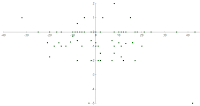
In any case, it seems that no amount of demonstrating the lack of any correlation between fasting insulin levels and weight loss will convince some people.  I really would think that the scatterplot (weight loss v. fasting insulin), discussed in this post,  would be impossible to explain away, and yet many just dismissed it from their minds.  It's that proverbial black swan all the Eades Popperites (or is that all you can eat (Eade)sous vide popper-bites?) constantly seek.  

Ketones Fuel Cancer?!

Ketones and lactate “fuel” tumor growth and metastasis


Previously, we proposed a new model for understanding the “Warburg effect” in tumor metabolism. In this scheme, cancer-associated fibroblasts undergo aerobic glycolysis and the resulting energy-rich metabolites are then transferred to epithelial cancer cells, where they enter the TCA cycle, resulting in high ATP production via oxidative phosphorylation. We have termed this new paradigm “the Reverse Warburg effect.” 
Here, we directly evaluate whether the end-products of aerobic glycolysis (3-hydroxy-butyrate and L-lactate) can stimulate tumor growth and metastasis, using MDA-MB-231 breast cancer xenografts as a model system. More specifically, we show that administration of 3-hydroxy-butyrate (a ketone body) increases tumor growth by ~2.5-fold, without any measurable increases in tumor vascularization/angiogenesis. Both 3-hydroxy-butyrate and L-lactate functioned as chemo-attractants, stimulating the migration of epithelial cancer cells.  Although L-lactate did not increase primary tumor growth, it stimulated the formation of lung metastases by ~10-fold.  thus, we conclude that ketones and lactate fuel tumor growth and metastasis, providing functional evidence to support the “reverse Warburg effect.” 

Monday, August 29, 2011

Fat Metabolism in Formerly Obese Women: Part I Resting Metabolic Rate

Wow!  Many recent events and blog posts about the web have hit a lot of my deja vu "memory nerves".  This has had me going to the draft bin looking for what it is I'm reminded of.  This one was sparked by being linked to a series discussing hunger and satiety over at gnolls.org.  I'm going to link you to Part IV as that is where the paper I'm discussing in this post/series is cited, but J. Stanton  has links to other installments.  

So, most of this current post has been in my hopper since February!  But this article/study has actually been "on my plate" longer still, as the PDF was downloaded to my HD back in June 2010 after reading James Krieger's  piece on the ease of regain.   I'm going to break this up into three parts:  
  • Part I dealing just with resting energy expenditure and its contribution to our overall "metabolic rates".  
  • Part II will deal with the resting metabolism in terms of contributions of fat and carbohydrate
  • Part III will address expenditure and substrate usage during and after exercise.  


Sunday, August 28, 2011

Where do triglycerides come from? Part III

If you haven't done so already, you may want to read Part I and Part II first.  Part II, especially, discusses the sources of fatty acids for VLDL triglycerides manufactured by the liver and two secretory pathways - an immediate one and a delayed one.  In this part I'll discuss the results of that study:


This group uses different radioactive tracers to identify the source the fatty acids in VLDL-triglycerides.  This study differed from the study in Part I in that it looked at prolonged triglyceride levels - fasting and postprandial - rather than just fasting.  For one week prior to the study all subjects were provided a standard diet (outpatient basis) of 50% carb, 35% fat, 15% protein*, at weight maintaining levels.  I would note that this would mean the obese study groups were likely ingesting significantly more than the lean controls.  The study diet followed for 5 weeks essentially replaced 20% of fat energy with carbohydrate energy for approximately 70% carb, 15% fat, 15% protein*.    It was noted that caloric content was similar, simple sugars were the same as a percentage, but absolute simple sugar intake was almost 40% more on the high carb diet.  The high carb diet also contained 50% more fiber and almost 90% less cholesterol.

Friday, August 26, 2011

Bloggo Science ~ A Hypothetical Post II ~ The Plots thicken

The following plots come from actual data from a real study.  In my hypothetical, however, I'm assigning the x-axis to be original hair length -- representing one variable measured in the real study -- and the y-axis will be (-) hair growth (e.g. it's vertically flipped from the original data set) -- representing the other variable from the real study.

My hypothetical study included 12 participants, 6 each with light hair (L) and dark hair (D).  Hair growth was measured for a period of about 20 weeks, but due to scheduling, the actual duration of the study varied between subjects.

Hypothesis:  Hair growth is inversely related to initial length.  Shorter hair grows faster than longer hair.

Thursday, August 25, 2011

Bloggo Science ~ A Hypothetical Post

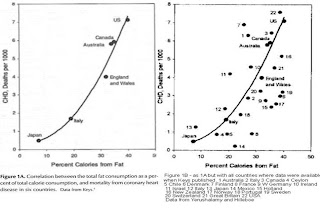
One of the, well-deserved, knocks on Ancel Keys is his cherry-picking of evidence.   A little while back Chris Masterjohn  posted a bit of an admonishment to those who might fall prey to Keys' error.  In that post Chris presented the "evidence" of Keys' cherry picking from  Uffe Ravnskov's The Cholesterol Myths.

Absurdium lo carbicus

The image below is currently featured on a low carb blogger's blog.  It's not the first time I've seen it, indeed I know for sure one other blogger who has featured this picture.  This graphic embodies what is wrong with the "LC movement" these days.

Tuesday, August 23, 2011

How Fatty Diets Cause Diabetes

How Fatty Diets Cause Diabetes

This was the provocative title of the Science Daily piece that made a minor splash across the LC web recently.  Perhaps overshadowed by the AHS drama and fallout, but nonetheless picked up on by a number of people.  The article begins with:
Newly diagnosed type 2 diabetics tend to have one thing in common: obesity. Exactly how diet and obesity trigger diabetes has long been the subject of intense scientific research. A new study led by Jamey D. Marth, Ph.D., director of the Center for Nanomedicine, a collaboration between the University of California, Santa Barbara and Sanford-Burnham Medical Research Institute (Sanford-Burnham), has revealed a pathway that links high-fat diets to a sequence of molecular events responsible for the onset and severity of diabetes.

Monday, August 22, 2011

Addressing Andreas (and Taubes): On Relevancy, Reality, Inconvenient Facts, and Internetiquette

OK ... Just so you know, dear readers, I thought a bit on whether Andreas Eenfeldt's response to my post was worthy of responding to, and on the best way to do so.  To respond to comments on his blog or a separate post here.  As you can see, I chose the latter, largely because he has allowed his comments to devolve with various and several scurrilous accusations of stalking, questionings of my mental capacity and stability, etc.  To engage in this environment is not appealing to me, and shame on you Dr. Eenfeldt for publishing such disgusting commentary on your blog.

I'm hoping this will be the last post on this particular topic, but who knows ... It seems a blogger's work is never done trying to debunk LC mythology, and for now Andreas is the only (somewhat?) credible voice speaking up in Taubes' defense.

Intracellular Fatty Acid Metabolism ~ Background Discussion

Before some of the recent commotion around here, a blog post entitled Let's Play Concentration caught the eye of Paul Jaminet over at Perfect Health.  His commentary then inspired me to write Glucose and NEFA: From Dysfunctional Metabolism to Toxicity.  

In the comments section Paul and I got into a discussion about free fatty acid (NEFA) clearance from circulation.  It seems that this is a subject of a lot of uncertainty.  Indeed when I first started looking into this stuff, way back when, I kept coming across statements like that insulin was required for fatty acids to be taken up by fat cells (three guesses where that traced to and the first two don't count ...).  My inner geek was prompted to look back into this.   This topic is of interest to me as my regular readers are well aware of my near-obsession with NEFA.  {grin}

Sunday, August 21, 2011

Grey & Kipnis ~ Hyperinsulinemia and Diet Paper

It appears that the website that formerly hosted the full text PDF of the Grey & Kipnis study I cite quite frequently here has been taken down.  I'm sad to see this.

I've linked to that hosted copy so many times it would be impossible to go back and change them all at this point.  Instead I'm posting this up if anyone ever needs to find the reference in an older post, and I'll use my new Google docs host link in all future posts.  

Here it is:

Taubes Watch Ticker

Have you heard?  Gary Taubes' had a bit of a public meltdown at the Ancestral Health Symposium.  I decided to set up this ticker to remind folks of how long Gary has remained silent with respect to recent events.

Let's have a little fun counting the elapsed time until when and if Gary responds.


It has been approximately this long since "the shot heard round the LC world":


I approximated this to be around 2:30pm PST 8/5/2011.  The ticker works on UTC so this would be 10:30 pm.  If anyone has a more exact time, I'm a stickler for accuracy and will fix accordingly!

Critical Visceral Adipose Tissue Theory

EDIT:  I'm bumping this in light of recent discussions.  Original publish date: 8-9-10  


I found this article almost a year ago, posted it on an LC discussion board, and was mostly greeted with silence so I had sort of forgotten about it.  In any case, I was reminded of this article while recently reading LynMarie's latest post on her blog:  Fat Fails First?  (Incidentally, that post corresponds well with my own recent offering on the topic:  The Progression of Insulin Resistance ).  

Quotable Quote: Frank on Science

This one is just so perfect, it was made by here by Frank .
Indeed, science has no good reputation lately.
And it's true that there are some (big) weaknesses to science.
But once you know the science and its weaknesses, it's much better to do things with science and its weaknesses than without science at all.
So true!  Kudos Frank!!  (yes, I fixed the grammar a bit)  

Saturday, August 20, 2011

The Scientific Method 101

OK ... I'm about at my wits end with some of these discussions about the net.  It's as if basic logic is not enough for some folks.  The scientific method for testing hypotheses is not difficult folks.  You don't need a genius IQ or even a high school diploma to "get it".  

Let's say, hypothetically that based on my observations, I propose A causes Z.  Others propose B, C or LMNOP cause Z.  I design my experiment.  Realistically it's impossible to control for all possible other factors -- called confounding variables or simply confounders -- but I make a good faith effort to do so.  In other words, I consider that B or C etc. may be the actual cause and merely occur concurrently with my beloved "A".  

A teaspoon of this ... A quarter teaspoon of that.

One thing that the recent Taubes meltdown at AHS has done is elicit the reappearance of the LC Kindergarten Cop in comments sections far and wide.  Yes, I'm talking about the hopelessly mired in parroting LC dogma Fred Hahn.   He's pulling back out the "teaspoon of sugar" schtick to proclaim that carb consumption is evil.  It just so happens I had addressed this in a recent post:  Let's play Concentration!

In that post I did the calculations on the circulating levels of the form of fat we burn at any given time.  For a normal person, this comes out to around 0.5g fat.  Using more elevated levels we're still talking at most about 1g fat.  Using even a low end density for oils and butter, 0.8 g/ml, we're talking 1.25 ml.  What's that in teaspoons?  One-quarter of a teaspoon.    (One eighth teaspoon for normal individuals, and knocked down to around one thirty-second of a teaspoon after a meal!)

Friday, August 19, 2011

Guyenet v. Taubes: Is There a Working Hypothesis for Obesity?

In re-reading this I realize there are a number of redundancies and it is hopelessly long.  I don't really have the time/desire to chop it down to a more concise version, so posting it up as is with apologies!

With his English language blog, appearances at various conferences and LLVLC events/cruises, and the apparent rise in popularity of low carbing in Sweden, Andreas Eenfeldt is a rising star promoting low carb diets.  Therefore, I think his comments on Stephan's recent debunking of Taubes Wrong Insulin Carbohydrate Hypothesis Of Obesity, TWICHOO, and the post on his blog about same deserve some attention.   One of the things that is disturbing about GCBC and Taubes' presentation of the science is that he frequently says "we don't know XYZ because the experiments haven't been done".  The "Diet Doc" seems to have taken this to heart as he views TWICHOO as a "working hypothesis" and he seems unaware of the state of knowledge possessed by researchers on various obesity related topics.  

Some excerpts of Andreas' first comment in response to Stephan's debunking:
First of all: You state that low carb diets do indeed work well for weight loss most of the time, and that you see that as a fact. Kudos to you for acknowledging it. However, you can't say for sure why they work, if not through insulin, so maybe we should not rush to conclusions yet.

Wednesday, August 17, 2011

Guyenet v. Taubes: Random Thoughts on the Reaction

Now that I've weighed in with my thoughts on Stephan Guyenet's disassembling of Taubes' "Carbohydrate Hypothesis", I thought I'd share some of my thoughts on the reactions of others to his posts (including the first one responding to the "drama at AHS").

First, although clearly many still (as well they should and hopefully always will) hold Stephan in high regard, the mere fact that he addressed the altercation at all has drawn the criticism of some.  I found the seemingly well-meaning-sounding comments of Andreas Eenfeldt to be especially bothersome in this regard.  Honestly folks, how many of you have been in a situation where you were caught by surprise by something only to think later -- gosh, I should have said that!  Or perhaps, I wish I had the time to look into that for a better response, or merely had more time to respond period.  Don't get me wrong, Stephan did well in that exchange.  But clearly he had more to say in response to Taubes' questions and/or wanted to share more thoughts with his readers.    For the life of me I can't see what's wrong with that, nor do I see what is so wrong with the "people who live in glass houses" written/online response vs. the "thanks for the advice" live one.  I thought the live one was witty and cool, but the glass houses one is actually more to the point as it calls Gary out on his hypocrisy -- much needed to say the least.  Why is it a one-way street for so many of these LC promoters?  Why was it OK for Gary to offer that advice, even if he apologized, and not for Stephan to essentially stick up for himself and point out that Gary is guilty of his charges?  Is it that somehow any who disagree with LC dogma are expected to take some stratospheric road all the time while these guys (and gals) muck around in the trenches ruthlessly abusing anyone who doesn't agree with them?  Oh ... and it is sooo funny when they do it too, right?

Tuesday, August 16, 2011

Guyenet v. Taubes: Thoughts on Stephan's Demolition of the Carbohydrate Hypothesis of Obesity

I've been laying kinda low on Stephan Guyenet's disassembling of Taubes' "Carbohydrate Hypothesis" and just sort of soaking in some of the responses.  However as the mood hits, I'll be sharing some thoughts on the reaction in the coming days.  

This post, however, relates to his blog post.  As I said in the comments on his blog:  Well done!  Most of the arguments he makes are not new to this blogger, but I think these things need to be stated by as many bloggers as many times as is needed -- and judging from the reactions the work in this regard may never be done!! -- until the following acronym becomes as common in LC circles as acronyms like ACE, OWL and CCL are to Atkins dieters. When Taubes' theories become known as Taubes' Wrong Insulin-Carbohydrate Hypothesis On Obesity - TWICHOO.  It kinda rolls off the tongue!

GCBC Reference Check ~ Part VI of ? ~ The Massa

With full attribution to Stephan Guyenet:


Northern Cameroon, 1980s.  The Massas tribe (also spelled Massa) is known for its overfeeding ritual called Guru Walla, which Taubes describes in GCBC:
The Massa tribe of northern Cameroon fattens their males using both milk and a porridge made from sorghum, a corn-like grain that provides sweet syrup from the stalk. One man gained seventy-five pounds on a ceremonial binge. The average weight gain tends to be fifteen to twenty pounds using milk and porridge.  The Massa are cattle herders and their staple diet is primarily milk. This fattening comes about by the addition of carbohydrates (sorghum) almost exclusively.

Sunday, August 14, 2011

Carbs or Cals for Weight Loss? Another Shai'ster shoots himself in the foot

Presentations from the Ancestral Health Symposium are up.  I'm a bit bugged by the fact that they focus on the speaker and don't show the slides.  It makes it hard to follow.  But beggars can't be choosers.  There are also slides up elsewhere, but not for all the presentations, and as of this posting there are none for the subject of this blog.

So who am I calling a Shai'ster this time?  Dr. Mike Eades, that's who.  Yeah yeah, it's not nice to call names but loosen up a bit if your loin cloth or edible pemmican panties just crawled up your butt ... it's a play on words folks!  

Eades AHS presentation was entitled  "Nouvelle Paleo: Caving in to Carbs?", and at the 20:45 mark, he begins to "discuss a couple of studies" that are going to explain why he's playing hide-the-middle-aged-belly behind the podium.  I'm thinking many of  my readers are as distracted as I am by this.  I know I just can't help myself from wondering if he's got a mirddle on under there, because he sure hasn't been following his artificial sweetener laced dairy protein so-not-Paleo cure of late.  But I digress ...

Glucose and NEFA: From Dysfunctional Metabolism to Toxicity

This post started out as a comment in response to Paul Jaminet's mention of a post on this blog in his Around the Web post yesterday.  It got rather long so I decided to move it here.  In the interest of more rapid publication, I'm not going to be doing a whole lot of referencing in my discussion here, but if you're interested in a particular statement please indicate so in the comments section and I'll try to track down the reference(s) I have in mind.  Paul writes:
Every once in a while someone writes to ask me if they should fear a high-fat diet because of CarbSane’s writings on lipotoxicity. I reply that lipotoxicity only appears after metabolic syndrome has developed and, while it may drive the transition from obesity to diabetes, it is not a cause of obesity, and not a danger to people who don’t have metabolic syndrome. Also, the implications for diet are not obvious, since carb intake suppresses NEFA clearance from the blood and enhances glucotoxicity. The literature commonly speaks of “glucolipotoxicity” to describe this compounded toxicity problem. CarbSane hasn’t always been clear on these points, so it’s good to see an excellent post from her covering the basics.
Thanks for the shout out Paul!

Let's Chat! Adrenal Insufficiency

Hi all!  Over in the comments on Stephan's blog, Dallas from Whole9 made the following statement:
Furthermore, I've observed a trend among long-term low-carbers (Paleo or otherwise) that seems to suggest some degree of adrenal insufficiency (which is worsened by large doses of high-intensity exercise). I'm not convinced that LC is generally healthy for a lot of folks, unless it's viewed as a limited-time corrective strategy to "offset" a long personal history of a HC diet from sugar and processed, nutrient-poor foods.

This seems to be a common knock against long term low carbing, and I often hear the term "adrenal fatigue" bantied about.  So I got to thinking what it actually means to folks expressing it, etc.  When I do a Google scholar search on "adrenal fatigue", I get a book by the owner of this website, and other articles on various health websites.  Therefore this catchphrase seems more of a medical pop-cultural thing.  I found a bit more on adrenal insufficiency, including this article:

Adrenal Insufficiency 

I am hoping we can get a discussion going here on what this means to folks.  Have you experienced it?  Do you have any citations indicating how VLC might cause this or contribute to it?  Etc.  Any more lay-friendly links/articles you care to share and discuss?  

I've made this an embedded Meeting Room topic so if we get a discussion going it should be easier to follow (thus comments are off).  I hope you'll join in!

Saturday, August 13, 2011

Lessons from my cat ...

I was feeding my low carb house carnivore this morning and a couple of things occurred to me in light of the discussions on what causes obesity.  Many of these theories are based on the knowledge of a presence of an energy homeostasis mechanism and how something goes awry with this.  

My kitty eats about 1.5 cans of food per day.   I put his food out a full can at a time and when the plate is empty I put out another can.  Therefore there's really no fixed time when a fresh can gets put out and sometimes he has to wait.  This morning was one such time as he was low on food last night before I went to bed, but since I want him to finish the old stuff I won't put out a fresh can.  So this morning he greeted me meowing at the plate and as soon as I put the food he went to town.  I'd say he ate about a third of the can and walked away.   He knows where the food is and that it will be there all day, but he probably won't go back for more until noonish.

Thursday, August 11, 2011

Let's play Concentration!

While I was writing the Essential Carbohydrate post, I got to thinking about another canard often bantied about in low carb circles.  That being that our circulating blood glucose amounts to only about a teaspoon of sugar.  Here's how that calculation goes:


Another way of looking at this is that for a normal person, a "glucose spike" to 125 mg/dL amounts to an increase in dissolved circulating glucose of perhaps 2g (85 mg/dL - 125 mg/dL) and a glucose intolerant person might see 10g dissolved glucose in circulation (200 mg/dL)  following a meal.  This small amount compared to the "large amounts" of carbohydrate in even a small serving of pasta or rice is often seized on by low carb advocates to foster carbophobia.

Wednesday, August 10, 2011

Red Meat Induced Blog Traffic Spike ...

I'm flabbergasted that (before even Stephan posted his comment here)  Blogger registered a "spike" in my traffic (and we're talking the "instantaneous" 2 hour hits kind) worthy of the blood glucose curve for Wheat Belly consuming 5 bowls of battery acid.  Stephan's comment has obviously been linked to at www's far and wide and generated more, but this is something *different* here, even given my penchant for those Gary Taubes exposes seen as provocative.

In the three days since the Wonder what he said post was published, it has rocketed up my most viewed posts to be #2 ALL TIME and as of this post, half the page hits of the long standing #1 GT email post.  

What does this say folks?  

Creative Input Request

In the very near future, My Carb Sane-Asylum will be branching out onto YouTube!  I have some ideas for the name of my YouTube Channel, and slogans, etc.  But I thought I'd cast a net out there to y'all as I think my readership is very creative and witty.  

So.  Name, logo, slogan, music, format (keep in mind initially these will not be live videos of moi, it will be narrated slideshow type vids), effects, etc.  If you've got an idea you'd rather share privately, the Inbox is always open: carbsane at gmail.com.

Thanks!

Tuesday, August 9, 2011

Welcome Ancestral Health Peeps!

I do hope you'll stay and poke around the site a bit!

You'll probably figure out pretty quickly that I'm not much of a strict-anything in either the diet I consume or advocate (actually I don't really advocate any lifestyle in particular).  But if I had to describe my diet these days as closely as I possible with a plan/book you may be familiar with, it would be a slightly imperfect, slightly higher in protein/lower in fat version of the Jaminets' Perfect Health Diet.  I'm not aligned with any movement and have no agenda here at this blog other than what sparks my own interest.  I guess it rubs some the wrong way that I don't suck up to or properly "honor" those bloggers with clout and/or followings just because they do.  So, just so you know where I'm coming from ....

Although many find their way here through my no holds barred posts on various internet celebs/gurus and book authors, the bulk of my work is actually sharing my take on various peer review science of relevance.  In this regard my interests in fat metabolism and NEFA has led me to share quite a bit on diabetes of late, though I'm not diabetic myself.  

Sunday, August 7, 2011

Atkins diet can kill you

I've never understood the nonchalant attitude many in the low carb community take towards some pretty serious side effects that you can experience with the diet.  It's not that this happens to everyone, or even most, but it does seem to occur more with LC diets than any other.  I, for one, never experienced my own symptoms of, likely hypoglycemia, ever before.  

So I was in the mood to torture myself further while on permahold the other day and listen to Gary Taubes' Walnut Creek Library lecture from April of this past year in it's entirety.  He was a bit more animated than usual so that helped, and I did make it through.

When they got to the Q&A my ears perked when he got to around the 2:30 minute mark here.  

Wonder what he said.

This from Dr. Jack Kruse, flavor of the month in LLVLC land, after the Ancestral Health Symposium.
Speaking of “Dominant causes of obesity”………..The buzz from day one was from Gary Taubes ripping Stephen Guyenet on his food reward series. Personally, many of you know I completely disagree with Dr. Guyenet on this topic, but I think he is a great blogger with a great mind. Maybe Gary’s tact could have been better allocated; but he said what had to be said, in my view. I would also remind many that even within a family it is normal to have disagreements from time to time. I personally think this a good thing that with in a group of like minded folks we can disagree at times. I complained loudly to Jimmy Moore on his FB wall and forum about Gary Taubes being “soft” with Dr. Oz earlier this year. So I can not fault him one bit when he decided to sink his canines in to Dr Guyenet at the AHS. I personally wanted to see Gary bare some teeth after the Dr. Oz debacle and this weekend showing tells me he can evolve. That to me was a positive in a bad situation. It does not in one bit negate the major contributions of Dr. Guyenet at all in my view. I just think he had a bad day with his food reward series. We all have bad days at times. No harm no foul.

Quite frankly, the sponsors of AHS have no business having folks like Taubes and Naughton, to name two, speak at such an event!   Seriously?   What is their expertise on this whatsoever?   

If anyone wants to clue me in on what Taubes said, I'm all ears.  Stephan and I may not agree on everything and that is fine.  His writings challenge me and I don't feel the need to look past everything he says for some body of evidence he's deliberately ignoring to drive an agenda.  I would love to know what the teeth-sinking was all about, although my money is on the comment on his blog stating that no serious researcher takes GT's carbs drive insulin drives fat accumulation theories seriously.  Where are the actual researchers willing to endorse that theory Gary?  Nah.   Funny how Taubes is NADless in the face of someone like Dr. Oz but grows a pair to slam someone far his intellectual superior to a sympathetic audience. 

And this Jack (quac)Kruse wants to write off Stephan's Food Reward series as "a bad day"????  Again.  It may or may not be a workable hypothesis depending on one's interpretations, etc.  But I think anyone who would write something like that off in this manner is not worthy of being taken seriously.

Saturday, August 6, 2011

The Essential Carbohydrate?

I would ask each and every reader to try as best you can to check their nutritional biases at the door here as best you can  and let's just talk semantics.  

What does essential mean?  

Something that is essential is something that we cannot do (or in the nutritional context live) without.  By this definition, it is clear that yes, for most humans, carbohydrates are non essential.  However, even this is too simplistic, because without looking very far, we can identify a group of humans for whom carbohydrates are "deadly" essential.  As in imminent death kind of essential.  Relatively rare as is their number, I'm talking about people with glycogen storage/breakdown disorders.

Now, let's look at the other macronutrients.  Well, we cannot live without protein.  Therefore it is essential.  No argument.   However, proteins are comprised of 21 distinct building block amino acids of which only 8 are actually identified as *essential*.  A strict interpretation of this fact might be that ... eh ... 13 amino acids, or the majority are non-essential.  We don't need them.  They can be made by the body from other stuff.

Join the Discussion On: Metabolic Consequences of Muscle Disuse Atrophy

This is a rather interesting find that Tsimblist posted over at the Meeting Rooms.  I thought I'd post it up here for exposure and comment.  Are these changes relevant to sedentary VLC/HF folks?

Metabolic Consequences of Muscle Disuse Atrophy       

T. P. Stein and C. E. Wade      
J. Nutr. 135: 1824S–1828S, 2005.


Abstract:

In response to decreased usage, skeletal muscle undergoes an adaptive reductive remodeling.  This adaptive response has been found with disuse during human spaceflight, rat spaceflight, rat hind-limb unloading, bed rest, and aging.  The reductive remodeling of skeletal muscle with disuse is largely independent of the reason for the disuse.  The process involves more than a transition from slow to fast myosin fiber types.  There are associated metabolic changes including a fuel shift toward glycolysis, decreased capacity for fat oxidation, and energy substrate accumulation in the atrophied muscles.  Glycolysis is very effective for high-intensity short duration acute activities, but if sustained output is needed, an energy profile where fat use is favored rather than compromised is desirable. For astronauts, there is a need to maintain as much functional capacity as possible during spaceflight for extravehicular activities.  The shift toward increased activity of the glycolytic enzymes in atrophied muscle is accommodated by an increase in gluconeogenic capacity in the liver. 


Do we need a Hall of Fame around here?

Frequent and long time comment contributor here, Sanjeev, has hit the big time!

In his most recent post, Anthony Colpo used a hysterical phrase Sanjeev first coined here:


Sanjeev said...
> additional layer of intellectual deceit
I think you mean 
"dysregulation of honesty metabolism"

Classic!   You rock Sanjeev!

Friday, August 5, 2011

The Dietary Strategy of Separating Carbs & Fats

The recent post on the Harcombe Diet reminded me of some things that I've posted here regarding the separating carbs and fats in one's diet.  Almost a year ago now, I wrote this post:  Separating Fats & Carbs

In that post I laid out my rationale for this dietary strategy to prevent obesity.  It is also a strategy I generally employ to this day for maintaining my losses thus far.  Personally, I doubt this is a viable ad libitum strategy for weight loss that I'll discuss later.  

Thursday, August 4, 2011

Zoe Harcombe ~ Credentials?

We've discussed this lady before here at the Asylum, but I was recently made aware of some additional information about her that folks might find interesting in assessing the information she promulgates or to counter those who tout her work in LC circles.  

Let's review.

Zoe Harcombe is the author of a few diet books who hopes to take the world by storm and fix the obesity epidemic in the UK.  She has a story to tell about weight loss after a history of eating disorders in college and 15 years of maintenance.  But as commendable as conquering ED's is, there's no indication this woman ever had significant excess weight she had to lose.   

Wednesday, August 3, 2011

When Insulin Goes Away ...

The very core of LC theory on weight loss is that insulin *causes* fat accumulation through it's action, and basically if we can lower insulin, weight loss occurs.  Sounds simple and straight forward.

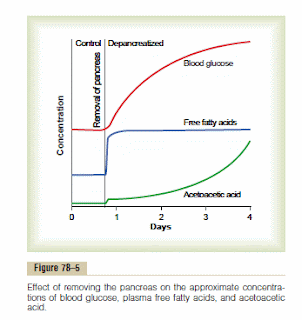
From Guyton & Hall's Textbook of Medical Physiology, 11th Edition, p. 966

Insulin Deficiency Increases Use of Fat for Energy
All aspects of fat breakdown and use for providing energy are greatly enhanced in the absence of insulin. This occurs even normally between meals when secretion of insulin is minimal, but it becomes extreme in diabetes mellitus when secretion of insulin is almost zero. The resulting effects are as follows.

Insulin Deficiency Causes Lipolysis of Storage Fat and Release of Free Fatty Acids.
In the absence of insulin, all the effects of insulin noted earlier that cause storage of fat are reversed. The most important effect is that the enzyme hormone-sensitive lipase in the fat cells becomes strongly activated. This causes hydrolysis of the stored triglycerides, releasing large quantities of fatty acids and glycerol into the circulating blood.  Consequently, the plasma concentration of free fatty acids begins to rise within minutes.  This free fatty acid then becomes the main energy substrate used by essentially all tissues of the body besides the brain.

Low Carb Potato?

Low Carb Potato
Nine years of breeding has produced a potato with up to 56% less calories than other spuds and 38% fewer carbohydrates, probably none too soon for the much maligned potato.
I can see it now.  There will be a run on aluminum foil as these hit the markets (my Big Agro sponsors have been waiting for this sort of thing for years now).   Sous Vide Supremes that have been collecting dust in the corner will be converted into expensive helmets.  Still too many carbs to be low carb friendly.  All that breeding certainly not "paleo", surely paleo dude's tubers were even more bereft of carbs.  The only hope for this spud is that it room can be made for it in the primal kitchen.  There's always that 20% fudge factor.     Or perhaps Julian Bakery will come out with low carb Potato Rolls.


Tuesday, August 2, 2011

Asylum A'surfin Musings ... What are you hiding Mike?

I was discussing the Eades' Sous Vide Supreme the other day, and I went looking for a link.  I found this commercial on YouTube:

Set Point ~ Settling Point Part II: Substrate Balance & Body Composition

Continuing the discussion of Point 9 from this paper, and Part I,
Although less obvious than the fact that energy intake must be equal to energy expenditure, weight stability also requires that the substrate mixture oxidized be equivalent, on average, to the composition of the nutrient mix consumed. When “substrate balance” is not achieved, changes in body composition occur, which in time are bound to elicit adjustments in food intake.
The contributions made by carbohydrate and by fat to the fuel mix oxidized is reflected in the ratio of CO2 produced to O2 consumed. This ratio is known as the “respiratory quotient” or “RQ.” It varies between the values of 1.0, when CHO is the predominant fuel, and 0.7, when oxidation of fat provides most of the body's energy. The ratio of CO2 produced to O2 consumed during the biological oxidation of a representative sample of the diet consumed is defined as the “food quotient” or “FQ”. Stable body compositions will only be sustained if the average RQ matches the average FQ of the diet.
Found something helpful today? Please consider a small donation. Thank you!

Where to now?

align="middle" align="middle"

align="middle" align="middle" align="middle"