Welcome all seeking refuge from dogmatic lifestyle advice!

Please check out the tabs below to learn more about the Asylum, its founding and purpose, and the inmate running this place. Take the light-hearted quiz to see if you should stay for a spell and join us over at the Meeting Rooms for some lively discussion.

align="middle" align="middle" align="middle" align="middle"
______________ last updated 6/28/11 _____________________ last updated 7/29/11 _____________________ last updated 6/25/11 ______________________ Come on Over! _________

Friday, September 30, 2011

Mitochondria and High Fat Diets

Lots of buzz over mitochondria of late.  So I thought I'd share this find:

High-fat diets cause insulin resistance despite an increase in muscle mitochondria
It has been hypothesized that insulin resistance is mediated by a deficiency of mitochondria in skeletal muscle. In keeping with this hypothesis, high-fat diets that cause insulin resistance have been reported to result in a decrease in muscle mitochondria.    In contrast, we found that feeding rats high-fat diets that cause muscle insulin resistance results in a concomitant gradual increase in muscle mitochondria.

Thursday, September 29, 2011

Science Krispies: Junk, Pseudo and Pop!

Oh CarbSane, why must you constantly criticize my favorite guru?  After all:

  • He/she helped me lose XX lbs
  • He/she is right about ABC & LMNOP
  • He/she is just trying to get the studies done
  • He/she saved my life!
  • He/she has helped me finally understand why I'm fat
  • He/she cured my XYZ
  • The mainstream is wrong, we need more like him/her, don't discourage them
  • Ad Hominem!!!!
  • etc. etc.

Tuesday, September 27, 2011

Wheat Belly on Acid

I used to read Dr. Davis' blog back in the days participating on Jimmy's forum, it was cited rather frequently.  His writing back then seemed well grounded.  Then about a year or so ago, the posts started getting sensationalistic.   Ahh ... he got a book deal for Wheat Belly.  I blogged previously on one of the more bizarre amongst them:  Bacon, Eggs & Battery Acid.  On his anti-oat campaign, Davis wrote:
Sulfuric acid is among the most powerful and potentially harmful acids known. Get even a dilute quantity in your eyes and you will suffer serious burns and possibly loss of eyesight. Ingest it and you can sustain fatal injury to the mouth and esophagus. Sulfuric acid's potent tendency to react with other compounds is one of the reasons that it is used in industrial processes like petroleum refining. Sulfuric acid is also a component of the harsh atmosphere of Venus.
This folks really is over-the-top rhetoric, and if Davis has a shred of credibility it is totally undermined by nonsense like this.  I'm just surprised he didn't mention Drano! Leaving aside, for the moment, whether the sulfuric acid content of foods is something to be concerned about, trying to equate minute amounts in foods with even dilute sulfuric acid solutions is worse that comparing apples and oranges.  The atmosphere on Venus?  Ingesting sodium metal will probably kill you (sodium is highly reactive), as will inhaling chlorine gas, but sodium chloride not so much.  Let's check out the MSDS (material safety data sheet) for hydrochloric acid at right.  {click to enlarge}  Pretty dangerous stuff!  Well, this turns out to be the acid in your stomach, produced by your body.  Gastric acid is pH 1 to 2.  I've never taken a piece of litmus paper to a bowl of plain oatmeal, but I'm thinking it's not going to be too acidic.   Do you think adding oatmeal to your stomach contents is going to make you acidic?  Eat out your intestines?  Un huh.

Adipose Tissue & Adipokines

Normally these days I'd put this in the library, since I'm not really going to blog on this, but I thought this paper a good one to share.

Adipose tissue and adipokines: for better or worse
In recent years, it has been recognized that adipose tissue (WAT) secretes a number of bioactive peptides and proteins, collectively termed “adipokines”.  These WAT-derived factors play a central role in whole body homeostasis by influencing a variety of biological and physiological processes, including food intake, regulation of energy balance, insulin action, lipid and glucose metabolism, angiogenesis and vascular remodeling, regulation of blood pressure and coagulation. The present review is focused on a restricted number of adipokines, which have been implicated in vascular (angiotensinogen, PAI-1) and energy and glucose homeostasis (ASP, TNFα, IL-6, resistin, leptin, adiponectin).  

Monday, September 26, 2011

The Dietary Source of Body Fat

Over on Stephan Guyenet's blog, in the comment section of his post on Humans on a Cafeteria Diet, a little discussion was started by one disgruntled reader (or I suppose ex-reader since this post apparently pushed him over the edge to unsubscribe) regarding where the fatty acids in our body fat came from.   Stephan wrote:  
When a diet of mixed macronutrient composition is eaten to excess, the carbohydrate is preferentially burned off, while the fat is mostly shunted into fat tissue. This makes sense, because why would the body go through the inefficient process of converting carbohydrate to fat for storage when it can just shunt dietary fat directly into fat tissue?
Said reader commented:  "This post has good info, but suggesting the fat is stored as fat is absolutely wrong and is bad science."    A discussion, contributed to by yours truly, ensued.  I think this is illustrative of just how damaging towards ultimate progress in the realm of understanding, preventing and treating obesity Gary Taubes has been.   On page 387 (according to Google books, my ebook page numbers are off) of GCBC, Taubes writes:

Wheat Belly on Fox & Friends

Dr. "Wheat Belly" Davis was on Fox and Friends a bit ago.  Video HERE.  For starters, he looked nothing like the picture on his website.  His presentation was weak overall.  He started out discussing the gliadins in wheat and how they've been modified to make them addictive, but when Gretchen asked him about gluten-free products and he likened them to filtered cigarettes.  This is when he did his BG schtick with the whole two slices of whole wheat bread will spike BG as much as 2 Tbs of sugar thing.    He discussed his preventative cardiology practice - paraphrasing - 80% of my patients are either diabetic or prediabetic and the rest are what I call pre-prediabetic. Therefore making it out that we're all destined for diabetes if we spike our blood sugar.  

Has anyone here read Wheat Belly?  Are the references there for his assertion that wheat specifically causes visceral fat accumulation?  I'm very interested in the referencing of that book.  

Unless he did much better in his other appearances, I don't see how this book is making such a splash, he sure didn't sell it very well.  I think many of us can certainly benefit by eliminating wheat because (a) some of us are clearly intolerant to it, and (b) it means eliminating (or dramatically cutting down) bread and other baked goods.  Aside from sandwiches, bread is often added to a meal = extra calories.  But the over-the-top rhetoric isn't going to square with most people.

Sunday, September 25, 2011

Fat Tissue Regulation ~ Part III: C3KO Meets Obi No Leptinobi

In the previous post in this series, we met the C3KO mouse, a mouse that is ASP deficient.  In this post, I'm going to discuss what happens when you take a leptin-deficient ob/ob mouse and also make it a C3KO.  Humor me my fun with Star Wars characters ;-)


It turns out I had discovered this study and blogged on it over a year ago:  Acylation-stimulating Protein (ASP) Deficiency Induces Obesity Resistance and Increased Energy Expenditure in ob/ob Mice   (Xia, Sniderman & Cianflone).


Saturday, September 24, 2011

Fat Tissue Regulation ~ Part II: Meet C3KO

I've shortened the title of this series from The Full Physiological Regulation of Fat Tissue to allow for some descriptions of each installment without generating 30 word blog post titles.  Yes, I did consider TFPRFT {cheeky grin} but thought the wiser of that one! 

Allow me to introduce you to C3KO 
(note my high tech graphics skills!  LOL)

No, C3KO is not a character in Star Wars Episode MMXI*:  Battle for the Adiposity Galaxy.  Rather, there is a protein known as Complement 3, C3 for short.  The complement system is an important one in the functioning of our immune systems and has long been recognized for mediating inflammation.  In studying the role of this protein in physiology, researchers created a C3 knockout mouse -- one that does not produce C3.  This mouse is sometimes called C3KO**   

Thursday, September 22, 2011

What Does Insulin Regulate Anyway?

Sorry about the acronyms.  A glitch in my new system.  I'll edit in later if I get a chance.

I hate semantics, and at the same time I can be a stickler for the notion that "words count" at times.  When I hear the word regulate, as in A regulates B, I substitute the word control.  So A controls B.  And this ultimately means that A determines what B is.  

Part of TWICHOO is that insulin *fundamentally regulates* fat accumulation.  What Taubes is saying is that insulin regulates fat tissue mass.  Insulin controls fat tissue mass, and ultimately that means that insulin levels determine how fat you are.  

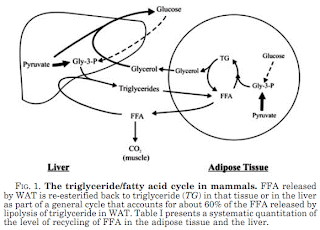
To state his case, Taubes zeros in on the TAG/FA cycle that occurs continually in the fat cell, and the known fact that insulin regulates this cycle (to large extent).  This is not in dispute, although the relative weight of insulin's actions on the outcome may be somewhat argued in these circles.  The full TAG/FA cycle is pictured at right (from Reshef et.al. 2003) -- the version Taubes discusses in GCBC.  We see that triglycerides and free fatty acids are constantly cycling in the fat cells, and between the fat tissue and the liver and muscle tissues.  Some is taken back up again.  

Wednesday, September 21, 2011

24hr Profiles: Insulin Secretion & Clearance in Normal and Obese

In this post I want to discuss two companion studies from the late 80's looking at twenty-four hour profiles of insulin secretion, uptake by the liver, glucose levels, etc.  The studies are available at the links below:

(I)  Quantitative Study of Insulin Secretion and Clearance in Normal and Obese Subjects

(II) Twenty-Four-Hour Profiles and Pulsatile Patterns of Insulin Secretion in Normal and Obese Subjects


Participants:  All non-diabetic with no family history of diabetes.  Age, weight, BMI are group averages.
14 normal weight:  7M/7F,  age 38.5 yrs, weight 70.1 kg, BMI 23.0
15 obese:  5M/10F, age 35.8, weight 105.7 kg, BMI 37.0

Sunday, September 18, 2011

Those Annoying Acronyms

Hey gang!

Just to let you know, I've given some thought to those acronyms some find so annoying.  I get it, really.  It's just that when I'm writing it would be totally untenable to write things out every time.   Even if I could, writing out "non-esterified fatty acids" rather than NEFA every time would unnecessarily lengthen my posts.  Most are long enough already!  Also, the acronym is ultimately easier for readability and speed.  However you sound it out in your head, NEFA is a heckuvalot shorter than non-esterified fatty acids.

So ... I've been working on a solution today, using an auto-type utility and a little HTML magic.  I think I have it!  Check out the sentence below.  You can mouse over NEFA and see what the acronym means.  It shows as a link.  (Don't click though ... I'm going to have to make a "go back" link but for now it takes you to the Asylum home.)
Elevated levels of NEFA  can be deleterious.
It will take me time to  put the acronyms in the auto-typing utility, but I think this should help.  Feedback greatly appreciated!

Saturday, September 17, 2011

Why Low Carb will always be a Fad

I really can't tell you how elated I was initially to find Jimmy's forum and what seemed to be what I was looking for in 2009:  (1) Some answers to why weight loss had stopped for a long time despite having weight left to lose, and (2) Support that the science backed the long term safety of following such a diet.  My mindset about 2-1/2 years ago was that I was generally pretty happy with where I was at.  If I didn't lose more weight I was still happy with how I looked and others looked at me.  I felt great and younger than I did when I was a decade younger.  There was the nag ... though I had not experienced the health issues of a previous stint this time, I still worried over their return.  But there was also this other nag compounded by the fact that my husband is not a low carber.  If LC was not producing further progress, was such an extreme necessary even if it was healthy.  

Insulin & Metabolic Rate ~ Am I Missing Anything?

As my regular readers are well aware, I've read a ton of peer review research on insulin and its action.  I also have a pretty freakish memory for certain things, so if I'd come across even an aside from a reputable source, I would have remembered it.  

So, I have yet to come across any information that insulin directly alters metabolism.  By that I mean the basal metabolic rate to keep you live and not-so-kickin -- BMR/RMR/REE.  As close as it comes is that insulin stimulates glycolysis (oxidation of glucose for energy), but it also suppresses fatty acid metabolism so that would seem to be a wash to me -- substrate switch but no impact on total rate of fuel burning.  I'm also not talking about minor differences in the TEF for carbs vs. other macros as this does not appear to be related to hormones per se.  

I'm talking whether insulin has any known action like that of leptin that specifically increases or decreases metabolic rate.  Have I missed anything?

Thanks in advance!

The Full Physiological Regulation of Fat Tissue ~ Part I of ?

Look it's late 2011 we have a disorder of excess fat accumulation, and low carb shills are saying that the physiological regulation of fat tissue by hormones secreted by the fat itself is irrelevant.  
~CarbSane channeling her favorite science fiction journalist/author

In this series of who-knows-how-many posts, I'm going discuss the full physiological regulation of fat tissue.   This was prompted by the response of the original LC Internet Kindergarten Cop to CICO vs. Regulation of Fat Tissue ~ Questions for Gary Taubes.  In that post I posed the following question:

  How can any hypothesis on the regulation of 
fat accumulation not include ASP and leptin? 

Indeed Taubes himself acknowledges the plethora of hormones in WWGF.  Note:  It's very easy to imagine how they can be so disturbed so that too much fat gets in and not enough gets out. {click to enlarge} 


Friday, September 16, 2011

Of Microscopes and Myopic Hypotheses

Surely somewhere somehow in your life you've used a microscope.  If this was in grade school, perhaps the teacher set it up for you, but most do not escape high school or college, even as non-science types, without using one at some point.  Here is your basic microscope you might encounter in a biology or forensic chemistry lab or such.   

The light shines up from the bottom, through your sample, up through the objective lens that magnifies the image and through the eye tube to your eye.  The eyepiece usually adds additional magnification (10X).  A choice of three objective lenses that can be "dialed in" is quite common.  Note the different lengths of these.   The shortest lens is the lowest magnification lens and is often called the low power objective.  As lens length increases so does the magnifying power of the lens.  The technique for using the microscope is pretty universal and begins with something that sounds rather silly:  Finding your sample when you look through your microscope!  If there's dust on the lens or the stage, etc., depending on what you're looking for, you might find yourself looking at something other than your sample.  Dumb as that sounds, it's far more common than you might think, especially if what you're looking at is a hair or a fiber to begin with!  The focus knobs work to adjust the vertical height between the sample and the objective lens -- this is called the working distance -- within the range of heights you see your sample, outside that range you basically see nothing.    The working distance is the longest for the low power objective and can be very small indeed for the higher power objective (which, incidentally, tends to be the most expensive and delicate of the objectives)

Wednesday, September 14, 2011

Diazoxide, Insulin & Obesity

In his recent post on insulin and obesity, Fat Tissue Insulin Sensitivity and Obesity , Stephan brings up one of those *nagging* studies that have been touted by TWICHOO advocates for quite some time.

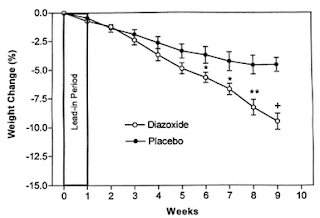
Back in May 2008, Peter/Hyperlipid posted Weight loss when it's hard 2. Diazoxide.  This discusses the following study:  Beneficial Effect of Diazoxide in Obese Hyperinsulinemic Adults.

What is diazoxide?  It is a drug that reduces insulin secretion.  As Peter writes:
You can simply reduce insulin secretion using diazoxide. Find enough obese people willing to put up with the hunger generating regime supplied by Slimfast and semi starve them for 8 weeks. Half can have a placebo, half get diazoxide in addition to Slimfast starvation. Figure 1 in the results is where you want to look. The idle porkers starving on Slimfast plus diazoxide lost significantly more weight in 8 weeks than the idle porkers starving on Slimfast alone.

Tuesday, September 13, 2011

Let's take a trip in the way back machine, shall we?

It's been exactly one year since this Gary Taubes interview with Jimmy Moore aired.  In one of Gary's emails to me he stated that this was taped on June 14, 2010, two weeks after your's truly published "Da Bomb":  Glyceroneogenesis v. Taubes.  I'm not aware of what other bloggers were talking about this specific issue at the time.  I'm going to ask you to give me about 10 minutes of your time to listen to what Gary was saying then about errors in GCBC.  It is important, I think, to listen to his "voicey language" as I call it.  The hesitation, high pitch at some points, throat clearing, etc.  Because there can be no doubt that the question was set up between Jimmy & Gary to give him a platform to set the record straight.  He was prepared for this ... he was not put on the hot seat in any way, and Jimmy would certainly not be trying to trip the guy up.   

FF to about the 38:30 mark


Monday, September 12, 2011

HCG Please say no!

For one  reason or another I've been getting a ton of traffic from HCG sites.   PLEASE.  Do not fall for this shit. It is quackery to the n'th.

Sunday, September 11, 2011

Insulin Wars w/ Todd Becker Chat

Newer readers may not remember this exchange from earlier this year, but Todd Becker of Getting Stronger and I had a nice back and forth going on insulin.  Around that time this blog started to get wicked busy, a health issue with a family member was taking a lot of my time and mental energy, etc.  Long story short, despite promises made, I never got around to posting any installments from Todd's last response.  I owe Todd a huge apology for letting this slide this long.  I've got a number of other things going with this blog and related projects so really don't have the time to devote to further installments of the Insulin Wars format, so I thought I'd catch everyone up with the discussion thusfar, and share Todd's last email in full via Google docs and let things go from here!

So, here's the series thusfar:
Insulin Wars IV: Todd Becker of Getting Stronger Blog
Insulin Wars IV.1: Todd Becker of Getting Stronger blog responds
More Todd Becker (Getting Stronger blog) on Insulin
Insulin Wars IV.2a: The Discussion with Todd Becker/Getting Stronger continues


Saturday, September 10, 2011

CICO vs. Regulation of Fat Tissue ~ Questions for Gary Taubes

In an interview with Andreas Eenfeldt (some time in 2010, uploaded by Eenfeldt 3/15/11), Gary Taubes makes the following statement (~3 minute mark is a good place to start):
Look it's 2010 we have a disorder of excess fat accumulation, and people are saying that the actual physiological regulation of fat tissue is irrelevant. 
One point Stephan made in his retracted response to Gary's recent blog post needs to be addressed.  So I'll  do so here.   Folks have been letting Taubes get away with this for a very long time, and that is his indiscriminate use of the word "regulation".   The core principal of TWICHOO (Taubes Wrong Insulin-Carbohydrate Hypotheses of Obesity)  is that insulin is the primary regulator of fat tissue metabolism, and thus fat mass.  He's actually ratcheted that up a notch so that in his view insulin acts as virtually the sole regulator.  

I'm going to use a computerized multi-fuel furnace with a fuel tank system depicted below to make my analogies.

Friday, September 9, 2011

You're as Hyperinsulinemic as You Need to Be †

Recent comments by Todd Becker (Getting Stronger blog) have prompted me to write yet another post on the (infamous on this blog) Grey & Kipnis study.  Perhaps, part of the problem in discussing these issues is a failure to define what it is we're talking about.  For instance with IR, we have chronic/pathologic IR, glucose-sparing IR (physiologic, fasting/carb restriction), and postprandial IR (usually impaired glucose clearance following a high fat meal or large fructose load).  With hyperinsulinemia we can talk about basal insulin levels vs. postprandial insulin levels.  It appears to me, that if we combine the observations in G&K with those of the long term fasting study, with the hypothesis of G&K -- that diet can play a role in basal hyperinsulinemia and therefore contribute to obesity -- perhaps basal insulin levels are comprised of both a chronic component (I would suggest related to NEFA) and a more transient component due to the diet of the previous day(s).  

So, Todd wrote:   Forgive me if I oversimplify the argument in your above post:
1. Obesity leads to spilling of excess fat as NEFA.
2. Excess NEFA leads to insulin resistance in the tissues, including the adipocytes

Metabolic Mad Libs

Anyone here remember Mad Libs?   These were game books of sentences, short stories even, where you would be asked to fill in the blank with a certain type of word (adjective, noun, profession, color, etc.) and the result would often be a very funny sentence/tale.

Let's take the carbs → insulin → obesity hypothesis and turn it into a Mad Lib.  Although my intent here is not one at humor, but instead to demonstrate how LC logic fails us.  

Here's a starting paragraph one might find in support of TWICHOO.

Insulin drives esterification and the storage of triglycerides in fat cells.  Dietary carbohydrates stimulate insulin therefore stimulate fat storage.  Obesity is associated with high fasting levels of insulin, therefore hyperinsulinemia causes fat accumulation.  Dietary fats don't stimulate insulin therefore fats have no influence on fat accumulation.  A deficiency in insulin [Type 1 diabetes] leads to weight loss.  Therefore, carbohydrates drive insulin drives fat accumulation.  Carbohydrates make you fat.

Thursday, September 8, 2011

Cysts and Hypothyroid ~ Any Info?

Hi all.  I'm hitting a brick wall trying to find any info on this and am wondering if anyone with hypothyroid has ever heard of this and/or might steer me in the right direction.  Searching on cysts and hypothyroid I keep getting info on cysts on the thyroid which is not my concern.

My mom injured her knee several months ago, and initial x-rays & MRI revealed, amongst torn this or that, a Bakers' cyst.  A few weeks ago she slipped and jammed her wrist breaking her fall.  No break, thankfully, but her doctor asked her if she had any thyroid issues that she was aware of.  I asked him why he would ask and he said it was because she had several small cysts in her wrist.  Apparently (ortho surgeon) he said this is common in people with hypothyroid.  

Is it?  Anyone know why?  Thanks in advance!

Monday, September 5, 2011

Bloggo Science ~ A Hypothetical Post ~ III: Fasting Insulin & Weight Loss

I started this series a while back and had intended this post to come right on the heels of the other two.  The best laid plans ...

If you haven't read them already, I suggest reading the first two posts now before proceeding:  A Hypothetical Post, and II: Plots thicken.  As I've related elsewhere, recent events have me cleaning out the draft bin here on the blog.  Many of these draft bin posts have been collecting dust for quite some time and this one is no exception.  It was started after the whole tiff I apparently set off with Peter of Hyperlipid with a post entitled  Insulin Caused Cerebral Stress.  The title was not intended to mock anyone, it was to point out just how untenable TWICHOO is.   In light of recent events and discussions on the merits of TWICHOO and Food Reward, it may not be the wisest thing I've ever done to complete this series at this time, but I think this sheds light on two important components in this whole debate.  Credibility and debate tactics.  Because the punchline of this series is that the data and the analyses were not published on some science blogger version of The Onion.  They came from a post of Peter's in support, apparently, of his contention that fasting insulin is the determinant of weight loss.

Saturday, September 3, 2011

The ExASPerating Gary Taubes

Yes, I'm going to address Part I of Taubes' ... um ... what would you call that bout of verbal incontinence he unleashed yesterday?  When someone writes a 4731 word blog post with a 30+ word title, ultimately about nothing of consequence, words to describe it escape even this usually ... shall we say ... less-than-concise blogger.  Yes, folks, the irony will not escape me when this post undoubtedly runs lengthy.

We're treated to Taubes' "shaggy dog story", whatever the heck that means, in which Gary yip yaps out the "iconic moment numero uno punch line" like the not-so-shaggy Taco Bell dog who just had his paw run over by some wayward scientist chasing a pair of dimes in his wheelchair:
In the Q&A session following my hour-long presentation, a member of the PBRC faculty, a distinguished-looking gentleman who I’d guess was in his mid to late sixties, raised his hand and said, “Mr. Taubes, is it fair to say that one subtext of your talk is that you think we are all idiots?”
Is it fair to say that I think they are all idiots? A surprisingly good question.

Thursday, September 1, 2011

Gary Taubes speaks ...

http://www.latestinpaleo.com/blog/2011/8/29/latest-in-paleo-30-gary-taubes.html

If you're in the mood for a little torture ;-)

He knows more than all those bloggers out there about those Pima!  (~21:30)  If this is the case, why does he still use them as examples?

He discusses AHS/Stephan Guyenet (~34:30).  Of note, this was obviously recorded recently.  He could have taken the opportunity to apologize publicly to Stephan.  Since he didn't address that specifically, the ticker stays.

Science Based Debate/Advice ... Messengers to Beware Of

I've been getting increasingly disillusioned with the state of discussions about the general nutrition web these days.  Why?  So many discussions get cluttered and/or dominated by a few types of purveyors of "scientific" information one should view with skepticism.  This is by no means a complete list, and these types are not mutually exclusive.  

1.  The Unsubstantiator:  There is a disturbingly large number of folks with MD after their names who fit this bill, but by all means not all of these.  There are also many folks who post on a variety of boards and blogs who have their "schtick" so to speak but offer no substantiation for their often repetitive claims. The Unsubstantiators will write long tomes filled with technical information and factual claims in an authoritative tone.  One problem.  No references are given.  I recognize that not everyone needs detailed, referenced as if it were a scientific paper, style information.  At least not all the time.  But when the message includes bold claims -- especially about things that are not "common knowledge" , or represent an alternative view -- these claims need to be substantiated.  It is not enough to say "X is the cause of Y" because I say so and I have letters after my name, or years of experience with this.
Found something helpful today? Please consider a small donation. Thank you!

Where to now?

align="middle" align="middle"

align="middle" align="middle" align="middle"