Welcome all seeking refuge from dogmatic lifestyle advice!

Please check out the tabs below to learn more about the Asylum, its founding and purpose, and the inmate running this place. Take the light-hearted quiz to see if you should stay for a spell and join us over at the Meeting Rooms for some lively discussion.

align="middle" align="middle" align="middle" align="middle"
______________ last updated 6/28/11 _____________________ last updated 7/29/11 _____________________ last updated 6/25/11 ______________________ Come on Over! _________

Sunday, October 30, 2011

Diabetes Treatment: New Dogma, Old Dogma or Just Carbophobic Myopia?

One of the points of contention raised in my brief exchange with Dr. Ron Rosedale over on the PaleoHacks forum is the notion that insulin is a harmful drug, and that diabetes should not be treated with insulin to "cover" dietary glucose.  This will only make the diabetic sicker and move them down the path of progression of their disease.   This reminded me of the flurry of blog hit pieces on the ADA's Hope Warshaw a while back.  One of the things these bloggers took special exception to was Warshaw's use of the term dogma and calling LC "old" dogma.  For starters:
Old Dogma: Losing weight will make blood glucose levels plummet no matter how long you have had type 2 diabetes. The message that people continually hear from their providers is "If you'd only lose weight, your blood glucose would go down." And the common reply from people with type 2 is "I'll try harder with my 'diet' over the next few months, but please don't put me on a diabetes medication."
New Reality: Research shows that the greatest impact of weight loss on blood glucose is in the first few months and years after diagnosis. (Read the Look AHEAD trial results, a study about the effect of weight loss on heart disease in type 2 diabetes.) In fact, the biggest bang for the effort per pound is likely in the prediabetes phase. (The sad fact is that most people don't know that they have prediabetes.)Large studies have shown that with loss of five to seven percent of body weight (approximately 10 to 20 pounds) and 150 minutes of physical activity (30 minutes five times a week), people can prevent or delay the progression to type 2. Once insulin production is on a dwindling course (particularly after 10 years with type 2), weight loss has less impact on glucose control.

Saturday, October 29, 2011

My Carbon Dioxide Sane-Asylum

Well folks, here in the NorthEast U.S.of.A we're having a snowstorm!  That's right!  This time last year I was getting in some last minute VitD sessions in the back yard, but as of now there's around 5" of snow here.  Global warming?  Ha!  Don't get me started on that fiasco!!  :-)

My 10' lilacs are bent over to the ground as they still have their leaves.  My big maple looks to be OK but weighted down.  I managed to bring quite a bit of wood up onto our covered deck and to the small pile nearby that's covered with a tarp before this started.  It's supposed to be in the mid 40's tomorrow so this should all be gone almost as quickly as it came.  I'm just hoping and praying that the one limb of a tree at the corner of our lot (that they didn't cut when they came around over the summer for every other leaner on the block despite this one leaning on the power lines) holds.  It's really leaning big time over the street with all it's leaves in their grandeur.   I've shoveled the walk once and will need to do it again when hubby is set to arrive home.  In my sneakers no less b/c winter boots?  Where are those?  Gloves?  But meantime the fire's roaring!  

Hope y'all folks in the general vicissitude stay safe and warm!  Happy Saturday :-)


Friday, October 28, 2011

Keep the Leptinade flowing! I'm going to die from my glucose anyway ...

A few general thoughts on this whole "safe starches" tangent into Ron  "Everyone's a Diabetic" Rosedale's contentions.  I was prompted to look into many of the claims of Rosedale by a short conversation I had with him over at PaleoHacks that can be found scrolling down to his responses here.  When one goes and reads the Facebook links in the root post, it is clear that Rosedale's views are pretty extreme as regards blood glucose levels, diabetes, etc.  It comes down, really, to viewing all blood glucose, leading to any level of glycation, as harmful.  Basically through Rosedale-colored glasses we see circulating glucose as always harmful and to be kept minimal both in circulation and as cellular fuel as much as possible for optimal health.  He also advocates getting virtually no glucose from your diet, relying, instead on your liver for all glucose needs.   Glycation debilitates, deteriorates and ultimately kills you, and in Rosedale's opinion, there's no "safe" level of glucose and its insidious glycation that causes no harm.  

As such, Jimmy Moore published a rebuttal to the rebuttal of sorts by Rosedale in response to Paul Jaminet of Perfect Health Diet.  Now, I think it's probably known to most of my readers that Paul is perfectly capable of responding eloquently to this, and I most certainly do not want to be seen as stepping on any toes.  But I think Jimmy's massive data dump blog posts -- liberally speckled with various uncalled for responses from LC luminaries -- deserve as many dismantlings as bloggers out there are willing to put up.  Law of numbers and all that, and hopefully some of this nonsense can be dispelled before we layer even more myths on a list that is already too long in low carb circles.

And so, with my previous post, I decided to focus on this notion that there is no such thing as a safe starch because there's no such thing as a safe glucose level, and look at some of the references Rosedale provided to make the case that this is "clearly" so.

Thursday, October 27, 2011

Glucose Assessments, Safe Starches and Interpretations

Before I serve up any more leptinade here at the Asylum, I wanted to share some broader thoughts on the analyses and implications of various measures of blood glucose levels as relates to normal and non-T1 diabetics.

The Common Measures:

1.  Fasting Blood Glucose (FBG):  Usually after at least a 10 hr or 12 hr fast.  The implication of this is that it is a measure of basal glucose levels.   Probably more than any other parameter, this one is subject to any manner of fluctuations and can vary 10-20 points mg/dL or more from just one aberration in eating the day before.  Also the degree of activity and length of time since awakening can dramatically alter FBG as can one's stress levels, medications (even an aspirin) and sleep patterns.  This is not going to make as much of a difference with an untreated frank diabetic as their overactive glucose production by the liver likely dominates.  But for the non-diabetic, it is easy to have a "bad day" exceeding prediabetic thresholds.  

Wednesday, October 26, 2011

Some Spiked Leptinade with My Science Krispies Please!

Well, Jimmy Moore is out with another installment of his crusade against "safe starches".  Yeah, I know, I know.  He's all about learning and helping people get to the truth, moving the debate forward constructively, and above all else protecting people from potentially bad advice such as that a major staple macronutrient for 99.99% of the human population for at least the past 10 millenia and more can actually be "safe".  Sorry, but I call things as I see them, baaayybee!   

It's another long piece, and I just can't stomach reading much of Jimmy's self-delusions anymore.  But I am interested in this whole notion that somehow we're all somewhere on a diabetic spectrum and our carb-induced post-prandial glucose spikes are lining our rat poison sprinkled paths to an early grave.  The post includes a long response by Dr. Ron Rosedale, pastor at the Church of the Not-Too-Late-in-the-Day Spiked Leptinade Drinkers.  

I'm going to address a few of the cited studies and Rosedale's basic claims.  (I'll be breaking this up in parts).  
The crux of the ‘safe starches’ argument is that no harm will come of this and it is, in fact, healthy. It is acknowledged that blood glucose will elevate after eating ‘safe starches’, but will generally stay below 140 mg/dl that Jaminet says is perfectly safe. Is it?? The science writing (below) is on the wall and the answer is…clearly no.
It is important to realize that this answer is no; there is no safe intake of sugar, nor a threshold level of blood sugar below which no harm will come, and I will shortly devote a fair amount of time to show this.

Now it would have been nice for Rosedale to include links to his science ... you know, just to make it a bit easier for the curious to go check out the studies in their entirety.  But by not doing so only those pesky blogger types like moi will likely bother. 

Tuesday, October 25, 2011

From My Alumni News ~ Weighty Research

The publication below landed in my mailbox last week.  I've watched a video lecture or two by Dr. Friedman, who discovered leptin, but did not know he was an RPI alum!
Rensselaer Alumni Magazine - Fall 2011 (pgs. 18-25)
There's nothing groundbreaking about the article, but I thought I'd share it here.  It does make a few things about leptin clear.

Monday, October 24, 2011

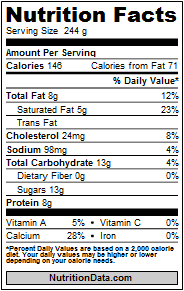
Commercial Milk: Full Fat vs. Non-Fat Nutrient Comparison

Just the Facts Ma'am from www.nutritiondata.com for Milk

Whole, 3.5%                             NonFat w/o Vit A


Yes, fat-borne vitamins and minerals are missing from the non-fortified non-fat milk.  But (1) low fat is not non-fat, (2) most low fat milk is fortified with vitamins A&D, and (3) The differences are small unless you're talking getting large percentages of daily calories in liquid milk form.   

Sunday, October 23, 2011

A Potentially Useful Weight Loss Tool?


Hat-tip to Sanjeev for finding this.  It might be helpful for those trying to lose weight in a more structured manner.    

Any time I see Hall's name, I can't help but be reminded of my good buddy Taubes.  He is one of those "smart young biophysicists at NIH" who kept trying to set Gary Taubes straight.  See Conservation of Energy -- Biophysicist Style , Gary Taubes Names Names.  In my opinion, Taubes deliberately misleads his audience on the works of Kevin Hall (and Carson Chow) when he claims that these two still agreed with him that insulin so fundamentally regulates fat mass the whole G3P thing is ultimately irrelevant.  For starters, the "can't store fat w/o carbs" used to be a key part of his hypothesis.  For another, Taubes is left with scrambled eggs all over his face (cue Frasier episode ending theme) about the G3P issue.  This is something when supposedly answering his critics, Taubes preferred ad hominem attacks on yours truly (I'm so confused!) than to address his Newsholme & Start problem.  

Taubes insists it's still all about the insulin though, and others will have you think you're at the mercy of your cortisol, leptin, thyroid, etc.  A problem here is that no doubt there are those who are legitimately genetically predisposed towards obesity in the mix of those afflicted in the course of this epidemic.  For these relatively few, their hormonal milieu is such that their basal metabolisms are unusually slow and their substrate oxidation rates and preferences dysfunctional, etc.   This can lead to increased energy intake due to an insatiable appetite or unconquerable fatigue. In this vein, the whole Eat Less Move More, ELMM, prescription may seem cruel (and ineffective) for this small proportion of the obese.  But, it does not invalidate the "tautology". And, frankly, it does not speak to those who have become obese (including myself) as part of the wave of the epidemic.   

I note that nowhere in this program is there a place to enter one's hormonal status.  This model is based on predictions obviously calculated from "average" data.  Do hormones come into play?  Sure.  And metabolic adaptations (reductions in RMR) are highly variable, but no doubt the simulator takes observed averages of this into account as well.   Still, basically *if* one can consistently control intake and deliberately maintain a degree of activity, the result will be reduced weight for good.  

Saturday, October 22, 2011

High Protein Diet Induces Sustained Reduction in Ad Libitum Intake Despite Diurnal Leptin Compensation

I have made over 600 posts on this blog.  There are some, especially from early on in 2010, that I would really like my readers to see, and I sure don't expect folks who are just finding this blog now to go back and read everything to find some that I feel are key.  I refer to this study quite often because I think for those finding themselves gaining a little bit each year and not wanting to hop on some "diet rollercoaster", there is merit to -- especially for us women -- upping the protein as a percentage in the diet.  So when I was compiling graphics for the 24 Hour Leptin Profiles post, this study was the first I knew to go to for a graphic.  So, I'm bumping the original, adding a little emphasis to the text but not changing it, and I'll add some commentary on leptin at the end.  


Original Publish Date:  4/30/10


Friday, October 21, 2011

Google Giggles

Another funny from the Blogger stats page ... A phrase that landed someone here :


baby white bunny yawn


I've spent the day unclogging my kitchen sink drain that had the audacity to back up into my dishwasher and spill over into my basement yesterday!  So please bear with me if this didn't tickle your funny bone like it did mine!


Thursday, October 20, 2011

Hormonal & Appetite Response to Macronutrients

I came across this paper recently and thought I would share it here on my blog.  I think it is rather eye-opening as to the postprandial hormone responses to meals rich in each of the macros (and alcohol) and the ultimate effect on satiety.


This study was done in normal weight healthy humans (9 women, 10 men) in their early 20's.  They fed them a meal containing the same calories, but high in one of each nutrient.  Each subject was given each diet with a 4-8 week "washout" in between, a standard diet the day before each test day, and subjects fasted 10 hour overnight before testing.   Hormones, etc. were measured for 5 hours postprandially, and then were provided an ad libitum meal.   Here are the diets tested:

Tuesday, October 18, 2011

Those NEFA are Pesky Things!

NEFA = Non-Esterified Fatty Acids aka Free Fatty Acids (FFA)
(By the way, I've just always preferred the NEFA acronym because in my head it sounds out more nicely than "ef ef ay" -- and for whatever reason, I sound it out "knee fah", though a reader once wondered about "neh fay".  I don't know there's a correct pronunciation for acronyms like this!)
On a hypothetical Metabolic SAT test NEFA are to lipids what glucose is to carbohydrates and amino acids are to proteins.  These are the forms of the three macronutrient classes that are absorbed/transported into and out of cells and circulation and the forms that enter into the energy-producing pathways.  By contrast, lipids are stored as triglycerides (aka triacyl glycerols, TAG), while carbs are stored in rather more limited quantities as glycogen, and there exists essentially no true storage depot for protein in excess of "tissue maintenance" needs.


Processed Dairy and Low-Fat Dairy-Phobia

I brought this topic up once or twice on Jimmy's forum back in the day.  Basically, aside from whole raw milk fresh from the cow, all dairy meets the definition of processed food.   This was usually met with absurd comparisons claiming I was equating butter with Crisco, or real cheese with Cheetos and Cheese Whiz.   Let's please put that strawman to bed right now.  I am not equating dairy products such as cream, cheese, yogurt, and butter with InsertNameBrandHere processed cheese food slices.  But make no mistake about it, you let raw milk sit around and it does not become any of the aforementioned without *some* processing.

Jimmy is apparently learning "life lessons" from TV these days and thinks Angie Harmon is clueless for promoting milk drinking in children, low fat of course.  He misrepresents what she says, but it's useless to try to correct someone Livin la Vida Low Clue.  (Harmon cites milk as one way to get essential nutrients, not the only way.)

Sunday, October 16, 2011

What are Dysfunctional Mitochondria?

The confusion with this whole mitochondria-based theory of obesity continues.  I'm not sure what's driving this other than a desperate clinging to the notion that one's obesity can not be the result of one's overeating and/or sedentary lifestyle, however they came about.  The more I read on this the more bizarre it all seems, but it comes down, once again, this notion that "fat burning" is related to fat accumulation or loss.  This is nonsense.  If your body requires 2000 cal/day to meet energy needs, it's pretty much all the same to your body where it gets that energy from.  And it will always be getting its energy from some mix of substrates:  glucose, fatty acids, and yes, amino acids and ketones.  Nobody disputes that energy is partitioned and substrates are oxidized in different manners largely at the direction of hormones ... insulin and leptin having well characterized roles in this regard.

Mitochondrial Trial Balloons

A trial balloon, for those who do not claim English as their primary language, is a term relating to "floating an idea", usually in hypothetical context, to gauge reaction.  The notion being one of plausible deniability (I never really meant to say/do that).  This is the only explanation I can come up with for why Peter/Hyperlipid is going down this whole mitochondrial dysfunction path of his.  In his most recent post, he floats the following (I've numbered the steps):
  1. Mitochondrial dysfunction leads to cytosolic fatty acid derivative accumulation.
  2. This leads to chronic hyperinsulinaemia via insulin resistance.
  3. This leads to adipocyte distension.
  4. This leads to adipocyte insulin resistance.
  5. This leads to increased plasma FFA delivery at a given level of insulin.
  6. This leads to increased cytosolic FFA derivatives.
  7. This leads to mitochondrial ATP production being normalised.
He concludes:  "The cost is increased insulin resistance. Oh, and the MECHANISM for improved ATP production is OBESITY. Call this a cost if you wish."

If I understand the premise, Peter is trying to support the notion that IR is the body's reaction to excessive fat accumulation to protect against even more fat accumulation.  This is inconsistent with the fact that numerous overweight and obese become insulin resistant yet continue to pile on the pounds for years, but it sounds appealing so let's go with it.  Do you see the problem with the above mechanism, however?  It's in the bolded statements.  If increased FFA derivatives normalized mitochondrial ATP production in step 7, why doesn't the backlog of same in dysfunctional mitochondria not stimulate their own normalization back in step 1?   Why would flooding mitochondria with more cytosolic FFA derivatives cause normalization.  This makes no sense on its face.

Trial balloon floated.
Keep trying?? 

Google Giggles

Regular readers are probably aware that every now and then I find silly Google search key words  that land folks here and highlight them in these posts.  Today's fun was:

Obi Sane

This just tickled my funny bone because of my Star Wars inspired posts on ASP.

24 Hour Leptin Profiles ... Sleep Off Your Spiked Leptinade?

In Science Krispies ... Spiked Pink Leptinade Anyone?,  I took on Dr. Ron Rosedale's claim  that "glucose spikes leptin".  The study I highlighted looked at 9-hour insulin and leptin profiles holding protein constant and essentially comparing a near-zero carb meal to a near-zero fat meal and fasting.  I've copied that graphic to this post:
A&B = women, C&D = men

OK, so we do see that the HC meal results in slightly elevated leptin, more pronounced in women, delayed about 4-5 hours after the meal vs. HF or fasting.  Over on the Perfect Health Diet blog (thanks for the shout out Paul!) , Paul Jaminet wrote:  
CarbSane partially confirms Dr. Ron Rosedale: eating carbs does raise leptin levels compared to eating fat, but it is a mild rise over an extended period of time, not a “spike.”

Saturday, October 15, 2011

Fat Tissue Regulation ~ Part V: C5L2KO - Meet the New Droid, Kinda Like the Old Droid


It seems that our friend C3KO city mouse has found his country mouse cousin:  C5L2KO.  In keeping with the Star Wars saga, albeit stretching things a bit with this one, I've found the depiction of our new friend!

To catch up, C3KO is a knockout mouse lacking the ability to produce Complement 3 (C3) protein which is a precursor for production of acylation stimulating protein, ASP.  Therefore C3KO is ASP deficient.  The result of this genetic mutation is to produce a mouse that is resistant to obesity, and essentially an ASP equivalent of insulin deficiency -- Type 1 diabetes.  If you've not read about C3KO, here are the links to the two relevant installments in this series:
  Fat Tissue Regulation ~ Part II: Meet C3KO
  Fat Tissue Regulation ~ Part III: C3KO Meets Obi No Leptinobi

It is known that fat tissue expresses insulin receptors.  Indeed this has been exploited to more clearly elucidate the roll of insulin acting on fat tissue in the form of insulin receptor knockout mice, the FIRKO mouse (F = fat specific, IR = insulin receptor) to be exact.  As it is less well characterized, ASP action on fat tissue is not universally well known or acknowledged.  Indeed ASP is pretty much a TWICHOOB's worst nightmare.  It seems silly to me to even be having this part of the discussion because it is absolutely not controversial that ASP plays a critical role in clearing dietary fat into the adipose tissue.  Or, we are to believe the fat tissue itself manufactures such a hormone for no purpose related controlling its own function.  Huh?  In any case, one piece of the puzzle that was missing was how ASP works and the absence of an identified receptor.  This piece of the puzzle was found in 2005 by Katherine Cianflone's group.

Friday, October 14, 2011

Science Krispies ... Spiked Pink Leptinade Anyone?

Leptin seems a very confusing hormone to pin down.  It's still relatively new, so despite there being a ton of research already, we're still in that era of lots of conflicting research and such.   As discussed previously, I think this makes leptin ripe for serving up oversized bowls of Science Krispies.  A lot of confusion also exists as regards the relationship between leptin and insulin.  Some say they work in concert, some say leptin rules insulin, and others say insulin rules leptin.  Insulin production is distinctly different in the basal and postprandial states.  How about leptin?  

Well if we believe Dr. Ron Rosedale (doing his best Joel Osteen impersonation shown at right, from over on his  Facebook page), it's leptin that rules the roost.  Rosedale posted a few advance installments of his response to the whole "safe starches" query from Jimmy Moore.  Here's one:

It appears to me that the paleo community has now been divided between a faction that backs Taubes who believes that insulin is supreme and the major cause of obesity, and a faction backed by Harris, Jaminet, Guyenet, and others who believe that insulin and glucose is less important and that leptin is more important in obesity and perhaps other diseases, and therefore eating so-called “safe starches” is OK if not even desirable. The major issue and source of confusion that I see, is that they are both half right and half wrong, but opposite halves. Taubes is right that sugars, starch, and elevated insulin are a major source of disease if not obesity that I heralded 2 decades ago, but not fully correct as to why. The Jaminet, Guyenet, Kruse, and Harris** group is right that leptin likely supersedes insulin as far as importance in obesity, diabetes, and other chronic diseases, at least in humans. However, they (not including Kruse) are quite wrong in believing that it is therefore okay to consume “safe starches” that will largely digest into glucose. Though true that leptin, more than insulin, controls fat storage and perhaps even blood glucose levels, this does not mean that raising insulin levels via glucose is unimportant. It still plays a huge role in the control of genetic expression influencing the aging and chronic disease phenotype. 

Wednesday, October 12, 2011

Do carb burners live longer?

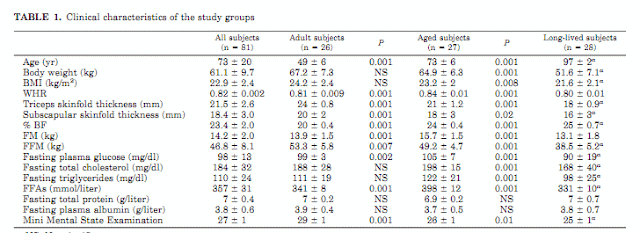
I've been looking at respiratory quotient a bit after my post series on the Ranneries paper on metabolisms of the formerly obese (Part IPart II, Part III) and found some interesting things.  One is this paper:

Resting Metabolic Rate and Respiratory Quotient in Human Longevity

In this study they compared three groups of women, I've included the table of various parameters below:

Mitochondrial Function and Dysfunction

Below is a wonderfully simple depiction of the mitochondria that depicts one of the points I've been trying to raise above the current internet noise about mitochondrial dysfunction.  That being that when it comes to carb burning (glycolysis) the initial steps occur outside the mitos while fat burning (ß-oxidation) occurs within the mitos.  However both create Acetyl-CoA, and from that point on, metabolism and energy production is the same.  

Tuesday, October 11, 2011

Science Krispies ... with a Tall Glass of Leptinade!

Yes folks, Science Krispies are best enjoyed with tall cold glass of Leptinade, stevia sweetened of course.

Last week over at PaleoHacks, I've gotten to know a bit more about someone I'd heard much about on Jimmy's forum, but never really bothered to look into.  Dr. Ron Rosedale, author of The Rosedale Diet.  I have a post in mind on some of his claims but we'll see if it floats my boat to post it up.  It was an odd coincidence that I was also skim reading through the copy of Nora Gedgaudas' PBPM book a friend bequeathed to me, and came across the section on leptin resistance, complete with referencing and a quotation from none other than Rosedale.   And when at PaleoHacks, there's no avoiding "The Quilt", aka Jack Kruse Neurosurgeon!  (Whenever I see his name I imagine some movie announcer booming Neurosurgeon! in action hero voice, with Jack as Dr. Evil flipping epigenetic switches on Mini-Me).  Jack's stance on everything seems to boil down to either you're leptin resistant or you're sensitive, and all manner of things can be explained with this simple wave of the hand.  Can't lose weight?  Resistant.  Eat 50g protein within an hour of waking and in a few weeks you'll be able to walk on water eating 10,000 calories a day of dark chocolate covered macadamia nuts while losing weight, all thanks to having reclaimed your leptin sensitivity!  It's a wonderful philosophy to have because it explains everything!

Monday, October 10, 2011

Not too shabby for a couple with deranged metabolisms

Gotta brag a bit.  On Saturday afternoon my husband got the bug to rent a log splitter so we could split the remaining wood from last year.  The hitch sleeve was rusty so it took a bit to even get the hitch on, but by 3pm we had the splitter and went to town.  Had built a small pile in a couple hours then showered and went out with friends.  I thought for sure I'd be sore yesterday but not really.  We gave the neighbors a break and didn't start until noon (plus we didn't want a visit from the police!).  We worked for about 5 hours (not constantly).   

The big pile ... around 7' high x 12 x 10'

Warning: This food contains starch. Consult your doctor before consuming!

In the comments section of Jimmy's "safe starch" post, Jimmy had this to say:
I'm still concerned with the use of the phrase "safe starches" because people will think that is universally true--and it may not be. Perhaps calling them "potentially safe starches" with the caveat that you should be checked by a physician to determine if they are safe for you or not would be better.
Has low carb dogma really come to this?  Where a couple of scientists with some health issues work them out with what appears to me to be exhaustive research, share their results with others in the form of a book, and are basically being accused of possibly harming people by suggesting that some starches are safe?

Sunday, October 9, 2011

Some thoughts on Diet and Cancer

I am not a doctor.  I've never had cancer, though I've had numerous close to me diagnosed and have actually studied it quite a bit.   So with Jimmy's Crap on the Jaminets fest going on over on his blog, lots of opinions on diet for cancer, ketogenic specifically, and Paul's "dangerous" recommendations are being bantied about.  I would be remiss if I didn't point out that Shou-Ching Jaminet is a cancer researcher!   But I guess she's only responsible for Paul's white rice consumption, and has no bearing on Paul-the-astrophysicist's understanding of molecular biology.   Yeauh right.  :-(

Friday, October 7, 2011

The next time I marinate or brine ...

... a piece of meat, I'm going to do it in 2 hour dips, 3X per day,  into diluted brine or marinade.  Also, I'll be rinsing in between my dips.  Normally I marinate or brine for upwards of 12 hours in fairly concentrated mixtures or solutions.  Still, I am convinced this will produce the same texture or flavor penetration.

Do you think this will work?   

Thursday, October 6, 2011

Fat Metabolism in Formerly Obese Women: Part III Energy Expended During Exercise

Continuing on from Part I and Part II:

Fat metabolism in formerly obese women
Ranneries, et.al.  AJP-Endo, 1998.

Overview:  An impaired fat oxidation has been implicated to play a role in the etiology of obesity, but it is unclear to what extent impaired fat mobilization from adipose tissue or oxidation of fat is responsible. The present study aimed to examine fat mobilization from adipose tissue and whole body fat oxidation stimulated by exercise in seven formerly obese women (FO) and eight matched controls (C).  They measured:
  • Lipolysis in the periumbilical subcutaneous adipose tissue 
  • Whole body energy expenditure (EE) 
  • Substrate oxidation rates (glucose, fatty acids) 
  • glycerol release (fat mobilization)

Wednesday, October 5, 2011

Fat Metabolism in Formerly Obese Women: Part II Resting Substrate Usage

Continuing the discussion from Part I

Fat metabolism in formerly obese women
Ranneries, et.al.  AJP-Endo, 1998.

In this part I wish to address the respiratory quotient, RQ.  The RQ is a measure of the relative amounts of energy derived from glucose oxidation vs. fatty acid oxidation.  

To recap the subjects of this study, when obese, the FO (formerly obese) subjects had body weights in excess of 120% normal weight.  They followed a conventional CRD to lose the weight and were weight stable for at least 2 months at 110% normal weight.  So weight losses were in excess of 10% bw and ranged from 15-20kg (33-44 lbs).    The FO & C groups were well matched as seen in Table 1.

Tuesday, October 4, 2011

Does eating fat stimulate fat burning?

Boost metabolism?

Well ... apparently not in rats.

full text in Google Docs HERE

The Rise & Fall of Soy & Gluten in the Low Carb World

Let's take a trip in the way-back machine.  I had never heard of him, but back a few years, George Stella was an LC chef featured on various and several TV shows, including his own.  I first heard of him on Jimmy Moore's forum ... someone commented on how too many of his recipes contained soy flour.   Fact is, "traditional" low carb was loaded with soy -- be it the flour or the oil (commercial mayo anyone?).  And guess what?  Folks lost weight on Atkins.  You want to know another frequent ingredient in LC recipes?  You guessed it ... gluten!  You see wheat gluten imparts some of the desired texture to LC products without the aaaack carbs.  And you know what?  Folks lost weight. I do think it's interesting to remember this in the context of today's paleo-styled low carb.  

I'm not knocking paleo, and certainly there are reasons why soy heavy diets are undesirable.  Ditto gluten, it may not be as detrimental to health in the general population as some charge, but at the very least I've yet to see any health benefits attributed to wheat protein.  But contrary to what some revisionist LC historians would have you believe, Atkins was quite far from paleo at its inception and until relatively recently.  Soy and gluten have fallen far out of favor now ... but it wasn't always that way.


Monday, October 3, 2011

And I'm the one that's Paranoid? (Yeah ... Dr. Wheat Belly Again!)

I just had to laugh at Fat Head's recent post The Long Knives are out for Wheat Belly where he seems convinced that folks criticizing Wheat Belly are trolling the internet at the behest of the grain industry.  I mean why would anyone criticize the nonsense on the basis of its bad science?   They've got to silence Davis!   Maybe I'm missing out on this guy's notorious humor and this post is tongue in cheek, but ... Ha ha ha.    

Of course we then get the "well they haven't read the book" whine in the comments.  Folks, enough of this book is available for preview on Google to get the gist of what is in it.   It's a compilation alarmism and hyperbole laced blog posts from this past year, fleshed out with a few references.   As I demonstrated in Wheat Belly on Acid, this section of his book was simply a tirade against oats turned against wheat.  I love eggs.  I would advocate for eating them were I in the nutritional advice business.  But by Davis' logic, eggs are more harmful to your bones than wheat.  Were I to employ his logic I might accuse him of advocating eating bowls of steaming furniture finish for breakfast.

Sunday, October 2, 2011

Fat Tissue Regulation: Part IV ~ How Acylation Stimulating Protein Works

Lipases are a tricky bunch of enzymes when one is looking to the action of an enzyme to extrapolate to overall regulation of fat mass.    What do lipases do?  They are enzymes that facilitate lipolysis, which is the breaking apart of triglycerides into glycerol and three fatty acids.  We have digestive lipases that break dietary triglycerides down so that they can be absorbed, but once absorbed they are packaged again back into triglycerides for transport to cells.  These triglycerides are packaged in chylomicrons.  There are lipases both in circulation and attached to all of our different cells, called lipoprotein lipases (LPL's) that break down triglycerides to free up fatty acids.  Those associated with the cells are doing so to facilitate uptake of the fatty acids.  Here's where it gets tricky, because lipases associated with, say, muscle cells, are acting to bring fatty acids into the cell to be oxidized for energy.  But the lipases associated with fat cells?  These are acting to bring fatty acids into the cells for the purposes of being re-esterified into triglyceride stores.  Then there are lipases within cells, like hormone sensitive lipase, HSL, in fat cells.  The function of this lipase is "mobilization" of fat stores -- breaking down triglycerides to release fatty acids.

If you're locked into a "fat burning" paradigm then, you want high HSL and LPL activity in fat cells and non-fat tissue cells respectively, and low adipocyte LPL activity.  Fats can't get into cells without lipolysis.  But this isn't how our human metabolism works.

Saturday, October 1, 2011

Mitochondria and Insulin Resistance

I hadn't paid much attention to this whole mitochondria thing, mostly because it would require some sort of en masse genetic switcharooni for dysfunctional mitochondria to have spurned the epidemic in diobesetes* in this country (and around the world).  

I had just happened across the paper briefly discussed in my last post looking for something else.  It is interesting what a simple PubMed search on the apparent head of the research group:  Dr. John Holloszy turns up.  Lots and lots about mitochondrial biogenesis.  

One such paper is this fairly recent, 2008, review paper by Holloszy.  
Found something helpful today? Please consider a small donation. Thank you!

Where to now?

align="middle" align="middle"

align="middle" align="middle" align="middle"