Low Carbohydrate, High Fat Diet Increases C-Reactive Protein during Weight Loss
Low Carbohydrate, High Fat Diet Increases C-Reactive Protein during Weight Loss
Janet W. Rankin, PhD and Abigail D. Turpyn
Journal of the American College of Nutrition, Vol. 26, No. 2, 163-169 (2007)
Studied Variable: Dietary Carbohydrate
Variables Measured: Body weight, IL-6, CRP, urinary 8-epi-prostaglandin, FBG, FFA (fasting)
Variables controlled for: Caloric intake
Protocol Summary: Subjects were ed into two groups followed calorie restricted (~1360 kcal/d) diets varied in composition: LC = 58F/12C/30P ; HC = 24F/59C/18P. Weight, inflammatory markers (IL-6 and CRP) and oxidative stress (8-epi) were measured weekly.
Human Study
Gender: Women
Age: adult, premenopausal
Number of Participants: 29
Weight Status: Overweight BMI 32.1 ± 5.4 kg/m2
Health Status: weight stable for at least 6 months, nonsmokers, sedentary, otherwise healthy and unmedicated
Study Duration: 4 weeks
Summary of results:
* LC lost a bit more weight (3.8 ± 1.2 kg LC vs. 2.6 ± 1.7 HC, p=0.04)
* CRP increased an average of 25% in the LC group whereas it decreased 43% in the HC group (p=0.02)
* FBG decreased similarly for both groups
* IL-6 increased similarly for both groups
* 8-epi varied differently between groups but with no consistent pattern.
* Serum NEFA increased for both groups, the increase was greater for LC
Here is a screenshot of the results: (click on image to enlarge)
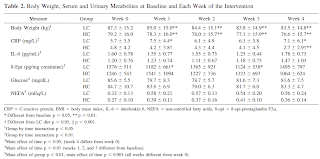

Researchers' Conclusion: "Diet composition of the weight loss diet influenced a key marker of inflammation in that LC increased while HC reduced serum CRP but evidence did not support that this was related to oxidative stress."
My Comments:
Although apparently not statistically significant, the LC group (~190 lbs) was a bit heavier than the HC group (~175 lbs) to begin with in this study. This could be related to the LC group starting at a higher (although also not indicated as significant) average CRP level.
But look at the CRP graph showing the individual results vs. baseline -- the horizontal axis is the baseline CRP. I find this disturbing. The first thing that jumps out is that almost all of the LC group had increases while all of the HC group had decreases. Also disconcerting is that this effect seems more pronounced for those who had a low level of CRP to begin with -- IOW, LC seems to induce an inflammatory state according to the CRP indicator. This is not seen for HC where in most cases CRP declines. If one looks at the right side of the graph, you have the subjects in the highest baseline "inflammatory state". What happens? Significant decreases in CRP for the HC group, negligible change either way for LC.
Whether or not to be stressed over CRP levels is a matter of continued confusion and controversy, but higher CRP levels are never, as far as I've seen, considered a good thing.
I came across this article while researching plasma free fatty acids (NEFA, FFA) and am concerned with the effect the LC diet had on fasting FFA's. The highest fasting level for the LC group was almost 1.5X (50% higher) than the highest fasting level for the HC group. The high level vs. baseline for LC was ~1.8X vs. ~1.5X for the HC group.
I don't know enough about 8-epi at this time to comment on that aspect of this study.
Janet W. Rankin, PhD and Abigail D. Turpyn
Journal of the American College of Nutrition, Vol. 26, No. 2, 163-169 (2007)
Studied Variable: Dietary Carbohydrate
Variables Measured: Body weight, IL-6, CRP, urinary 8-epi-prostaglandin, FBG, FFA (fasting)
Variables controlled for: Caloric intake
Protocol Summary: Subjects were ed into two groups followed calorie restricted (~1360 kcal/d) diets varied in composition: LC = 58F/12C/30P ; HC = 24F/59C/18P. Weight, inflammatory markers (IL-6 and CRP) and oxidative stress (8-epi) were measured weekly.
Human Study
Gender: Women
Age: adult, premenopausal
Number of Participants: 29
Weight Status: Overweight BMI 32.1 ± 5.4 kg/m2
Health Status: weight stable for at least 6 months, nonsmokers, sedentary, otherwise healthy and unmedicated
Study Duration: 4 weeks
Summary of results:
* LC lost a bit more weight (3.8 ± 1.2 kg LC vs. 2.6 ± 1.7 HC, p=0.04)
* CRP increased an average of 25% in the LC group whereas it decreased 43% in the HC group (p=0.02)
* FBG decreased similarly for both groups
* IL-6 increased similarly for both groups
* 8-epi varied differently between groups but with no consistent pattern.
* Serum NEFA increased for both groups, the increase was greater for LC
Here is a screenshot of the results: (click on image to enlarge)


Researchers' Conclusion: "Diet composition of the weight loss diet influenced a key marker of inflammation in that LC increased while HC reduced serum CRP but evidence did not support that this was related to oxidative stress."
My Comments:
Although apparently not statistically significant, the LC group (~190 lbs) was a bit heavier than the HC group (~175 lbs) to begin with in this study. This could be related to the LC group starting at a higher (although also not indicated as significant) average CRP level.
But look at the CRP graph showing the individual results vs. baseline -- the horizontal axis is the baseline CRP. I find this disturbing. The first thing that jumps out is that almost all of the LC group had increases while all of the HC group had decreases. Also disconcerting is that this effect seems more pronounced for those who had a low level of CRP to begin with -- IOW, LC seems to induce an inflammatory state according to the CRP indicator. This is not seen for HC where in most cases CRP declines. If one looks at the right side of the graph, you have the subjects in the highest baseline "inflammatory state". What happens? Significant decreases in CRP for the HC group, negligible change either way for LC.
Whether or not to be stressed over CRP levels is a matter of continued confusion and controversy, but higher CRP levels are never, as far as I've seen, considered a good thing.
I came across this article while researching plasma free fatty acids (NEFA, FFA) and am concerned with the effect the LC diet had on fasting FFA's. The highest fasting level for the LC group was almost 1.5X (50% higher) than the highest fasting level for the HC group. The high level vs. baseline for LC was ~1.8X vs. ~1.5X for the HC group.
I don't know enough about 8-epi at this time to comment on that aspect of this study.
Comments
@theOzel: A much belated welcome! Every now and then a comment slips past me. It is entirely possible - or just high O6 consumption period. Many traditional low carbers eat commercial salad dressings and mayo - both of which are soybean oil/O6 heavy. I do have reservations on how inflammatory they are. Unfortunately NSAIDS & antibiotics have increaed those instigators of inflammation like certain plant proteins around the same time as seed oil consumption was climbing. It's hard to sort all this stuff out!
So the point here... would be to try and sift out what a given diet does to the human body.
At least, that would be my take on it anyway.
I'd also say it is relevant that the "otherwise healthy" people in this study had improvements in an inflammation marker on HC but the opposite result on LC. Seems an effort to dismiss inconvenient results in this study.
Also, we don't know what other confounders might be at work. We all know of people who drink/smoke/gorge or junkfood and are lean and long-lived. So how do we know whether the "healthy" people we use in a study are healthy because of what they eat or are healthy in SPITE of it?
However, I don't agree that the results would necessarily be different in an unhealthy body, let alone opposite. Is there evidence for that? If a type of diet raises C-reactive protein levels in a healthy body, why not in an unhealthy body?
In his 2007 study, Westman's hypothesis that C-reactive protein levels would RISE in the low carb group, in part because they didn't consume the anti-oxidants that the high carb low fat group did. And that hypothesis proved true. Low carb dieters' C-reactive protein levels rose 25% from baseline and low fat dieters' C-reactive protein levels fell 43%. The low carbers did lose more weight, but C-reactive protein (CRP) still rose. I'm no expert, but a brief glance through the literature suggests that elevated CRP levels is not something you want to have.
I don't know much about renal disease except that it can happen to diabetics, so is a result of elevated blood glucose. Eating excess protein stresses the kidney. A healthy kidney can take the added stress, a diseased one can't. This doesn't mean that the additional stress is long term a good idea, but it doesn't mean it's necessarily bad either.
I also don't dispute that there is a range of reactions to inflammation levels, and a given body's reaction is likely related to factors such as genetics or disease. If you've lost the genetic lottery so that your body reacts poorly to inflammation, then lowering causes of inflammation seems a good idea to me.
If the anti-inflammatory effect of lowering blood glucose levels is greater than inflammatory effect of elevated C-reactive protein, It makes sense that other health markers might improve. But it doesn't negate the potential effect of the elevated CRP over time.
I'm sure it's obvious, but I'm in WAY over my pay grade now, but I thought CRP was produced in the liver. Some of the diabetes review articles Carbsane has blogged about state that diabetes is actually a liver disease (because the liver produces too much glucose.) Certainly, the liver is involved, even if it's not the genesis of the disease (and I found the inefficient beta cell endoplasmic reticulum model very convincing). So to me, a diet that adds stress to the liver-- even as it lowers blood glucose levels-- would not the best long term option.
Second, what exactly is "leguminous fibre"? They don't mention the people eating legumes, which is what you'd expect if that was the case. Instead they say "leguminous fiber" which is usually a legume-based fiber supplement that contains little or no available carbohydrate. As you likely know, even though fiber is a carbohydrate and is counted in the carb content on food labels, fiber has little or no glycemic impact and isn't counted toward net carbohydrate intake-- as it's more likely to produce fatty acids in the gut.
If I eat 300 grams of carbohydrate in my food today, and 200 of that is fiber, I'm eating a low-carb diet. So what if BOTH diets contained 100 net grams of carbohydrate but the "high carb" group also consumed 200 ectra grams of soluble fiber? I'd expect the results to vary greatly between the groups too, even though the net carb intake was the same. So without knowing more of the detail, I don't believe this study evidentiates your claim very well.
As for insulin being anti-inflammatory? i don't think so. An October, 2005 study published in Archives of Neurology (of JAMA) found that even moderately elevated levels of insulin increase the levels of inflammatory markers and beta-amyloid in plasma and in cerebrospinal fluid. The authors wrote:
"Our findings suggest that insulin-resistant conditions such as diabetes mellitus and hypertension may increase the risk for AD, in part through insulin-induced inflammation."
In the The Insulin Resistance Atherosclerosis Study (IRAS), the authors state,
"In 3 other studies, fibrinogen [another inflammatory marker] levels were independently associated with fasting insulin levels in nondiabetic subjects."
In other words, even in people withOUT metabolic disease, circulating insulin appears to be inflammatory.
These results do not prove anything. Also, the study only lasted 4 weeks and when doing a study where exactly what the folks ate was extremely important, you have to have them sequestered and monitor what they eat. People lie all the time about what they eat, and sugar and carbs eaten in the presence of fats will increase inflammation. How did they really know what these people ate?
Post a Comment
Comment Moderation is ON ... I will NOT be routinely reviewing or publishing comments at this time..