Posts

Showing posts with the label Fat Loss

Diazoxide, Insulin & Obesity
Image
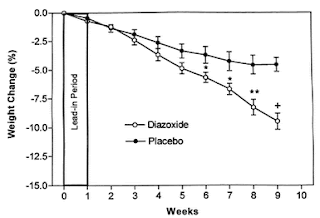
In his recent post on insulin and obesity,  Fat Tissue Insulin Sensitivity and Obesity  , Stephan brings up one of those *nagging* studies that have been touted by TWICHOO advocates for quite some time. Back in May 2008, Peter/Hyperlipid posted  Weight loss when it's hard 2. Diazoxide .  This discusses the following study:   Beneficial Effect of Diazoxide in Obese Hyperinsulinemic Adults . What is diazoxide?  It is a drug that reduces insulin secretion.  As Peter writes: You can simply reduce insulin secretion using diazoxide. Find enough obese people willing to put up with the hunger generating regime supplied by Slimfast and semi starve them for 8 weeks. Half can have a placebo, half get diazoxide in addition to Slimfast starvation. Figure 1 in the results is where you want to look. The idle porkers starving on Slimfast plus diazoxide lost significantly more weight in 8 weeks than the idle porkers starving on Slimfast alone.

Is LC Morphing to HAES? Part II: There's Something About Laura

Image
As I stated in Part I of this series, I'm seeing increasing mention of low carbing for health irrespective of weight loss.  The subject of this installment is going to be Laura Dolson of About.com.  Her recent interview with Jimmy Moore is what actually sparked me to blog on this topic. I wish to put a disclaimer here, and I'll probably C&P this paragraph into each subsequent Part I may add to this series in which I name names.  I have nothing personal against any of these people.  I don't know any of them personally, so I can only go by their interviews, writings and podcasts.  For the most part these folks seem like quality people, although I do find the snarky and often mocking anti-anyone-who-disagrees-with-their-pet-theories attitudes off-putting at times.   In naming names my purpose is not to embarrass anyone or attack them or make them feel badly about themselves.  Lord knows the last thing an obese or overweight person needs is someone ...

Endogenous v. Exongenous Hormones

Image
I'm going to be using insulin as my example in this post.  Endogenous insulin is the insulin produced in your body by your pancreas.  Exogenous insulin would be that derived from outside the body - e.g. insulin injections.  For the most part exogenous hormones are obtained through some "pharmaceutical" route.  In the case of insulin, subcutaneous injections. Now I’m sure most of my readers are familiar with the picture below:

Exercise v. Diet for Weight Loss

Image
In recent months, mainly sparked by Mr. Exercise Only Makes You Hungry's appearance on the Dr. Oz show, there seems to have been some renewed interest in the LC community in the role of exercise for weight loss.  Most studies show little effect of exercise only, but, as the authors of this study I'm about to share state,  "these conclusions are drawn from studies in which individual energy intake and expenditure were not rigorously controlled or accurately measured"  .  When it has been controlled, the calorie deficits created through exercise alone were not sufficient to produce significant weight loss. Reduction in Obesity and Related Comorbid Conditions after Diet-Induced Weight Loss or Exercise-Induced Weight Loss in Men This study was done in weight stable (6+ months prior to study) obese (BMI >27) men with waist circumferences over 100 cm (~39").    The men were sedentary, non-smokers, non-light drinkers, and had normal lipids and glucose toleran...

Of Mice & (Wo)Men: When's the last time you saw an 5'4" 130 pound fat woman?

Image
I'm always amused when a rodent study that seemingly counters the calorie-based theories on obesity comes down the pike.  In predictable fashion, someone in the LC webosphere will pick up on it and use it as an example to counter calorie-based theories on weight/obesity.   A recent example of this is brought to us by low carbers' favorite comedian edutainer, Tom Naughton:  Fat Mice & The Laws of Thermodynamics  that referenced the following study:   Mild calorie Restriction Induces Fat Accumulation in Female c57BL/6J Mice .   Now Tom starts out misrepresenting things by picturing a fat mouse, likely an ob/ob.  This study actually involved females of the strain pictured below: Kind of a cute little critter, no?   The study was also conducted in the context of calorie restriction and its demonstrated increase in longevity of mice.  They are not a mutant strain genetically predisposed to obesity.

More on Water Weight & Insulin

There's an interesting related conversation on this topic going on over at Paul Jaminet's site: Water Weight: Does It Change When Changing Diets? Does It Matter? For those not familiar with the Perfect Health diet, one component is to get ~400 cal in "safe starches" -- around 100g.  For those transitioning to their diet from a low carb diet, some have experienced a not-unexpected weight gain.  I've added some thoughts to the comments there and -- can't be sure and some is just a hunch -- but I think any weight bounce is probably more carb associated, predominantly glycogen repletion.  It may well be due to replenishing other "carb" molecules with their associated water as well.  My guess is that for the most part these changes show up on the scale more than in dimensions.  That was my experience during the almost 3 years of my "low carb cheating" plan.  I can't know for sure for the first year and a half or so of that, because I never...

Exercise to lose weight and reduce lipotoxicity!

Thanks to reader Cody for finding a study I had come across previously regarding IMCL/IMTG.  Actually the study linked to was an update, but there's a secondary lesson, I believe, to be had from the results.  Since this was a study in older folks, there's a sub-message here:  it's never too late! Study:   Exercise-induced alterations in intramyocellular lipids and insulin resistance: the athlete’s paradox revisited We previously reported an “athlete’s paradox” in which endurance-trained athletes, who possess a high oxidative capacity and enhanced insulin sensitivity, also have higher intramyocellular lipid (IMCL) content. The purpose of this study was to determine whether moderate exercise training would increase IMCL, oxidative capacity of muscle, and insulin sensitivity in previously sedentary overweight to obese, insulin- resistant, older subjects. Twenty-five older (66.4 0.8 yr) obese (BMI 30.3 0.7 kg/m2) men (n 9...

Dietary Fat v. Endogenous Fat for energy

It has become increasingly clear to me that regardless of the macronutrient composition of one's diet, dietary fat is only marginally "burnt" for energy on a given day.  The exception to this would be medium and shorter chain fatty acids that are not included in this discussion. There's a lot of misinformation out there spread by various LC gurus regarding fat burning and storage.  Without carbs, we can still store fat and we do!  The energy substrate for "fat burning" ( is the free fatty acid (NEFA/FFA).  Where do most of these come from? 1.  Lipolysis of "lipid droplets" of stored triglycerides within the cells, often called intramyocellular triglycerides (IMTG)  2.  Lipolysis of adipose tissue.   3.  Lipolysis of other circulating triglyceride-carrying lipoproteins   4.  NEFA/FFA's that "escape" the re-esterification process. Sources 2-4 are all circulating FFA's and my research all points to the conclusion that circulating N...

Interval Training and Fat Loss

The effects of high-intensity intermittent exercise training on fat loss and fasting insulin levels of young women. OBJECTIVE: To determine the effects of a 15-week high-intensity intermittent exercise (HIIE) program on subcutaneous and trunk fat and insulin resistance of young women.  DESIGN AND PROCEDURES: Subjects were randomly assigned to one of the three groups: HIIE (n=15), steady-state exercise (SSE; n=15) or control (CONT; n=15). HIIE and SSE groups underwent a 15-week exercise intervention.  SUBJECTS: Forty-five women with a mean BMI of 23.2+/-2.0 kg m(-2) and age of 20.2+/-2.0 years.  RESULTS: Both exercise groups demonstrated a significant improvement (P<0.05) in cardiovascular fitness. However, only the HIIE group had a significant reduction in total body mass (TBM), fat mass (FM), trunk fat and fasting plasma insulin levels. There was significant fat loss (P<0.05) in legs compared to arms in the HIIE group only. Lean compared to overweight women lost ...