Posts

Showing posts matching the search for water weight

More on Water Weight & Insulin

There's an interesting related conversation on this topic going on over at Paul Jaminet's site: Water Weight: Does It Change When Changing Diets? Does It Matter? For those not familiar with the Perfect Health diet, one component is to get ~400 cal in "safe starches" -- around 100g.  For those transitioning to their diet from a low carb diet, some have experienced a not-unexpected weight gain.  I've added some thoughts to the comments there and -- can't be sure and some is just a hunch -- but I think any weight bounce is probably more carb associated, predominantly glycogen repletion.  It may well be due to replenishing other "carb" molecules with their associated water as well.  My guess is that for the most part these changes show up on the scale more than in dimensions.  That was my experience during the almost 3 years of my "low carb cheating" plan.  I can't know for sure for the first year and a half or so of that, because I never...
Insulin, Weight Loss & Water Weight

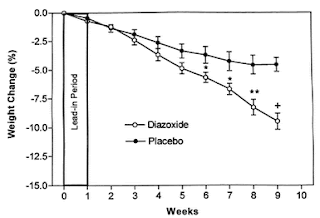
Reader kds posted a link to this Peter of Hyperlipid's blog post about the following study:  . Beneficial Effect of Diazoxide in Obese Hyperinsulinemic Adults Basically, diazoxide is a compound that has been used to treat hypoglycemia and reduces insulin secretion.   Two groups of 12 obese hyperinsulinemic adults were treated with diazoxide or placebo for 8 weeks while each consuming the same Optifast diet.   Compared with the placebo group, DZ subjects  had greater weight loss (9.5 ± 0.69%   vs.   4.6 ±   0.61%,   P   < 0.001), greater decrease in body fat ( P   < 0.01),   greater increase in fat-free mass to body fat ratio ( P   <   0.01), and greater attenuation of acute insulin response to   glucose ( P   < 0.01).    This is pretty phenomenal and difficult to fathom -- almost twice the weight loss.  It was also reported that there was no significant change in resting energy expe...

Diazoxide, Insulin & Obesity

Image
In his recent post on insulin and obesity,  Fat Tissue Insulin Sensitivity and Obesity  , Stephan brings up one of those *nagging* studies that have been touted by TWICHOO advocates for quite some time. Back in May 2008, Peter/Hyperlipid posted  Weight loss when it's hard 2. Diazoxide .  This discusses the following study:   Beneficial Effect of Diazoxide in Obese Hyperinsulinemic Adults . What is diazoxide?  It is a drug that reduces insulin secretion.  As Peter writes: You can simply reduce insulin secretion using diazoxide. Find enough obese people willing to put up with the hunger generating regime supplied by Slimfast and semi starve them for 8 weeks. Half can have a placebo, half get diazoxide in addition to Slimfast starvation. Figure 1 in the results is where you want to look. The idle porkers starving on Slimfast plus diazoxide lost significantly more weight in 8 weeks than the idle porkers starving on Slimfast alone.

Sugar Addiction & Minerals ... Accidental Evidence Countering Addiction

Image
Blogstress Note: I wrote most of the analysis in this post around a year ago when I was looking for some additional examples of what I call "accidental evidences" against the concept of sugar addiction (and food addiction in general), just never got to tidying it up.  Therefore this post will be formatted a little oddly as it's what I have time for.  I'll do some general conclusions as regards sugar addiction, and then include the detail afterwards.  Whatever conclusions one might make vis a vis the minerals involved in this study are welcomed in comments, with the understanding that I'll likely not engage on those points due to time constraints.  In the end it seems difficult to arrive at any consistent conclusion  from the study I'll discuss, as results often contradicted themselves from one of the three experiments to the next. While perhaps not as striking as the image I've chosen here, I believe the size (and thus age) differentials of the animal...

The $12M NuSI/Ludwig Study: Part I: Critique of the Study Design

Image
S UMMARY The results of the $12 Million Dollar NuSI-sponsored study, headed up by Dr. David S. Ludwig, are finally out.   Effects of a low carbohydrate diet on energy expenditure during weight loss maintenance: randomized trial While the good doctor is making the rounds touting them as evidence in support of the Carb-Insulin Hypothesis (TWICHOO in these parts), a review of the raw data made available to the public casts grave doubts on his victory lap.  This study built upon the "promising" results of the 2012 study:   Effects of Dietary Composition on Energy Expenditure During Weight-Loss Maintenance    This post focuses on comparisons of Study Design between these two studies, some improvements, and the ultimate failure that renders the primary outcome data suspect, if not outright useless.  (And I don't say that lightly!) Improvements: Study size Length of time on one test diet (20 weeks) vs. 4 weeks crossover on each...

Insulin & Weight/Fat Loss ~ The Long and the Short of It

Image
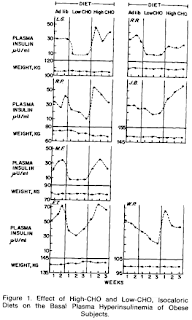
In the comments of my recent post, On Cherry Picking & Debunking , my "Insulin Warring" partner Todd Becker posted a multi-point commentary.  I'll get to the rest over in the comments section in that post when I get a chance, but one of his points hit on something just a little different as it goes to the core of my issue with the insulin hypothesis. (And I'm reminded I'm long overdue for an installment on the IW exchange with Todd) In any case, here was what I said: G&K demonstrated absolutely no correlation between fasting insulin and weight change. Therefore fasting insulin is not a factor in determining weight loss. Todd challenged:   Your claim that there is "no correlation" between insulin levels and weight looks only at the instantaneous correlation. But fat loss may be a delayed response, as the Woodhouse paper I linked to you indicates. Figures 1 and 2 in G&K suggest that weight either dropped or plateau'd after a slight lag ...

Keto Clarity ~ A Review of the Chaos and Confusion in Memes

Image
Those who follow me on social media know that I broke down and purchased a copy of Keto Clarity .   I'm deciding on whether to bother with a formal review of the book or Jimmy Moore's contribution.  With respect to Jimmy Moore, this is a second volume of convincing himself and the world that his crazy diet schemes are healthy rather than unhealthy, as if repeating it often enough will make it so.   But for the rest of the world, it is more Dr. Eric Westman's stamp of approval and co-authorship that is problematic for his credibility.  In Cholesterol Clarity , he signed off on a book where Jimmy's horrific lipid panel including, at times, LDL-P over 3000, LDL-C over 300, TC over 400.   In Keto Clarity , the fact that Jimmy Moore's biomarkers did NOT improve, despite a temporary weight loss of almost 80 lbs, is magically presented as a healthy dietary lifestyle.  

Insulin Treatment in Diabetes ~ Why Does It Often Cause Weight Gain?

S ummary: Diabetes, whether Type 1 or Type 2, is a dysfunctional, wasteful metabolic state.  As a result, an uncontrolled diabetic either uses or loses more energy than their non-diabetic selves would otherwise use.  As such, the untreated diabetic is essentially "underweight" compared with the body weight that the same energy intake would produce were they not diabetic. There are differences in endogenous insulin production between the two types of diabetes.  In Type 1, there is effectively no insulin production.  In Type 2, there is usually elevated basal insulin production, but a relative deficiency in acute insulin secretion, specifically an impaired early insulin response to glucose (GSIS).  The absolute or relative insulin deficiency results in the following to a greater or lesser degree: Excessive lipolysis resulting in an increased cycling of the Triglyceride/Fatty Acid cycle.   Impaired suppression of glucose production in t...

Failure of LC/HF Diets to Suppress NEFA Release

Image
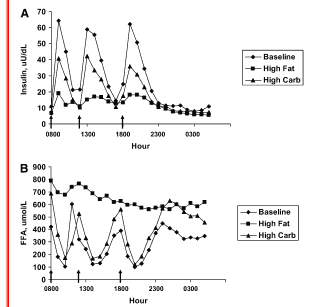
Thanks to reader MM, I have procured a full text copy of the following study that I've discussed a bit previously:   Lack of suppression of circulating free fatty acids and hypercholesterolemia during weight loss on a high-fat, low-carbohydrate diet A bullet pointed, sometimes paraphrased abstract/summary: This study compared a low carb (less than 20g/day, no fat content provided but "high fat") diet to a high carb diet (55% energy, 30% fat)  Fasting, 24 hour AUC (cumulative exposure) and time courses for metabolites were measured during weight loss. Subjects were healthy, obese adults (n = 32; 22 women, 10 men) - diabetics and those with a history of CVD were excluded. The study lasted six weeks.  A 24-h in-patient feeding study was performed at baseline and after 6 wk. Glucose, insulin, free fatty acids (FFAs), and triglycerides were measured hourly during meals, at regimented times. Remnant lipoprotein cholesterol was measured every 4 h...

A Collection of "Accidental Experimental Evidences" Against Sugar/Fructose Addiction

Image
This post may be added to from time to time, to collect in one place evidence against the concept of sugar/fructose addiction.   When added to it will be bumped, and the "skip to using browser search" table of contents below will be updated.   Accidental Experimental Evidences Mice Fed 18% Fructose Mice Fed 60% Sugar or Starch Unmotivated Fat Rats

The $12M NuSI/Ludwig Study ~ Part III: Some "Early" Lessons

Image
S UMMARY Continuing on with discussion of: Effects of a low carbohydrate diet on energy expenditure during weight loss maintenance: randomized trial In Part I , I discussed some issues with methodology, mostly focusing on the reduced Run-In Phase that likely compromised the outcomes irreparably. In Part II ,  I highlighted a serious issue with the Run-In Phase, the purpose of which was to produce a somewhat homogeneous "reduced weight state" to test various diets in maintenance of that state. Ultimately,  randomization to the various test diets occurred after weight loss (PWL) all subjects lost weight on the same 45% Carb / 30% Fat / 25% Protein diet targeting a weight loss of 12% ± 2% initial body weight. The researchers do not appear to have made many adjustments in the weight loss phase to produce a more uniform weight loss.   Rather than 12% ± 2%  (from 10% to 14%)  losses, the actual outcome was roughly 10.5% ± 5% (actual ...

The problem with The Calorie Myth (Smarter Science of Slim) by Jonathan Bailor

Image
A few days ago, I alerted the blog on actions taken by Quest Nutrition vis a vis some videos they had partnered with Jonathan Bailor on.    In the comments section, Kevin posted a link to Bailor's response to the situation.   His main response was: The calorie myth is the idea that we must consciously count calories to avoid obesity and disease. To which I would respond that perhaps he should have titled his book The Calorie Counting Strawman .   I cannot think of a single person who believes that the laws of thermodynamics do indeed apply to the human body, myself included, who also believes people MUST necessarily count calories.  Not a one.  I believe that one would be hard pressed to find a person amongst the successes in the National Weight Loss Registry who will say that calorie counting is a requirement, even if they, themselves, must count calories in order to maintain their personal achievement in that regard.

That 5000 Calorie Jokesperiment

Image
Note:  I started this article with the intent of it being a single stand-alone before Smash the Fat's Sam Feltham had done his final summary of his overeating stunt.  Since then, however, he has written said summary and I've written two posts discussing this disconnect between the you-can-eat-all-the-calories claims and the current uber-restrictive low carb plans many long time low carbers are actually following themselves.  See:   Fast or Feltham and Fast or Feltham II Apologies in Advance :  I wrote this with updates/edits over several days and with "new information" coming in the interim.  It could probably use a good bit of editing and crunching down, but as this is just a blog, I'm going to publish it up w/o wasting time on that.  Please forgive the length, repetitiveness, etc.  Thanks!

Cookies & Calories

Image
As many of my readers are likely aware, I have attracted the attention of a few true bullies and stalkers who consider it noble to ridicule my every word and move.  In line with this, they have picked apart my interview with Jimmy Moore and made fun of various parts.  Two of the issues both happened to involve cookies, hence the title of this post. My (long, long ago and one time) Cookie Diet: The purpose of my interview with Moore was ostensibly to discuss my issues with the science of Gary Taubes.  It wasn't to discuss my own life, weight, history, etc.  However this was around the time of the Twinkie diet so I guess Jimmy felt compelled to waste time (less for the real issues) discussing that.  In that context, I related a story from long ago .  I don't remember exactly what year that was, but as I recall what apartment I baked in I would have been under 25.  My weight struggles were continuing at that time having began with a crash diet ...

Is LC Healthy? Part I: What's with the Cramps?

At the risk of needing a hankie for my moist and dreamy eyes , I can't help but notice that so many seem so almost brainwashed to equate VLC with healthy, they don't listen to their bodies.  The two most recent blog posts by Dr. Eades, here and  here , are illustrative for examining the validity of the "healthy low carb lifestyle" mantra.   Let me say off the bat here that I do not consider the "induction flu" or a couple of days of feeling like crap whilst getting keto-adapted to be dangerous or unhealthy.  I've never experienced this myself.  But I have experienced one of the other side effects of low carbing -- that being severe cramps, usually in the middle of the night -- and I must say they were excruciating and worse by a mile than my worst menstrual cramps.  In his second post, Eades relates what I would consider rather scary episodes of cramping:

The $12M NuSI/Ludwig Study ~ Part V: Intake, REE and TEE Measures

Image
S ummary: Continuing on with discussion of:   Effects of a low carbohydrate diet on energy expenditure during weight loss maintenance: randomized trial Previous posts in this series: Part I: Critique of the Study Design Part II: $12 Million for 12% Weight Loss? Part III: Some "Early" Lessons Part IV: Insulin Resistance Does Not Hamper Weight Loss This post should perhaps have come first, but it has taken a while to look deeply at the data for the primary outcome -- total energy expenditure measured by doubly labeled water -- and related outcomes of intake and resting energy expenditure. In this study, all participants were paid to participate, AND provided free food for ~8 months.  Said food was professionally and meticulously prepped, weighed, measured, individualized to provide each subject with some pretty exact caloric level and macronutrient composition.  The test phase (in other words, the study proper) involved maintaining a consiste...

Countering Anti-Energy Balance, CI=CO Arguments ~ Part I The 3500 Cal = 1 Pound Fat

Image
Calories In - Calories Out = Change in Energy Stored I continue to be amazed by the number of people who argue against this basic physical law.  This series will discuss the various versions by which folks seek to argue against this.   This installment will consider the argument that 1 pound of fat = 3500 calories is incorrect. = 3500 Cals??

Mass MUST be conserved ... v. 2.0

Do you ever have those "I wish I said that" moments?  I've been having a few after my recent Jimmy Moore interview.  We discussed the whole insulin thing a bit and I mentioned that you can't gain more than a pound of fat eating a pound of any food.  As time would be used discussing other things, we never really got to Jimmy's initial reaction that he didn't believe that.  I wish I had a chance to suggest this simple experiment to Jimmy to prove this point beyond all doubt. Here is my experiment for you.  Right now, go get on a scale and weigh yourself.  Then, go get a pound bag of something "evil" ... be it cookies, chips, bread, etc.  Lift it up while still on the scale (for best results, hold close to your body) -- hopefully your scale is accurate enough to register the difference.  You should weigh the initial weight + 1 lb.   If you will need to drink anything to down the food, have that in the other hand -- IOW weigh yourself + 1 lb foo...

LC Cookbook author acknowledges LC reality!

(Not really a science post, but not really specifically personal either, so posted here). I have been a somewhat regular follower of Dana Carpender's Hold the Toast blog lately.  Some might consider my occasional mentions of Dana as being critical, but really that is not my intent.  I look to her, as a long-term, seemingly consistent low carber, who is not all that much older than myself, as an example of possible LC outcomes.   Where else should I be looking to move forward from here?  Those who follow other approaches have their Denise Austin's out there.  For better or worse, we don't really have too many such role models. When I first discovered her, I was looking at pictures of a woman who, frankly, more closely resembled a "before" picture than an "after".  Sorry if that sounds blunt or cruel, but at the time I was coming from the viewpoint of a long stall and/or slightly regaining (or feeling like I was), and Dana had clearly regained some of h...

Fasting Insulin & Weight Loss

Image
Some folks have been having a bit of a go at me over at Peter/Hyperlipid's blog.  I guess it all started by Peter taking some sort of offense to my post on his Potatoes and weight loss  post entitled Insulin Caused Cerebral Stress .  My intent with my post was not to mock Peter.  It was to point out how so inconsistent with observations the carb/insulin hypothesis is, so as to elicit elaborate explanations such as the scenario Peter described to explain a simple phenomenon:  Voight lost weight eating potatoes by estimating his energy needs and eating a controlled amount of predominantly potato-derived calories.   Peter, himself, started that post discussing the time/pages he had spent developing his theory.  I don't question/contest that what he says regarding insulin, sensitivity, etc. may actually be true.  I do believe, however, it is irrelevant.  I say that because I just do not see consistent evidence to support his assertion that: ...