Posts

Showing posts with the label Acylation Stimulating Protein (ASP)

Revisiting Taubes' Four Facts from the Sixties

Image
In Good Calories Bad Calories , Gary Taubes wrote the somewhat shockingly definitive summary paragraph below (I've separated out the numbered statements for clarity):   By the mid-1960s, four facts had been established beyond reasonable doubt: (1) carbohydrates are singularly responsible for prompting insulin secretion; (2) insulin is singularly responsible for inducing fat accumulation; (3) dietary carbohydrates are required for excess fat accumulation; and (4) both Type 2 diabetics and the obese have abnormally elevated levels of  circulating insulin and a “greatly exaggerated” insulin response to carbohydrates in the diet, ...  (Kindle Locations 8010-8014)

Fat Tissue Regulation ~ Part IX: ASP, LPL and the Triglyceride/Fatty Acid Cycle

Image
In this installment, we reunite with our old friend C3KO mouse to learn a little bit more about the role of acylation stimulating protein, ASP, in the regulation of fat tissue (and muscle) from this study:   Differential regulation of fatty acid trapping in mouse adipose tissue and muscle by ASP .  The C3KO mouse was discussed in Part II of this series.  This mouse lacks the gene to produce a protein called C3 (short for Complement 3) which is a precursor for the formation of ASP.  Thus C3KO mice are ASP deficient.  The C3KO is to ASP as a type1 diabetic is to insulin.  These mice are also resistant to obesity.  BTW, hyperASPemia accompanies the hyperinsulinemia and hyperleptinemia of obesity when it's measured. ASP-deficient mice have delayed postprandial triglyceride (TG) clearance and reduced WAT mass. The objective of this study was to examine the mechanism(s) by which ASP deficiency induces differences in postprandial TG clearanc...

Fructose, Fat & Obesity

Image
The other day, Stephan Guyenet shared some of his own thoughts on David Despain's can't-say-enough-nice-things-about-it interview with Dr. John Sievenpiper.  In case you missed it, Stephan discusses his post looking at the links or lack thereof  between sugar consumption per se and obesity.  See:   Is Sugar Fattening?   At the end of the current post is the following footnote: ** If fructose is fattening due to its ability to become fat, then dietary fat should be even more fattening because it doesn't have to undergo an inefficient conversion process-- it's already fat. Excellent point!  I might add that if saturated fat is such a healthy fat for your body, fat produced by de novo lipogenesis -- mostly palmitic acid in the liver -- would be an even better source of that fat as it would give you a "metabolic advantage"!   It takes almost no calories to digest and store dietary fat in body fat.  It is highly energy intensive to convert fruct...

Fat Tissue Regulation ~ Part VIII: C5L2KO v. Kit FIRKO

Image
It's been a while since we last had a Star Wars installment.  With the War on Insulin raging out there, it seemed a good time to re-address the FIRKO mouse in this series.  You gotta admire the tireless efforts of    TWICHOOB 's  in rescuing a hypothesis.  It's a brave face to herald an Insurgency while one's hypothesis is circling the drain.    There are a number of IRKO mice -- Insulin Receptor Knock Out.  There's FIRKO (Fat), LIRKO (Liver), MIRKO (Muscle), NIRKO (Brain).  Interestingly enough, two of these (M&F) are consistent with and seem to support TWICHOO, while the other two (L&N) present serious stumbling blocks (in the case of LIRKO, pretty much fatal for the hypothesis).  Allow me to introduce our characters for today's saga, C5L2KO and Kit FIRKO.  

Fat Tissue Regulation ~ Part VI: Journey & Fate of Dietary Fat

Image
Regulation of fatty acid transport and storage: influence of acylation-stimulating protein Katherine Cianflone and Sabina Paglialunga, 2006 Commonly, the dietary sources of fat exceed the actual needs and the tissues are faced with dealing with the excess. Under these circumstances, the removal process of dietary triglycerides and fatty acids becomes overloaded, resulting in excessive postprandial lipemia and accumulation of chylomicrons, remnant particles and non-esterified fatty acids. These particles are associated with disruptions in lipoprotein metabolism and changes in inflammatory factors, thus their association with cardiovascular disease, metabolic syndrome and diabetes is not surprising. Dietary factors, not just fat, influence postprandial fluxes. This leads to the question: do we need a standardized fat tolerance test? I've been reading a lot of studies lately dealing with postprandial clearance of fats from the blood and it certainly seems to me that these are coales...

Fat Tissue Regulation ~ Part V: C5L2KO - Meet the New Droid, Kinda Like the Old Droid

Image
It seems that our friend C3KO city mouse has found his country mouse cousin:  C5L2KO.  In keeping with the Star Wars saga, albeit stretching things a bit with this one, I've found the depiction of our new friend! To catch up, C3KO is a knockout mouse lacking the ability to produce Complement 3 (C3) protein which is a precursor for production of acylation stimulating protein, ASP.  Therefore C3KO is ASP deficient.  The result of this genetic mutation is to produce a mouse that is resistant to obesity, and essentially an ASP equivalent of insulin deficiency -- Type 1 diabetes.  If you've not read about C3KO, here are the links to the two relevant installments in this series:    Fat Tissue Regulation ~ Part II: Meet C3KO    Fat Tissue Regulation ~ Part III: C3KO Meets Obi No Leptinobi It is known that fat tissue expresses insulin receptors.  Indeed this has been exploited to more clearly elucidate the roll of insulin acting on fat tiss...

Fat Tissue Regulation: Part IV ~ How Acylation Stimulating Protein Works

Image
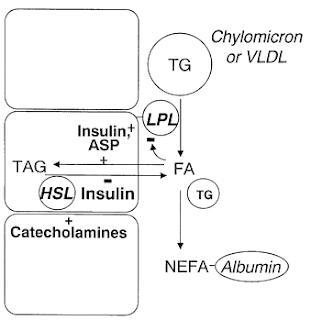
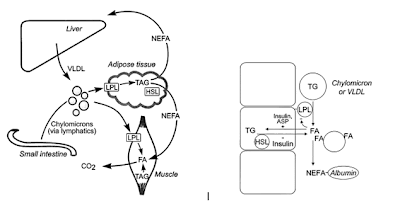
Lipases are a tricky bunch of enzymes when one is looking to the action of an enzyme to extrapolate to overall regulation of fat mass.    What do lipases do?  They are enzymes that facilitate lipolysis, which is the breaking apart of triglycerides into glycerol and three fatty acids.  We have digestive lipases that break dietary triglycerides down so that they can be absorbed, but once absorbed they are packaged again back into triglycerides for transport to cells.  These triglycerides are packaged in chylomicrons.  There are lipases both in circulation and attached to all of our different cells, called lipoprotein lipases (LPL's) that break down triglycerides to free up fatty acids.  Those associated with the cells are doing so to facilitate uptake of the fatty acids.  Here's where it gets tricky, because lipases associated with, say, muscle cells, are acting to bring fatty acids into the cell to be oxidized for energy.  But the lipases asso...

Adipose Tissue & Adipokines

Normally these days I'd put this in the library, since I'm not really going to blog on this, but I thought this paper a good one to share. Adipose tissue and adipokines: for better or worse In recent years, it has been recognized that adipose tissue (WAT) secretes a number of bioactive peptides and proteins, collectively termed “adipokines”.  These WAT-derived factors play a central role in whole body homeostasis by influencing a variety of biological and physiological processes, including food intake, regulation of energy balance, insulin action, lipid and glucose metabolism, angiogenesis and vascular remodeling, regulation of blood pressure and coagulation. The present review is focused on a restricted number of adipokines, which have been implicated in vascular (angiotensinogen, PAI-1) and energy and glucose homeostasis (ASP, TNFα, IL-6, resistin, leptin, adiponectin).  

Fat Tissue Regulation ~ Part III: C3KO Meets Obi No Leptinobi

Image
In the previous post in this series, we met the C3KO mouse, a mouse that is  ASP  deficient.  In this post, I'm going to discuss what happens when you take a leptin-deficient ob/ob mouse and also make it a C3KO.  Humor me my fun with Star Wars characters ;-) It turns out I had discovered this study and blogged on it over a year ago:   Acylation-stimulating Protein (ASP) Deficiency Induces Obesity Resistance and Increased Energy Expenditure in ob/ob Mice    ( Xia, Sniderman & Cianflone).

Fat Tissue Regulation ~ Part II: Meet C3KO

Image
I've shortened the title of this series from The Full Physiological Regulation of Fat Tissue to allow for some descriptions of each installment without generating 30 word blog post titles.  Yes, I did consider TFPRFT {cheeky grin} but thought the wiser of that one!  Allow me to introduce you to C3KO   (note my high tech graphics skills!  LOL) No, C3KO is not a character in Star Wars Episode MMXI*:  Battle for the Adiposity Galaxy .  Rather, there is a protein known as Complement 3, C3 for short.  The complement system is an important one in the functioning of our immune systems and has long been recognized for mediating inflammation .  In studying the role of this protein in physiology, researchers created a C3 knockout mouse -- one that does not produce C3.  This mouse is sometimes called C3KO**   

The Full Physiological Regulation of Fat Tissue ~ Part I of ?

Image
Look it's late 2011 we have a disorder of excess fat accumulation, and low carb shills are saying that the physiological regulation of fat tissue by hormones secreted by the fat itself is irrelevant.   ~CarbSane channeling her favorite science fiction journalist/author In this series of who-knows-how-many posts, I'm going discuss the full physiological regulation of fat tissue.   This was prompted by the response of the original LC Internet Kindergarten Cop to  CICO vs. Regulation of Fat Tissue ~ Questions for Gary Taubes .  In that post I posed the following question:    How can any hypothesis on the regulation of  fat accumulation not include ASP and leptin?   Indeed Taubes himself acknowledges the plethora of hormones in WWGF.  Note:  It's very easy to imagine how they can be so disturbed so that too much fat gets in and not enough gets out. {click to enlarge} 

CICO vs. Regulation of Fat Tissue ~ Questions for Gary Taubes

Image
In an interview with Andreas Eenfeldt  (some time in 2010, uploaded by Eenfeldt 3/15/11), Gary Taubes makes the following statement (~3 minute mark is a good place to start): Look it's 2010 we have a disorder of excess fat accumulation, and people are saying that the actual physiological regulation of fat tissue is irrelevant.  One point Stephan made in his retracted response to Gary's recent blog post needs to be addressed.  So I'll  do so here.   Folks have been letting Taubes get away with this for a very long time, and that is his indiscriminate use of the word "regulation".   The core principal of TWICHOO  (Taubes Wrong Insulin-Carbohydrate Hypotheses of Obesity)   is that insulin is the primary regulator of fat tissue metabolism, and thus fat mass.  He's actually ratcheted that up a notch so that in his view insulin acts as virtually the sole regulator.   I'm going to use a computerized multi-fuel furnace with a fuel tank system ...

Glucose and NEFA: From Dysfunctional Metabolism to Toxicity

Image
This post started out as a comment in response to Paul Jaminet's mention of a post on this blog in his Around the Web   post yesterday.  It got rather long so I decided to move it here.  In the interest of more rapid publication, I'm not going to be doing a whole lot of referencing in my discussion here, but if you're interested in a particular statement please indicate so in the comments section and I'll try to track down the reference(s) I have in mind.  Paul writes: Every once in a while someone writes to ask me if they should fear a high-fat diet because of CarbSane’s writings on lipotoxicity. I reply that lipotoxicity only appears after metabolic syndrome has developed and, while it may drive the transition from obesity to diabetes, it is not a cause of obesity, and not a danger to people who don’t have metabolic syndrome. Also, the implications for diet are not obvious, since carb intake suppresses NEFA clearance from the blood and enhances glucotoxicity. The l...

Adipose tissue as a buffer for daily lipid flux ~ Keith Frayn 2002

Image
Adipose tissue as a buffer for daily lipid flux Insulin resistance occurs in obesity and Type II (noninsulin-dependent) diabetes mellitus, but it is also a prominent feature of lipodystrophy. Adipose tissue could play a crucial part in buffering the flux of fatty acids in the circulation in the postprandial period, analogous to the roles of the liver and skeletal muscle in buffering postprandial glucose fluxes. Adipose tissue provides its buffering action by suppressing the release of non-esterified fatty acids into the circulation and by increasing triacylglycerol clearance. In particular, the pathway of ‘fatty acid trapping’ (adipocyte uptake of fatty acids liberated from plasma triacylglycerol by lipoprotein lipase) could play a key part in the buffering process. If this buffering action is impaired, then extra-adipose tissues are exposed to excessive fluxes of lipid fuels and could accumulate these in the form of triacylglycerol, l...

Insulin Wars IV.2a: The Discussion with Todd Becker/Getting Stronger continues

Image
If you haven't read the discussion thus far, or just to recap, here are the links: Insulin Wars IV: Todd Becker of Getting Stronger blog Insulin Wars IV.1: Todd Becker of Getting Stronger blog responds More Todd Becker (Getting Stronger blog) on Insulin  (this last one links to his piece on his blog) {Todd quoted the relevant prior exchanges in his email, so most can probably follow along just with this post} I've been putting off posting this for too long, mostly because in its entirety it is very lengthy (15 pages!) and I haven't had the length of uninterrupted time to devote to a thorough point by point response to the entire email.  So I decided to break this installment (IV.2) up into parts (a,b..., however many) so we can keep this discussion alive and continuing.  I'm also likely to address some topics out of order from Todd's email response.   Eventually it will all get up here :-)  I very much appreciate all the hard work Todd put into his response...

Non-esterified fatty acid metabolism and postprandial lipaemia

Image
Non-esterified fatty acid metabolism and postprandial lipaemia Yet another gem from ... who else? ... Keith Frayn! Non-esterified fatty acids (NEFA, or free fatty acids) are an important metabolic fuel. Both the concentration of NEFA and their flux through the circulation vary widely from hour to hour, reflecting nutritional state and physical activity. Inappropriately elevated plasma NEFA concentrations may have a number of adverse effects on both carbohydrate and lipid metabolism. As my regular readers know well, this is a focus of my research. These adverse effects are likely to be most marked in the postprandial period, when NEFA release from adipose tissue is usually suppressed. Although the regulation of NEFA release in the postabsorptive state is well understood in molecular terms, the predominant pathway for release of NEFA in the postprandial state is the action of lipoprotein lipase (LPL) in adipose tissue capillaries on chylomicron-triacylglycerol...

Insulin Wars IV.1: Todd Becker of Getting Stronger blog responds

Image
I received an email from Todd Becker of Getting Stronger blog who tried to add his comments/responses to my review of his contribution on Jimmy's blog regarding James Kreiger's Insulin Series. Here is a link to that installment:   Insulin Wars IV: Todd Becker of Getting Stronger blog I did my best to retain the emphasis/formatting from Todd's email.  So, with apologies in advance if any of my responses are repetitious of my initial post, without further adieu: Todd writes: Hi CarbSane, Congratulations on your articulate, informative and passionate podcast interview on Jimmy Moore’s site. Small world: I’ll be a guest on his podcast in a few weeks. Your interview inspired me to look at your blog, where lo and behold I found your critical review of my analysis of James Krieger’s views about insulin, which I wrote for Jimmy’s blog. I appreciate the time and thought that went into your analysis, and I’ve learned several interesting things from your site. But if you would...

The ASP pathway and regulation of postprandial metabolism ~ Part I

The acylation-stimulating protein pathway and regulation of postprandial metabolism By regulating the rate of adipocyte triacylglycerol synthesis, the acylation-stimulating protein (ASP) pathway plays a critical role in postprandial triacylglycerol clearance (Baldo et al. 1993) I came across this one following the trail of, who else?, Keith Frayn.  Thank you Gary Taubes for inadvertently introducing me to this fountain of truth of the science of fat metabolism.  I was going to make this the lastest install in Frayn v. Taubes series, but I think that does an injustice to Frayn, not to mention Allan Sniderman, Katherine Cianflone, Lucinda Summers, and Barbara Fielding (the first four authors of this article). I'll do my best at a bullet point summary of the research cited in this review and the conclusions of the authors.  Indented italics will be direct quotes from the article.  Note:  triacylglycerol = triglyceride

Insulin Wars IV: Todd Becker of Getting Stronger blog

Image
Okey Dokey, I made a big boo boo and edited the original of this post to create another post in this series by changing the title.  Result?  The original disappeared.  Won't be doing that again!  Live and learn some more :-)  Anyway, luckily I had the post open in another browser window so I didn't lose it.  Phew!!  C&P'd the existing comments too.  Hope I didn't lose any!  Sorry if I did :-( Friday, December 17, 2010 Insulin Wars IV: Todd Becker of Getting Stronger blog I thought I would share some thoughts on some of the responses of LC "experts" to James Krieger's excellent series on insulin.  For any who missed them, here are the links    “Insulin…an Undeserved Bad Reputation” ,   Part 2 , Part 3 ,   Part 4 ,  Part 5 . Jimmy Moore asked an array of people in LC circles for their thoughts  HERE The subject of this installment is Todd Becker of Getting Stronger blog.

Insulin Wars III: Valerie Berkowitz (formerly of Atkins Center)

I thought I would share some thoughts on some of the responses of LC "experts" to James Krieger's excellent series on insulin.  For any who missed them, here are the links    “Insulin…an Undeserved Bad Reputation” ,   Part 2 , Part 3 ,   Part 4 ,  Part 5 . Jimmy Moore asked an array of people in LC circles for their thoughts  HERE I'm just going to address one quotation:   It’s true that the body can store fat even when it has low insulin levels when excess calories from a high carbohydrate low fat diet are stored as fat even if insulin levels are not high. Upwards of 85% of excess carbs turns to triglycerides or fat. The body is less likely to store fat if it is primarily burning fat for fuel. This perpetuation of the myth that it is excess carbohydrate calories that are converted to fat has got to stop!