Posts

Showing posts with the label David Ludwig

What's the Problem with Nutrition Research? Is it True Health Iniative or NutriRECS?
Image
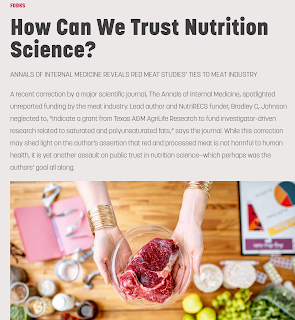
Hello World .. and anyone still reading this blog!! Yes, it's been forever.  I've been generally pretty well.  Knocking about on social media (Facebook and some Twitter) ... occasionally getting the urge to blog, write something, get to 80% then lose the mojo.   What has turned into a long hiatus wasn't planned, but it happened due to running out of steam and still seeing the same old, same old.  I may or may not discuss more at some point, but if I don't just jump back in and blog, I probably never will again! And so, with that said ... 𐩘𐩘𐩘𐩘𐩘𐩘𐩘𐩘𐩘𐩘𐩘 The following editorial in JAMA has been making the rounds on my Facebook feed, and I have a bit of a different take and reaction to it ... one that comes from roughly a decade now of delving into dietary recommendations wars from where I "stand". The Editorial:   Backlash Over Meat Dietary Recommendations Raises Questions About Corporate Ties to Nutrition Scienti...

The $12M NuSI/Ludwig Study ~ Part V: Intake, REE and TEE Measures

Image
S ummary: Continuing on with discussion of:   Effects of a low carbohydrate diet on energy expenditure during weight loss maintenance: randomized trial Previous posts in this series: Part I: Critique of the Study Design Part II: $12 Million for 12% Weight Loss? Part III: Some "Early" Lessons Part IV: Insulin Resistance Does Not Hamper Weight Loss This post should perhaps have come first, but it has taken a while to look deeply at the data for the primary outcome -- total energy expenditure measured by doubly labeled water -- and related outcomes of intake and resting energy expenditure. In this study, all participants were paid to participate, AND provided free food for ~8 months.  Said food was professionally and meticulously prepped, weighed, measured, individualized to provide each subject with some pretty exact caloric level and macronutrient composition.  The test phase (in other words, the study proper) involved maintaining a consiste...

The $12M NuSI/Ludwig Study ~ Part IV: Insulin Resistance Does Not Hamper Weight Loss

Image
       C ontinuing on with discussion of: Effects of a low carbohydrate diet on energy expenditure during weight loss maintenance: randomized trial No summary for this post.  Here are links to earlier parts in this series: Part I: Critique of the Study Design Part II: $12 Million for 12% Weight Loss? Part III: Some "Early" Lessons :   In this most recent post, I discussed the relationship between measures of insulin (both fasting and 30 minute OGTT response) and weight loss during the Run-In Phase.  

The $12M NuSI/Ludwig Study ~ Part III: Some "Early" Lessons

Image
S UMMARY Continuing on with discussion of: Effects of a low carbohydrate diet on energy expenditure during weight loss maintenance: randomized trial In Part I , I discussed some issues with methodology, mostly focusing on the reduced Run-In Phase that likely compromised the outcomes irreparably. In Part II ,  I highlighted a serious issue with the Run-In Phase, the purpose of which was to produce a somewhat homogeneous "reduced weight state" to test various diets in maintenance of that state. Ultimately,  randomization to the various test diets occurred after weight loss (PWL) all subjects lost weight on the same 45% Carb / 30% Fat / 25% Protein diet targeting a weight loss of 12% ± 2% initial body weight. The researchers do not appear to have made many adjustments in the weight loss phase to produce a more uniform weight loss.   Rather than 12% ± 2%  (from 10% to 14%)  losses, the actual outcome was roughly 10.5% ± 5% (actual ...

The $12M NuSI/ Ludwig Study ~ Part II: $12 Million for 12% Weight Loss?

Image
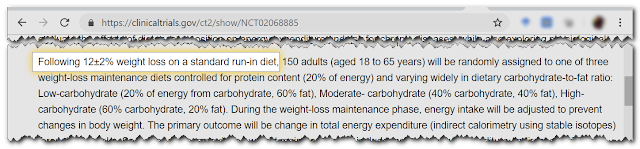
U PDATE:   12/17/2018      Original Posting: 12/3/2018    During the writing of a new installment in this se ries, I revisited the following paper: A randomized study of dietary composition during weight-loss maintenance: Rationale, study design, intervention, and assessment Yes, folks, so full of themselves were these researchers, that they felt the need to write an entire paper (submitted approx. one year in advance of the "real study") outlining their amazing study. Regarding this post, focusing on the OUTRIGHT FAILURE TO IMPLEMENT THEIR STUDY DESIGN AS STATED , I stress the following from the previous paper. ONCE AGAIN, the stated goal of the weight loss run in is 12% ... not 10 or 5 or 15 or whatever ... 12%.  I'm just going to quote the relevant part here (cleaned of references, etc. and formatted for readability, all emphasis mine) Energy intake was restricted to 60% of estimated needs to achieve a target weight loss equ...

The $12M NuSI/Ludwig Study: Part I: Critique of the Study Design

Image
S UMMARY The results of the $12 Million Dollar NuSI-sponsored study, headed up by Dr. David S. Ludwig, are finally out.   Effects of a low carbohydrate diet on energy expenditure during weight loss maintenance: randomized trial While the good doctor is making the rounds touting them as evidence in support of the Carb-Insulin Hypothesis (TWICHOO in these parts), a review of the raw data made available to the public casts grave doubts on his victory lap.  This study built upon the "promising" results of the 2012 study:   Effects of Dietary Composition on Energy Expenditure During Weight-Loss Maintenance    This post focuses on comparisons of Study Design between these two studies, some improvements, and the ultimate failure that renders the primary outcome data suspect, if not outright useless.  (And I don't say that lightly!) Improvements: Study size Length of time on one test diet (20 weeks) vs. 4 weeks crossover on each...

Thoughts on Obesity as "Disease" or Choice ~ Part 1: Smoking & Lung Cancer Analogy

Image
R ecently (May 2018) comments about obesity at a Pediatric conference have made the rounds. Specifically: Obesity Is a Disease, Not a Choice, Experts Advise .  Here is link to the full text in   "print version" . The AMA classified Obesity as a disease in 2013. Five years later we've made little to no progress, likely because we've got "experts" pontificating and arguing over semantics and false dichotomies.  The false dichotomy of Disease vs. Choice is right out of whatever master playbook teaches that if you keep the "masses" arguing, they might not notice you're full of it.  It's really the only explanation I can think of for the circular arguments made with nary a tinge of irony on board straight faces. I have a bunch of stuff in the draft pile here on this topic, but cannot seem to organize it. I decided to start a series.  In no particular order.    This installment deals with the following statement from the 2013 R...

The Manhattan Project of Nutrition That Wasn't

Image
W ith publication of the results of the second of the "Original 3" NuSI funded studies, I'm finally getting around to publishing up this post (and perhaps a second one shortly) regarding the Nutrition Science Initiative (NuSI), founded in 2012 by Peter Attia, MD and "science journalist" Gary Taubes. Bottom line ... for NuSI, it was "all over but the crying" a couple of years ago now. 

Maybe the Solution Lies in Making the Food Industry Our Friends

Image
I n our current times of rising obesity and chronic disease rates in the developed world (and spreading globally), I see a handful of "usual suspects" upon which the phenomenon is blamed: The food industries Governments and guidelines The entertainment industries  The general health and beauty industries The diet and fitness industries  By far and away, in no particular order, the two at the top of the list shoulder most of the blame.  You know the story by now.  Ancel Keys .... McGovern Committee ... Low fat dietary guidelines ... we got fat because CARBS and INSULIN!!!

Insulin Treatment in Diabetes ~ Why Does It Often Cause Weight Gain?

S ummary: Diabetes, whether Type 1 or Type 2, is a dysfunctional, wasteful metabolic state.  As a result, an uncontrolled diabetic either uses or loses more energy than their non-diabetic selves would otherwise use.  As such, the untreated diabetic is essentially "underweight" compared with the body weight that the same energy intake would produce were they not diabetic. There are differences in endogenous insulin production between the two types of diabetes.  In Type 1, there is effectively no insulin production.  In Type 2, there is usually elevated basal insulin production, but a relative deficiency in acute insulin secretion, specifically an impaired early insulin response to glucose (GSIS).  The absolute or relative insulin deficiency results in the following to a greater or lesser degree: Excessive lipolysis resulting in an increased cycling of the Triglyceride/Fatty Acid cycle.   Impaired suppression of glucose production in t...

If Fat Doesn't Make You Fat, Explain Tokelau vs. Pukapuka

Image
In light of the recent brash of coconut oil articles following the Dietary Fats and Cardiovascular Disease: A Presidential Advisory From the American Heart Association , I thought I'd bump this post.  Of course all the coconut oil advocates are up in arms over this.  Mind you, coconut oil is the most nutritionally bereft oil out there ... "empty calories".  This post discusses a study in the Sixties on two Atoll island populations that live in virtually the same environment, etc. but with nearly opposite diets in terms of total fat content, where the majority of fat comes not from coconut oil, but the more nutrient dense coconut meat and embryos. One Line Summary :   The increased fat content in the Tokelauan diet correlates in increased adiposity in this population as compared to nearby Pukapuka.   While the cited study abstract says the following: Vascular disease is uncommon in both populations and there is no evidence of the high saturated fat i...

The Top Five Worst People in Nutrition/Obesity Research & Treatment

5.  Dr. Mark Hyman -- Because of his pop culture appeal coupled with the gravitas of "Cleaveland Clinic".   This man will stop at no mangling of the facts for personal enrichment. 4.  Gary Taubes -- Despite his own funded study (and countless before that), he continues to cling to his deliberately misrepresented hodge podge of facts supporting TWICHOO.  Still given legitimate ink in the press.  Sigh. 3.  Dr. Arya Sharma -- Big on the Canadian and international obesity stages.  Torch-carrier for obesity as an incurable disease that needs to be managed medically through useless pharmaceuticals.  Wears that darned red sweater too much (grin). 2.  Dr. Dariush Mozaffarian -- Heads up Tufts' nutrition research, big into sustainability and other things, huge pusher of veggie oils as "healthy fats", seemingly funded by anyone and everyone at some time that explains some of his more absurd commentary.  This high on the list as he is...

Thirty Years of Glycemic Index Dogma, and The American GI Man

Image
Sixteen post bumps for 2016 ... No. 3 I think this post from around a year ago, in light of the new book by David Ludwig is a necessary bump. It's not every diet guru that is a principal investigator on a "groundbreaking" study that directly debunks the thesis of their book.  In this regard, Ludwig is, if not one of a kind, the leader of the pack. Originally published on January 19, 2015 The former British colonies/territories may be known for a lot of things, but in the nutrition world, I'm going to go out on a limb here and state that the Glycemic Index - GI - is the trifecta. In Canada, David Jenkins pioneered the concept, for applications in diabetes treatment.  This cause was picked up and concurrently championed in Australia by Janette (Jenny) Brand-Miller.  A little late to the party, in one of the original Thirteen, David Ludwig took up the cause in the USofA.  Are these the men and woman who made us fat? Adapted from Adele Hite's Eat...

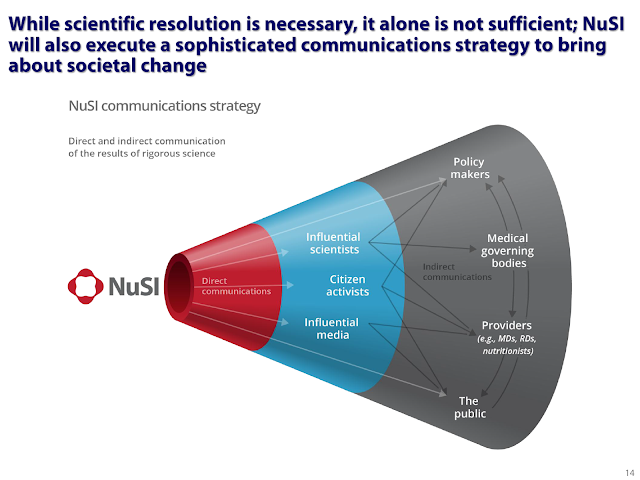
Revisiting NuSI, Its Funding by The Laura and John Arnold Foundation, and Its Mission

Image

Calories ... and Taubes, NuSI, Ludwig & Co.

Image
Bump! Over on Twitter I was made aware that Dr. David Ludwig is coming out with a new book in January (HT Steven Snyder @NoGimmicksNutri) mentioned in this Time piece:   You Asked: Should I Count Calories?    The book is to be called Always Hungry   (affiliate link if you're going to buy it anyway!)   This is a similar title to the NYT editorial Ludwig co-wrote with NuSI's VP of Research last year, discussed in this post.  I also have a friend who attended an obesity conference recently at which Ludwig presented much of the same ideas.  It is repackaged TWICHOO (Taubes Wrong Insulin-Carbohydrate Hypothesis Of Obesity) , and what is most galling about all of this is that much of Ludwig's own research counters this ... Yet he perpetuates it?  From the article:

Let's Do Away With The Dietary Guidelines

Image
Blogstress Note:  This post has been in the draft bin for some time, most of it written very shortly after the JAMA article that sparked it.  As you'll see, it's more ranty than usual ;-)   I thought about toning it down or adding to it from the NYT editorial, but have just gotten too busy.  So I'm publishing it up -- as is -- before it exceeds its best-if-blogged-by date by too much!  There's probably some repetition with the Percentages post published up in the interim.  Please forgive typos, dropped sentences, incomplete thoughts, etc.  Dunno how many there may be, so here goes ... Let's Do Away With The Dietary Guidelines   The true cause of the obesity epidemic! ... if this is what it takes to save me from being bombarded with one more idiotic editorial in a peer review journal -- like the recent one in JAMA by Dariush Mozaffarian MD,DrPH and David S. Ludwig MD,PhD -- I'm jumping on board.  Oh!!  And this rank stupi...

Percentages are Often Meaningless II

Image
image link Percentages are Often Meaningless    Summary: You can reduce the percentage of one item by increasing the total amount of all items.  This can give the illusion that you've reduced the amount of the item in question, but is just that ... an illusion. That previous post on this was inspired by yet another round of Fun with Numbers, this time courtesy of David Ludwig and Dariush Mozaffarian in JAMA ... and now the NYT    (I'm beginning to see a pattern here.  NYT is the publicity outlet for all JAMA editorial nonsense, much like Time is the outlet for BMJ's Open Season on Science Heart journal.)

The Circulating "Food" Supply and The Failed Internal Starvation Hypothesis

Image
There are several recurring themes, mostly from low carb advocates of the "fat burning is best" bent, that keep ... well ... recurring!  Perhaps foremost among these is this concept of "internal starvation".  From Gary Taubes in Good Calories, Bad Calories :   "F or the past century, the conspicuous alternative to the positive-caloric-balance hypothesis has always been, as Pennington, Astwood, and Hilde Bruch suggested, that obesity is caused by a defect in the regulation of fat metabolism. At the risk of repetition, it is important to say this is, by definition, a disorder of fat accumulation, not a disorder of overeating. For whatever reason , the release of fat or its combustion is impeded, or the deposition or synthesis of fat is promoted, as Astwood said, and the result is obesity. That in turn will cause a deficit of calories elsewhere in the body— Astwood’s “internal starvation”— and thus a compensatory hunger and sedentary behavior.

The Mechanisms of the Glycemic Index: A Fatty Acid Roller Coaster?

Image
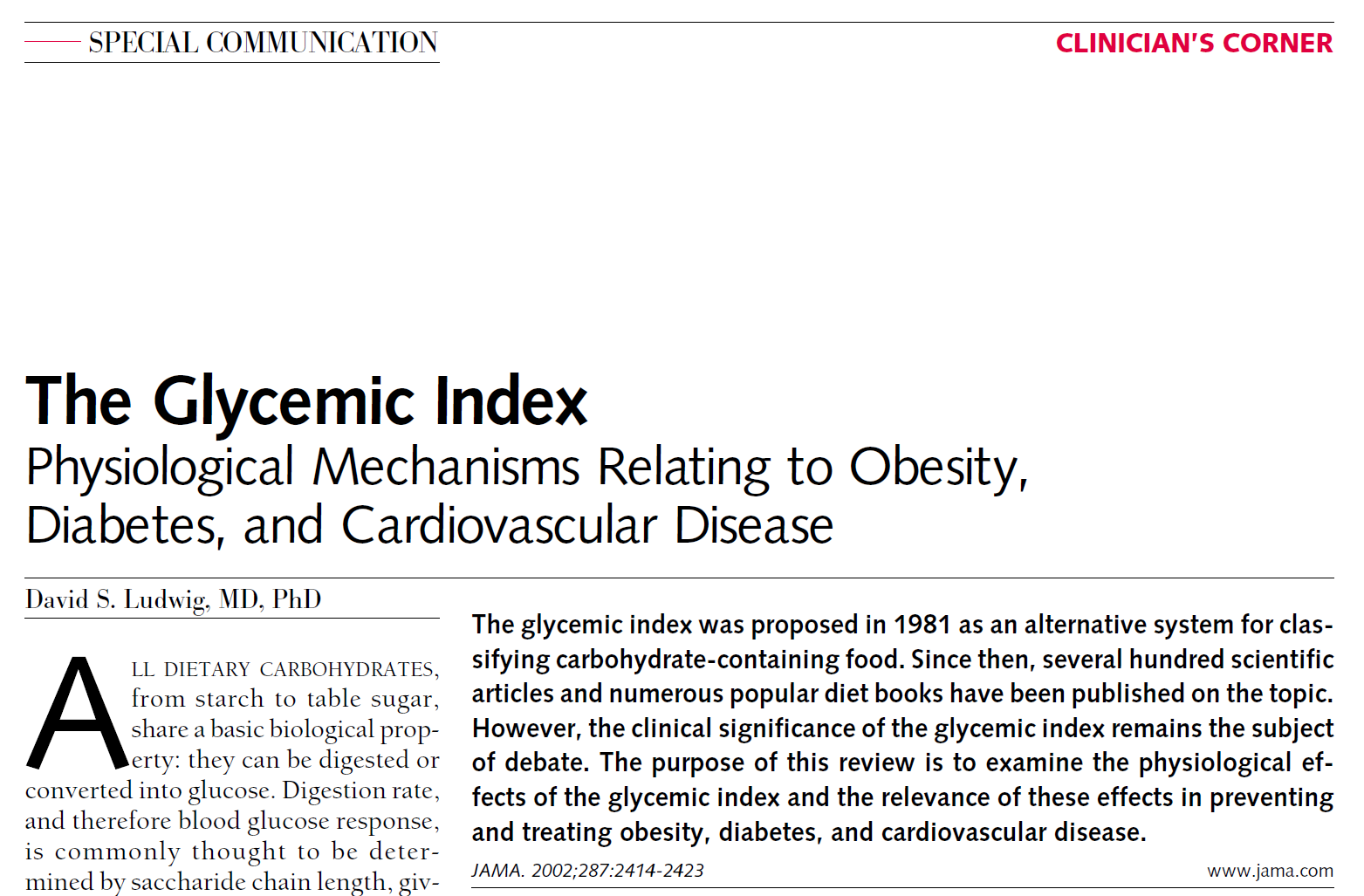
This post will focus on some statements made by a researcher who I've dubbed "America's GI Man", Dr. David Ludwig, in this review: The Glycemic Index: Physiological Mechanisms Relating to Obesity, Diabetes and Cardiovascular Disease , JAMA , 2002. A Note Regarding Definitive Statements in Review Papers As I found myself getting sucked down the Pubmed rabbit hole that is the GI, it was really this paper that took me past that point of no return.  I have taken a screenshot of the top of the PDF format of the article to convey a few things, and at this point I'm beginning to understand how it is that doctors can get sucked into bad paradigms when their "prestigious journals" put out "SPECIAL COMMUNICATION"s from their "CLINICIAN'S CORNER"

A Matter of Control

Image
In advance of my next installment of Nina Tei¢holz, Shai'ster, wherein I will discuss her claims that the Shai/DIRECT study was "rigorously controlled", I thought I'd give this post a bump. Original publish date Dec. 10, 2011 Control. It seems to me that many people misinterpret -- at least in their minds -- the meaning of this word when it is used in the scientific context.   While most of those no doubt understand the concept, after hearing the term enough, it just seems it comes to mean something else to them after a while.  I submit as evidence, statements made by two popular bloggers.   First up, J. Stanton at gnolls.org with  How “Heart-Healthy Whole Grains” Make Us Fat .  Wait!!  Did you click that link already?  I forgot to caution you that the post you are about to read contains science, so you might want to proceed with caution.  < / sarcasm > .  Anyway, the study he discusses in that post is:   High G...