Posts

Showing posts with the label Subcutaneous Fat (SCAT)

Fatty Acid Trafficking

This post discusses:   Downregulation of Adipose Tissue Fatty Acid Trafficking in Obesity, A Driver for Ectopic Fat Deposition? Fats are continually being cycled in and out of our fat cells.  In the obese, circulating free fatty acids (or non-esterified fatty acids), NEFA, are often elevated.  These are often accompanied by deposition of fat in non-adipose tissues, aka ectopic fat deposition.  This ectopic fat is implicated in various impairments of cell function and even cell death (apoptosis) that result in insulin resistance, beta-cell dysfunction, etc.  This is often referred to as lipotoxicity.   This study sought to determine if this lipotoxicity is due to excessive release of NEFA from adipose tissue or from impaired trapping by adipose tissue of the NEFA released from dietary fat.  This work is from Keith Frayn's group.  It might be worthwhile to read my blog post on  Frayn's paper on adipose tissue as lipid buffer. ...

Adipose Tissue Characteristics in Obese Teens & Insulin Resistance

Cellularity and Adipogenic Profile of the Abdominal Subcutaneous Adipose Tissue From Obese Adolescents: Association With Insulin Resistance and Hepatic Steatosis Yes ... I'm going to be on a bit of a bookmarking post spree here :-) This study looked at fat cell size and proliferation in obese teens and compared this to IR and fatty liver.  This study seems to be consistent with the whole "critical threshold" or "normal fat capacity" theories on why some obese are relatively "metabolically healthy" while others are not.  I've not, however, had a chance to read thoroughly. Conclusions:  A reduced lipo-/adipogenic capacity, fraction, and estimated number of large subcutaneous adipocytes may contribute to the abnormal distribution of abdominal fat and hepatic steatosis, as well as to insulin resistance in obese adolescents. Thinking out loud:  It seems more and more to me these days that abdominal fat - visceral in particular - is our short term bu...

Subcutaneous and Visceral Adipose Tissue: Their Relation to the Metabolic Syndrome

Subcutaneous and Visceral Adipose Tissue: Their Relation to the Metabolic Syndrome Another bookmarking post of sorts. One interesting statement: ... in a review of 23 published studies of intervention strategies   to promote loss of visceral adipose tissue... ( 32 ) concluded that   individuals with greater visceral fat mass, either through an increase   in body weight or the propensity to store fat in the visceral depot,   lose more visceral fat when adjusted to the loss of body fat, regardless   of the intervention applied (caloric restriction, pharmacological   therapy, or exercise) because the visceral adipocyte has a higher   lipolytic rate also in the steady state.  For me, this makes my body fat distribution change all the more confusing, except that it does seem I'm talking more subQ belly fat than visceral in my case. 

Elevated Free Fatty Acids: Detrimental?

As many of my readers know, I've been challenged lately on my beliefs on NEFA.  So I thought I would summarize my thinking on this in a post rather than having several comments scattered amongst a few threads.   I'm not going to be referencing my post here at this time (it's too time consuming to do so at the moment).  If/when I have the opportunity to do so in the future, I'll do a bumped update.   These are my thoughts based on extensive research of the peer review literature on this topic, in almost all cases, considered review of full text articles including reading as many supporting citations in major reviews as possible.  Over the past year I have read at least a hundred such articles. Elevated non-esterified or free fatty acids (NEFA/FFA) are a symptom associated with insulin resistance, Metabolic Syndrome (aka Syndrome X) and Type II diabetes.  The overwhelming evidence in the literature points to elevated NEFA being more than just associated wit...

Insulin, Weight Loss & Water Weight

Reader kds posted a link to this Peter of Hyperlipid's blog post about the following study:  . Beneficial Effect of Diazoxide in Obese Hyperinsulinemic Adults Basically, diazoxide is a compound that has been used to treat hypoglycemia and reduces insulin secretion.   Two groups of 12 obese hyperinsulinemic adults were treated with diazoxide or placebo for 8 weeks while each consuming the same Optifast diet.   Compared with the placebo group, DZ subjects  had greater weight loss (9.5 ± 0.69%   vs.   4.6 ±   0.61%,   P   < 0.001), greater decrease in body fat ( P   < 0.01),   greater increase in fat-free mass to body fat ratio ( P   <   0.01), and greater attenuation of acute insulin response to   glucose ( P   < 0.01).    This is pretty phenomenal and difficult to fathom -- almost twice the weight loss.  It was also reported that there was no significant change in resting energy expe...

Subdivisions of subcutaneous abdominal adipose tissue and insulin resistance

Image
Subdivisions of subcutaneous abdominal adipose tissue and insulin resistance This is a very interesting article.  They looked at not only visceral vs. subQ abdominal fat, but differentiated between two types of abdominal SCAT (subcutaneous adipose tissue):  superficial vs. deep. There is a well described fascial plane within the SAT of the abdomen (18, 28), with the superficial adipose layer possessing compact fascial septa (Camper’s fascia), whereas the deeper layer of adipose tissue has more loosely organized fascial septa (Scarpa’s fascia).  Fat lobules of the two sites also differ. The superficial layer is characterized by small tightly packed lobules, whereas those of the deeper layer are larger and distributed in an irregular manner (28). The thickness of the deep layer appears more variable among individuals and especially in relation to obesity (3). The presence of these fascial planes and differences in histol...

Visceral fat and insulin resistance – causative or correlative?

Image
Having been introduced to "the English guy" aka Keith Frayn, I've discovered a rather extensive, as well as diverse, body of work by this researcher.   I'm sure to be sharing more in the coming weeks.   Visceral fat and insulin resistance – causative or correlative?   (link is to full-text PDF) The association between abdominal fat accumulation and risk of chronic diseases, including type II diabetes and coronary heart disease, has long been recognized. Insulin resistance may be a key factor in this link. Many studies have pointed to an association between insulin resistance and intra-abdominal fat accumulation (visceral obesity). However there is no clear proof of a causal link between visceral fat accumulation and insulin resistance. In assessing the probability of a causal link, it is useful to consider potential mechanisms. One such potential causal link is the release of non-esterified fatty acids from visceral fat into the portal ...

Sat Fat --> PUFA = Less SubQ Belly Fat?

Image
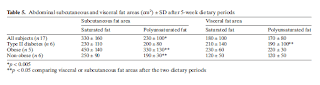
Mostly a bookmarking post, but I found this interesting Substituting dietary saturated fat with polyunsaturated fat changes abdominal fat distribution and improves insulin sensitivity For some reason I can't C&P the abstract. They analyzed the results of 5 weeks on diets rich in sat fat vs. PUFA (described as spreads and oils, presumably high in omega 6 and probably some transfats :( ) on T2's, obese and non-obese subjects.  The study size was small, but I think most readers will be as surprised as I was by the results. All of the PUFA groups had less subcutaneous belly fat at the end of the 5 weeks. This was statistically significant in the non-diabetics, both obese and non-obese.  Visceral fat either decreased or stayed the same. This was statistically significant for the diabetics, but not the non-diabetics.   The PUFA group seemed to eat less, but total body weight didn't change.  Not sure what that's about.  Could be underreporting or a slower m...

Adiposopathy v. Obesity ~ I

I just came across the following article, and haven't quite digested the whole thing just yet.  Still, it is interesting so I thought I would share it here.  This post will be about the most curious topic in this paper, but I hope to revisit this in a series of future blog posts (hence the "I" in the title).   Adiposopathy Is a More Rational Treatment Target for Metabolic Disease than Obesity Alone Near as I can tell, the lead author, Harold Bays, is the doctor who coined the term "adiposopathy" or "sick fat".   Adiposopathy is pathologic adipose tissue dysfunction that may be initiated and/or exacerbated by fat accumulation (adiposity) in genetically susceptible patients [1••].  Adipocytes are metabolically active and adipose tissue is an important endocrine organ (Table 1) [2••]. Abnormalities of adipocyte factors contribute to dysmetabolism (Fig. 1), and adiposopathy [1••,3•] promotes some of the most...

Can low carb cause central adiposity?

This is mostly a post of a personal nature, but I thought I would put it here on the science side of things because I'll try to tie observations and anecdotes in with some scientific backing/references. Personal background for my interest in this:   As a child I had a rather boyish body until around age 12 or so.  At that age my shape (butt and thighs) started coming out (not fat though), but I was a rather late bloomer.  I didn't gain my "puberty weight" until I was 16 or so -- perhaps 20 lbs -- again mostly in my butt/thighs.  Anyone remember Tracey Gold from Growing Pains?  That would be pretty close (pre-anorexia) to my shape.  I lost the weight then yo-yo'd most of my 20's on various diet plans (none of which were low carb).  Although cycling as high as the 200-210 range and as low as 145 during that time, my general body type did not change.  I would always gain or lose weight mostly in my butt/thighs only getting the back and belly bulge...

Critical Visceral Adipose Tissue Theory

Image
I found this article almost a year ago, posted it on an LC discussion board, and was mostly greeted with silence so I had sort of forgotten about it.  In any case, I was reminded of the article while recently reading LynMarie's latest post on her blog:   Fat Fails First?   (Incidentally, that post corresponds well with my own recent offering on the topic:   The Progression of Insulin Resistance  ).   On to the subject of this post:   Role of a critical visceral adipose tissue threshold (CVATT) in metabolic syndrome: implications for controlling dietary carbohydrates: a review