Posts

Showing posts with the label Incretin

My Sump-Pump Analogy for the ß-Cell

I'm going to try to make this as short and to the point as possible.  It's just me thinking out loud a bit, drawing on the massive amount of peer review research I've read on the topic -- a mere fraction of which I've formally blogged on -- but without any references so that I can just get this out there.  No ... this is not some manifesto grand theory on diabetes and all that to be analyzed and picked apart as if I'm presenting this as fact.  It's just a plausible analogy for what I think happens when metabolic mahem turns to "diabetes".  I'm also going to simplify things and deal with only glucose and fatty acids here. Our ß-cells metabolize glucose and fatty acids the same way our other cells like muscle cells do for energy.  Essentially this metabolism is part of the mechanism by which the ß-cell senses the circulating levels of these energy substrates.  This metabolism also produces ROS -- reactive oxidative species.  While ROS are often...
Endogenous v. Exongenous Hormones

Image
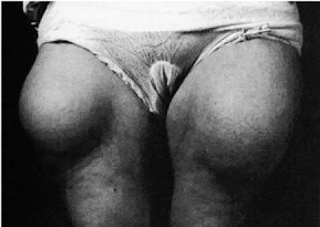
I'm going to be using insulin as my example in this post.  Endogenous insulin is the insulin produced in your body by your pancreas.  Exogenous insulin would be that derived from outside the body - e.g. insulin injections.  For the most part exogenous hormones are obtained through some "pharmaceutical" route.  In the case of insulin, subcutaneous injections. Now I’m sure most of my readers are familiar with the picture below:

Byetta (Exenatide) v. Taubes

Taubes has 10 major conclusions for GCBC, the ones relevant to this post are quoted below: 5. Obesity is a disorder of excess fat accumulation not overeating and not sedentary behavior. 6. Consuming excess calories does not cause us to grow fatter any more than it causes a child to grow taller. Expending more energy than we consume does not lead to long-term weight loss; it leads to hunger. 7. Fattening and obesity are caused by an imbalance – a disequilibrium -- in the hormonal regulation of adipose tissue and fat metabolism: Fat synthesis and storage exceeds the mobilization of fat from the adipose tissue and its subsequent oxidation. We become leaner when the hormonal regulation of the fat tissue reverses this balance. 8. Insulin is the primary regulator of fat storage. When insulin levels are elevated – either chronically or after a meal – we accumulate fat in our fat tissue. When insulin levels fall, we release fat from our fat tissue and use it for fuel. 9. By stimulating insul...