Posts

Showing posts with the label Statistics

Science ...

Image
... it's called that for a reason.   This post was prompted by the discussions in this seemingly non-monumental post -- Are the Dietary Guidelines REALLY So Radical? -- that erupted to over 750 comments. The discussion somewhat culminated in this comment , and there are a few posts forthcoming that require this "backgrounder" on thoughts . I like to blog about science.  I like to deal in science.  I consider myself a scientist in much the same way that formerly practicing MDs still consider themselves doctors.   I used to conduct primary research.  The kind that some of today's "scientists" have never even done outside of the classroom environment , if that   (I refer to the likes of Gary Taubes, Zoe Harcombe and James DiNicolantonio to name a few) .  I studied science (a few disciplines, and some engineering too), and I had a career in scientific research (again a few differing fields and applications).  I "can't help myself" ...

SysteMeta-Antics in the Paleo Systematic Review & Meta-Analysis

Image
This was intended to be a targeted post on one specific issue pertaining to the recent AJCN study and the actions of some of the study authors involved.   Not sure I succeeded ;-) When I wrote my first post on the topic , I had not read the full text of the study.  Instead I compiled a table of characteristics for the four individual studies involved, and concluded that no meta-analysis was appropriate for such disparate studies.  That initial "analysis" holds despite the table containing a few errors. After being called "unscientific" by author Esther van Zuuren on Twitter, I obtained a copy of the full text and read it.   Additional information contained in the full text makes matters worse, not better, on virtually every point I made in my original post .  So I am working on a letter to the AJCN and in doing so am working on an expanded and more accurate version of the summary table.  During this process I sought to check values published in the or...

Manheim Steamed-over Paleo: The Shai'ning of Mellberg

Image
The controversy should serve as a warning about meta-analyses, Willett adds. Such studies compile the data from many individual studies to get a clearer result. "It looks like a sweeping summary of all the data, so it gets a lot of attention," Willett says. "But these days meta-analyses are often done by people who are not familiar with a field, who don't have the primary data or don't make the effort to get it. " And while drug trials are often very similar in design, making it easy to combine their results, nutritional studies vary widely in the way they are set up. "Often the strengths and weaknesses of individual studies get lost"   "It's dangerous." Walter Willett MD Speaking about Chowdhury, et.al. (HT: Colby Vorland of NutSci.org ) Yes.  This.  

What Non-Scientists Do When You Criticize Their "Science" -- A Meta-Analysis

Image
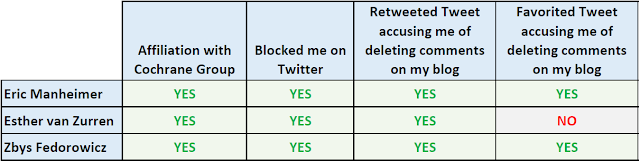
I have conducted a systematic search on my Twitter notifications for all people who have retweeted a tweet in which my ID has been mentioned.  I then narrowed it down to tweets in which inaccurate claims were made about me and furthermore to whether the retweeter had subsequently blocked me. @zbysfedo O dear. I saw CS deleted all your comments from her blog. Expected a lot, but not that. @CarbSane @Ezzoef — Melchior Meijer (@PolderPaleo) August 22, 2015 I'd draw you all a funky flow chart, but it's not really worth my time.  I did, however construct this nice table. Conclusion:  Inability to answer to criticisms based on the merits of their study.

That Paleo Meta Analysis

Image
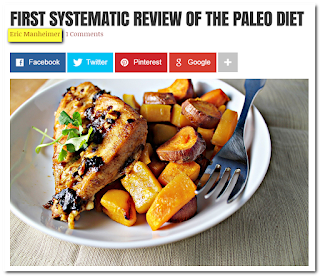
Screenshot of Meta-analysis lead author Eric Manheimer's article on Cordain's ThePaleoDiet commercial website. Is it that time already?  For systematic review and meta-analysis?  Apparently someone thinks so and managed to get some time at or off of work to do one on the paleo diet.  Seriously?  What even is the paleo diet?  I have asked that question many times here myself.  If a premier expert in paleolithic nutrition cannot provide an answer, then who can? I've also written on this many times.  I believe that THIS POST   is a great place to start as it contains links to the various studies and blog posts I've done on those studies.  I'll repeat some links here in a bit. These were the clinical trials (not all randomized-controlled) to date as of January 2014.   I've included the purported composition of "paleo diets" as well. Direct links to blog posts:   Frassetto , Lindeberg & J ö n...

Percentages are Often Meaningless II

Image
image link Percentages are Often Meaningless    Summary: You can reduce the percentage of one item by increasing the total amount of all items.  This can give the illusion that you've reduced the amount of the item in question, but is just that ... an illusion. That previous post on this was inspired by yet another round of Fun with Numbers, this time courtesy of David Ludwig and Dariush Mozaffarian in JAMA ... and now the NYT    (I'm beginning to see a pattern here.  NYT is the publicity outlet for all JAMA editorial nonsense, much like Time is the outlet for BMJ's Open Season on Science Heart journal.)

Zoe Harcombe and Adele Hite's Hyper-System(at)ic Meta-Statistical Bovine Fecalemia

Image
Alternate Title:  Baffling with Bull $#!† This post discusses two "research articles" recently published in peer review journals, and how their use of statistical terminology: imparts undue scientific seriousness to the content of the paper obscures the fact that there is nothing new in the paper to make it even worthy of publication, and allows the authors to assign scientific significance to editorial opinions that are at best not supported by the statistical analysis in question, at worst directly contradicted by it. These two "studies" both boil down to exploiting statistical jargon and methodology to further an agenda.  It's a darned shame the quality of the peer-review process has declined so precipitously in recent times as to allow such obvious examples to get through.  

Science Made Simple ~ Of Causation & Correlation

Summary: If A and B are significantly correlated, then: A  MAY  cause B, or B  MAY  cause A, or Any number of other factors could correlate with A and B such that these two variables "track" together. If A and B are not correlated, then it is exceedingly improbable that any of the above are true.    Shorter Summary: Correlation does not equal causation, but without correlation, there's no causation.

Some comments on the Bazzano "LC" vs "LF" Study

Image
So as the weighing in continues regarding:   Effects of Low-Carbohydrate and Low-Fat Diets  (full text) I thought I'd add a little bit to the mix.   First, I do believe the low carb advocates hailing this as any sort of endorsement for their high saturated fat, high animal fat, eat a ton of food, ketogenic or paleo diets need to all watch this entire video  of Lydia Bazzano discussing the diet:

Shananigans ~ How Not to Respond to Being Caught Faking Something

Image
So ooooooooo ..... I wrote a post a couple days ago calling out Dr. Cate Shanahan for her blatant misrepresentation of Ancel Keys and his part in the advocacy of a low fat diet.  One could write volumes on the problems with Shanahan's " science "  and ideas, but hopefully this overnight guru phenomenon -- because some minor celebrity shill kingmaker deems them so -- is on the outs.  One can only hope.   The first image included in that post was this one below. Figure in Deep Nutrition

Nina Tei¢holz, Shai'ster ~ Part IV: Random Smoke and Mirrors

Image
Shyster [ shīs-tər ]:   A person, especially a lawyer, who uses unscrupulous, fraudulent, or deceptive methods in business. Shai'ster [ shī-stər ]:   A person, especially a science journalist, who is unscrupulous, fraudulent or deceptive in their representation of the Shai clinical trial. Part I:  The Diets of Shai et.al. and Extrapolating from Weight Loss Studies Part II: Applicability of RCTs to the General Population Part III:  Well Implemented Clinical Trials Related posts:   A Matter of Control ,  Control in Clinical Trials DISCLAIMER:  What follows is in no way intended to be a review or analysis of the findings of the LA Veterans Study or the role of saturated vs. polyunsaturated fat in heart disease.  The purpose of this post is solely to discuss how randomizing and controlling was conducted in two studies, as described by Teicholz in her book and interviews vs. how it really happened. To revi...

Nina Tei¢holz, Shai'ster ~ Part III: Well Implemented Clinical Trials

Image
Shyster [ shīs-tər ]:  A person, especially a lawyer, who uses unscrupulous, fraudulent, or deceptive methods in business. Shai'ster [ shī-stər ]:   A person, especially a science journalist, who is unscrupulous, fraudulent or deceptive in their representation of the Shai clinical trial. Part I:  The Diets of Shai et.al. and Extrapolating from Weight Loss Studies Part II: Applicability of RCTs to the General Population Related posts:   A Matter of Control , Control in Clinical Trials DISCLAIMER:  What follows is in no way intended to be a review or analysis of the findings of the LA Veterans Study or the role of saturated vs. polyunsaturated fat in heart disease.  The purpose of this post is solely to discuss the quality and nature of the implementation of two research studies, as described by Teicholz in her book and interviews vs. how they really were. A running theme in The Big Fat Surprise, and in practically e...

Control in Clinical Trials

Image
I am going to use diet comparison studies for examples throughout this post.  In a previous post, A Matter of Control , I discussed the concept of control in experiments compared with the general English language meaning of the word. Therefore, when using the word control it has no meaning with respect to how well implemented a particular study is with respect to compliance, completeness of data, etc. I do want to stress, however, that the "proper" usage of the term in clinical trial design can be rendered all but meaningless if the compliance cannot be properly assessed and verified.  Without this, we have GIGO = Garbage In, Garbage Out.   If you are studying the effects of a daily pill, you can have a perfect experiment, but if the subjects don't take that pill according to schedule, the outcome will always be shadowed with doubt. Before I go on, I also want to make it clear that this is in no way intended to be a detailed discussion of statistical methods, et...

A Matter of Control

Image
In advance of my next installment of Nina Tei¢holz, Shai'ster, wherein I will discuss her claims that the Shai/DIRECT study was "rigorously controlled", I thought I'd give this post a bump. Original publish date Dec. 10, 2011 Control. It seems to me that many people misinterpret -- at least in their minds -- the meaning of this word when it is used in the scientific context.   While most of those no doubt understand the concept, after hearing the term enough, it just seems it comes to mean something else to them after a while.  I submit as evidence, statements made by two popular bloggers.   First up, J. Stanton at gnolls.org with  How “Heart-Healthy Whole Grains” Make Us Fat .  Wait!!  Did you click that link already?  I forgot to caution you that the post you are about to read contains science, so you might want to proceed with caution.  < / sarcasm > .  Anyway, the study he discusses in that post is:   High G...

Lessons from Diet RCTs II: Randomizing, Blinding, and perhaps even Controlling, is Futile

Image
You hear it all the time -- the randomized controlled trial is the "gold standard" for clinical research.  Unfortunately, just because something is an RCT doesn't make it a good study, not by a long shot.  I blogged recently calling for an end to diet comparison RCTs  because I don't believe this model is productive in identifying what a healthful non-obesigenic diet is for humans.  All of the foods that have been blamed have been around for far longer than this problem has, so, frankly it really isn't the food.  There's no magical macronutrient ratio, no superfoods that will impart you with superhuman powers, and no foods that are inherently fattening or slimming ... even butter and celery, but please no buttered celery.

Twenty tips for interpreting scientific claims

It's not often I share journal articles without comment here anymore, but I just wanted to share this with my readers. Twenty tips for interpreting scientific claims   from Nature .

Exaggerations?

Image
direct image link The following comes from a slide presented by (?) at the Low Carb Down Under tour.  You can click to enlarge, but here's what the slide says under the title "What changed in the 1900s?" Sat fat down 83% Veggie oil/margarine up 535% Sugar up 1150% Now, no doubt there are changes in eating habits, and perhaps "down under" people changed their eating habits even more dramatically than we Americans have, or are purported to have.  I've blogged many times that something's "off" with any stats indicating that Americans actually consume a low fat diet, but I'm not going to address the fat claims above.  It's the sugar claim that just screams -- that can't be so?!

A Friday JAMA-lama Ding Dong!

Image
Well ... I wasn't really going to weigh in further past using that recent JAMA article  (EDIT:  full text no longer free at JAMA, see link below) as an example of where statistics can lead us astray.  But ... as is probably expected, this study has kicked up some dust in the community.  I'm sure I'll miss a few, but here's the weighing in so far: Stephan Guyenet Anthony Colpo Marion Nestle Don Matesz Fat Head That's just the blog posts, not the tweets, FB postings or other social media buzz ... and I'm happy to edit in more, just drop the hint in comments.  And here's the full text of the study:   Effects of Dietary Composition on Energy Expenditure During Weight-Loss Maintenance

A Modest Proposal for Peer Review Research

Image
With the advent of, and inexpensive nature of online sharing of information, I propose that all peer-review research should include (anonymous) raw data for each subject.  At the very least, there should be scatter plots presented for the individual data points for the main outcomes. I frequently teach statistics, and one of the first things we discuss in that class is sort of the "first purpose" of it all.  Because before we can analyze data, first we must summarize and present the data in such a way that the "consumer" can readily glean information.  In one classic stats text -- Triola -- this part is given the acronym CVDOT.  C = Center, V = Variation, D = Distribution, O = Outliers and T = Time.  So we go through the various ways we can convey the center of a data set, it's variability, distribution, etc.  In most of the studies we discuss here, data is presented as a mean value +/- either the standard deviation or standard error (C +/- V in the acrony...

Keep the Leptinade flowing! I'm going to die from my glucose anyway ...

Image
A few general thoughts on this whole "safe starches" tangent into Ron  "Everyone's a Diabetic" Rosedale's contentions.  I was prompted to look into many of the claims of Rosedale by a short conversation I had with him over at PaleoHacks that can be found scrolling down to his responses here .  When one goes and reads the Facebook links in the root post, it is clear that Rosedale's views are pretty extreme as regards blood glucose levels, diabetes, etc.  It comes down, really, to viewing all blood glucose, leading to any level of glycation, as harmful.  Basically through Rosedale-colored glasses we see circulating glucose as always harmful and to be kept minimal both in circulation and as cellular fuel as much as possible for optimal health.  He also advocates getting virtually no glucose from your diet, relying, instead on your liver for all glucose needs.   Glycation debilitates, deteriorates and ultimately kills you, and in Rosedale's opini...