Posts

Showing posts with the label Triglycerides

Where did the fat in this blood come from? ~ An Ead-iotic Analysis
Image
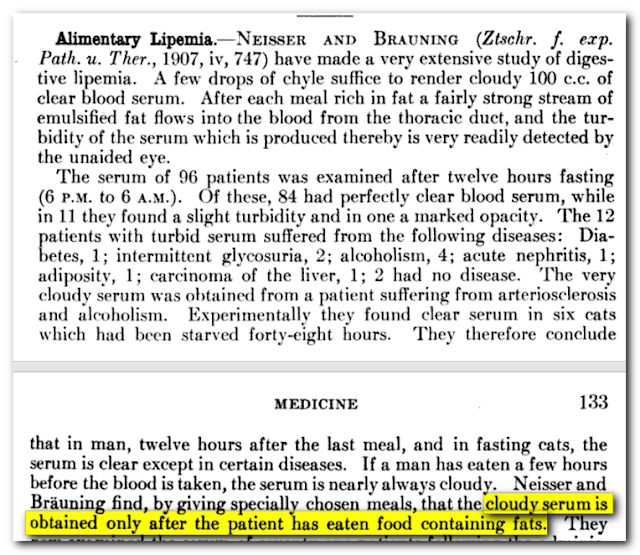
NOTE  (8/7/2018):     I've edited this post, originally written/published 5/5/2011, to omit the no longer relevant back story and broken links.  I had referred to a discussion on Jimmy Moore's now-long-defunct LLVLC Discussion Board that made me aware of the Eades' post discussed. SUMMARY:  Fat in the blood following a fatty meal is almost entirely due to the fat in the meal. ~~~~~ Several years ago, Dr. Michael Eades wrote the following post:   ABC’s big meal propaganda .  Sadly, the video is no longer available.  It involved subjects consuming a GIGANTIC meal of 6000 calories, after which blood was drawn two hours later.  This "after" blood was very cloudy, and the technician holds this up and identifies the source of the cloudiness as fat.  The meal was deep fat fried mac&cheese, a bacon cheese burger quesadilla and fries and an ice cream smothered giant cookie.  Yes, high in fat and carbs, but favoring the s...

β-Cell lipotoxicity in the pathogenesis of non-insulin-dependent diabetes mellitus of obese rats: Impairment in adipocyte-β-cell relationships

Image
BUMP NOTICE:  I'm bumping this post due to some recent discussions on social media regarding the reversibility of Type 2 Diabetes and the role of low carbohydrate diets in the growing "curing diabetes" paradigm.  Recently Dr. Roy Taylor (the investigator I most closely associate with the crash diet, though this is an extensive group) and colleagues, who implemented a "crash diet" to cure diabetes -- by reducing pancreatic and hepatic (liver) fat concurrently with rapid weight loss -- published the following in BMJ:   Beating type 2 diabetes into remission .    The criteria are non-diabetic markers for a period following reversal of the progression.  Here is where various low carbohydrate interventions "fail", as many are able to maintain normoglycemia only by avoiding carbohydrates.  The question remains if this is effectively the same as other reversals.  I contend it is not, as normal pancreatic function -- specifically GSIS -- has not ...

The Great Cholesterol Con-Artist: Malcolm Kendrick

Image
There has been a spate of studies and commentaries coming out of late related to plasma saturated fatty acid content, dietary sat fats and carbohydrates.  It gets mightly frustrating to hear the same arguments made over and over, when some basic calculations and critical radiolabel-tracer studies have shown otherwise for over 15-25 years now (and longer, I'm talking major summary papers and supporting studies).  And still .... What Happens to the Carbs Kendrick is a Scottish physician, author of The Great Cholesterol Con , hence my title.  He's also a card carrying member of  and spokesman for THINCS:  THe International Network of Cholesterol Skeptics.    Sadly, his skepticism and paranoia have turned him into quite the con artist ... feet planted firmly in denial. Professors, who shall be nameless, appear unable to admit how basic human physiology works. For example, they may concede a few steps here and there, but they will never...

That New Volek (& Phinney) Study: Part II ~ More on Journal Choice, Funding and Thoughts on Press Quotes

Image
Previously ... Part I: The Journal Article & The Headlines T here is so much about the recent study from principal low carbohydrate advocate Jeff Volek, that this may well be the subject or impetus for several posts here as we close out 2014 -- it is so much more than just the study, but more what it embodies vis a vis the whole low carb/keto schtick.  Along with Stephen Phinney and ten -- count them, TEN! -- others who claim to meet the PLOS One standards to be designated as authors, we were brought the following study: Effects of Step-Wise Increases in Dietary Carbohydrate on Circulating Saturated Fatty Acids and Palmitoleic Acid in Adults with Metabolic Syndrome In a way this tops off a year of disgraceful behavior on the parts of just about everyone in the IHC who seem hell-bent on deceiving people into adopting their extreme lifestyles. If the science were really so clear, then why can they not address it honestly? There is nothing, N.O.T.H.I.N.G. in ...

De novo Lipogenesis to Palmitoleic Acid ~ Teaspoon? Might as Well Measure with a Cup!!

Image
This is a minor side thought prompted by the recent Volek saturated fat - turns out to be monounsaturated fat - paper and comments Volek has made to the press.  The same general comments have been repeated in various outlets.  In  the study , subjects were first put on a VLC (< 50 g/day) diet (six weeks including half that of "run in") and then carbs were exchanged for fat incrementally every three weeks until the final carb levels were roughly equivalent to starting levels at around 350 g/day.  I'll definitely have something to say about the study itself, but the "major" groundbreaking result of the study was that the levels of the 16 C monounsaturated fatty acid -- that is produced by desaturating the palmitic acid product of de novo lipogenesis -- dropped with carb restriction and gradually came back up as carbs were re-introduced.   An increase in this fatty acid indicates that a growing proportion of carbohydrates is being converted into fat instea...

That New Volek (& Phinney) Study: Part I The Journal Article & The Headlines

Image
Yes folks! Yet another study has hit the presses to tell you everything you thought you knew about nutrition is wrong, wrong and more wrong!!  The Journal Article Effects of Step-Wise Increases in Dietary Carbohydrate on Circulating Saturated Fatty Acids and Palmitoleic Acid in Adults with Metabolic Syndrome Brittanie M. Volk, Laura J. Kunces, Daniel J. Freidenreich, Brian R. Kupchak, Catherine Saenz, Juan C. Artistizabal, Maria Luz Fernandez, Richard S. Bruno, Carl M. Maresh, William J. Kraemer, Stephen D. Phinney, Jeff S. Volek . Count 'em ... a dozen authors.

Where do triglycerides come from? Part I (Updated)

Image
This post contains sufficient updates from the original (dated 5/11/11) that I consider it more of a fully updated version vs. a bump.   This began with my intent to link to this post in an upcoming discussion of triglycerides, when I noticed that Dr. Ronald Krauss was amongst the authors.   This study originally caught my eye because of    Marc Hellerstein 's name, he of  DNL not a major pathway in humans fame , that I've  blogged on  previously. Now I have excerpted copiously from the discussion because the authors make several points relevant to the discussion of what comprises a healthy lipid profile.  As part of updating, I am breaking those excerpts up a bit more and adding some/more emphasis and additional commentary.

Aug. 1 Over the Hump Bump: Baby Your Pancreas? Part II: Go all Jillian Michaels on your Liver?

Image
On Facebook today, Mark Hyman MD (functional medicine doc) posted : There are no essential carbohydrates. There are essentials fats and essentials proteins, but if you never had any carbohydrates again, you would survive. The Teaspoon Party This was brought to my attention but also reminded me that Richard Feinman is at it again with a recent blog post on this no essential dietary carb canard, couched in a history lesson of sorts:   Revolutions. Political and Scientific .  He discusses Claude Bernard finding sugar in a dog that hadn't been fed any carbohydrate.  The question is why ... again ... why ... now?   This idea has earned him an honored place in the group at right.

It’s high time we start treating actual DISEASE rather than risk factors anyway.

Image
I’m currently on a personal quest to find the answers to these questions [why his lipid profile has gone from almost normal to nightmare territory after 7 years of LLVLC] and more by speaking directly with as many of my expert friends in the medical, nutrition and research fields over the next six months researching and writing my book all about this topic tentatively titled A Patient’s Guide to Understanding Your Cholesterol Test Results (releasing Fall 2013). People are so confused about what to believe about their cholesterol test results that this book is way overdue. Arming people with solid information will help them make a more informed decision about what to do about the current state of their health rather than blindly following some dubious drug therapy promoted by their doctor to treat risk factor numbers. It’s high time we start treating actual DISEASE rather than risk factors anyway. ~ Jimmy Moore  

Hacking Jimmy Moore's Latest Lipid Report

Image
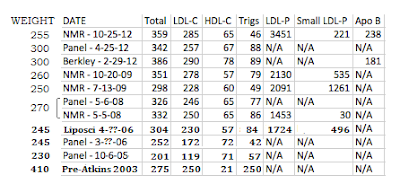
So Jimmy Moore has released his latest lipid panels , after losing 50-or-so pounds in 5 or so months of his nutritional ketosis experiment.  Before I comment on these, a huge revelation was made in the post: Interestingly, before I started on the Atkins diet in January 2004, my highest total cholesterol was only about 230. Of course, my doctor put me on both Lipitor and Crestor to lower that number and it did get down to 130 at some point (don’t know what the breakdown was of HDL and LDL nor do I know what my triglycerides or LDL-P were at the time either). Ummm ... Jimmy, do you even bother to look back at your own blog? Seems not, which is a darned pity for someone so darned and determined to figure all of this out, but who doesn't even look at his own data.   Before I started livin’ la vida low-carb , my HDL was a dismal 21 and my triglycerides hovered over 250. My LDL was about 250 which brought my total cholesterol to around 275. It wasn’t a pretty picture.

Insulin Doing Its Thang! And Still No Starving Cells

Image
In comments yesterday, Wayne/ProudDaddy wondered whether triglycerides might be the bad guy instead of NEFA based on this study from Keith Frayn's research group: Adipose tissue fatty acid metabolism in insulin-resistant men . Aims/hypothesis   Increased NEFA production and concentrations may underlie insulin resistance. We examined systemic and adipose tissue NEFA metabolism in insulin-resistant overweight men (BMI 25–35 kg/m 2 ).

Fructose, Fat & Obesity

Image
The other day, Stephan Guyenet shared some of his own thoughts on David Despain's can't-say-enough-nice-things-about-it interview with Dr. John Sievenpiper.  In case you missed it, Stephan discusses his post looking at the links or lack thereof  between sugar consumption per se and obesity.  See:   Is Sugar Fattening?   At the end of the current post is the following footnote: ** If fructose is fattening due to its ability to become fat, then dietary fat should be even more fattening because it doesn't have to undergo an inefficient conversion process-- it's already fat. Excellent point!  I might add that if saturated fat is such a healthy fat for your body, fat produced by de novo lipogenesis -- mostly palmitic acid in the liver -- would be an even better source of that fat as it would give you a "metabolic advantage"!   It takes almost no calories to digest and store dietary fat in body fat.  It is highly energy intensive to convert fruct...

Fat Tissue Expansion: Part II ~ Overview of How it Can Happen

In Part I , I laid out some terminology that we'll use in the discussion of how we get fat.  In this installment, I'm mostly going to list the various means by which fat tissue can expand, emphasis on the word can.  Because as future installments will lay out, while some of these mechanisms are plausible, some of these mechanisms contribute very little if at all to the fattening process.  So what mechanisms might be involved in the expansion of fat tissue?  It is not controversial that fat tissue expands by two means: Adipocytogenesis:  The growth of new fat cells, increased fat cell number Adipocyte growth:  Increased size of adipocytes

Fat Tissue Expansion: Part I ~ Terminology

One of the things that irks me about discussions of various obesity related topics is the inappropriate use of terminology.  I would like to give the benefit of the doubt and presume that for most who do this, it is inadvertent.   Often this is due to not having a complete understanding of human metabolism and physiology (cough ... ahem ... Mr. Gary Taubes) , but at some point, when speaking from a presumed position of authority, this excuse doesn't cut it.  To be fair, the peer review literature and higher level texts are rife with inconsistencies of their own.  Most authors are likely simply using the term they are most familiar with not realizing that those terms mean different things in different contexts.  Still, a careful reading of said literature is all that is needed to understand how they are using the terms and the process to which they are referring.   This has been briefly addressed here previously .   As with insulin res...

Physician Phollies ~ II: Dr. William "Wheat Belly" Davis

Image
Next up in our "how can he/she even say that?" series of blatantly erroneous things said by practicing physicians in furtherance of the carbophobic agenda ... I bring you, an Asylum favorite, Dr. William "Wheat Belly" Davis.  In the most recent post on his WB blog , Wheat Belly trips over himself trying to implicate wheat, specifically, in the diabetes epidemic.   But can we blame diabetes on wheat? Yes, absolutely, as much as you can blame poor oral hygience for toothlessness in West Virginia. Wow!  Gratuitous slam on WVa's aside, Dr. Wee Bee goes on  to list all the ways wheat causes diabetes: –Any food that increases blood sugar to high levels (i.e., high glycemic index) also increases insulin to high levels. Repetitive high insulin leads to insulin resistance, which leads to visceral fat deposition, more insulin resistance, inflammation, etc., eventuating in diabetes. –High blood sugar, such as that resulting from eating two slices of whole wheat bre...

Fat Tissue Regulation ~ Part VI: Journey & Fate of Dietary Fat

Image
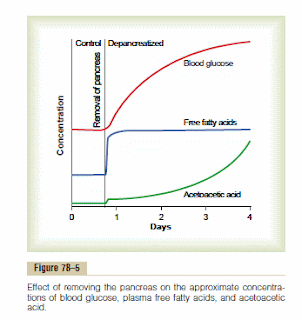
Regulation of fatty acid transport and storage: influence of acylation-stimulating protein Katherine Cianflone and Sabina Paglialunga, 2006 Commonly, the dietary sources of fat exceed the actual needs and the tissues are faced with dealing with the excess. Under these circumstances, the removal process of dietary triglycerides and fatty acids becomes overloaded, resulting in excessive postprandial lipemia and accumulation of chylomicrons, remnant particles and non-esterified fatty acids. These particles are associated with disruptions in lipoprotein metabolism and changes in inflammatory factors, thus their association with cardiovascular disease, metabolic syndrome and diabetes is not surprising. Dietary factors, not just fat, influence postprandial fluxes. This leads to the question: do we need a standardized fat tolerance test? I've been reading a lot of studies lately dealing with postprandial clearance of fats from the blood and it certainly seems to me that these are coales...

Hormonal & Appetite Response to Macronutrients

Image
I came across this paper recently and thought I would share it here on my blog.  I think it is rather eye-opening as to the postprandial hormone responses to meals rich in each of the macros (and alcohol) and the ultimate effect on satiety. Meals with similar energy densities but rich in protein, fat, carbohydrate, or alcohol have different effects on energy expenditure and substrate metabolism but not on appetite and energy intake This study was done in normal weight healthy humans (9 women, 10 men) in their early 20's.  They fed them a meal containing the same calories, but high in one of each nutrient.  Each subject was given each diet with a 4-8 week "washout" in between, a standard diet the day before each test day, and subjects fasted 10 hour overnight before testing.   Hormones, etc. were measured for 5 hours postprandially, and then were provided an ad libitum meal.   Here are the diets tested:

Fat Tissue Regulation ~ Part V: C5L2KO - Meet the New Droid, Kinda Like the Old Droid

Image
It seems that our friend C3KO city mouse has found his country mouse cousin:  C5L2KO.  In keeping with the Star Wars saga, albeit stretching things a bit with this one, I've found the depiction of our new friend! To catch up, C3KO is a knockout mouse lacking the ability to produce Complement 3 (C3) protein which is a precursor for production of acylation stimulating protein, ASP.  Therefore C3KO is ASP deficient.  The result of this genetic mutation is to produce a mouse that is resistant to obesity, and essentially an ASP equivalent of insulin deficiency -- Type 1 diabetes.  If you've not read about C3KO, here are the links to the two relevant installments in this series:    Fat Tissue Regulation ~ Part II: Meet C3KO    Fat Tissue Regulation ~ Part III: C3KO Meets Obi No Leptinobi It is known that fat tissue expresses insulin receptors.  Indeed this has been exploited to more clearly elucidate the roll of insulin acting on fat tiss...

Why Insulin Levels & Lipolysis Do NOT Dictate Weight Loss ~ Part I

Image
I'm really rather amazed that at this point we're still having to discuss this topic.  As a good friend of mine once said to me in an email (paraphrasing):  One would expect these sorts of myths to persist back in the 80's and 90's.  But in this day and age of information availability on the internet, it seems impossible that enough people continue to be influenced by such easily debunked notions.  Low carb Wiener anyone? {grin} In any case, it seems that no amount of demonstrating the lack of any correlation between fasting insulin levels and weight loss will convince some people.  I really would think that the scatterplot (weight loss v. fasting insulin), discussed in this post ,  would be impossible to explain away, and yet many just dismissed it from their minds.  It's that proverbial black swan all the Eades Popperites (or is that all you can eat (Eade) sous vide popper-bites?) constantly seek.  

Where do triglycerides come from? Part III

Image
If you haven't done so already, you may want to read Part I and Part II first.  Part II, especially, discusses the sources of fatty acids for VLDL triglycerides manufactured by the liver and two secretory pathways - an immediate one and a delayed one.  In this part I'll discuss the results of that study: Delayed secretory pathway contributions to VLDL-triglycerides from plasma NEFA, diet, and de novo lipogenesis in humans This group uses different radioactive tracers to identify the source the fatty acids in VLDL-triglycerides.  This study differed from the study in Part I in that it looked at prolonged triglyceride levels - fasting and postprandial - rather than just fasting.  For one week prior to the study all subjects were provided a standard diet (outpatient basis) of 50% carb, 35% fat, 15% protein*, at weight maintaining levels.  I would note that this would mean the obese study groups were likely ingesting significantly more than the lea...