Posts

Showing posts with the label Visceral Fat

Bump: The Diabetes "Crash" Cure & Pancreatic Fat

Bumping Again! New Article in BMJ:   Analysis: Beating type 2 diabetes into remission * The original posting of this was shortly after the first papers published on the success of a very low calorie diet -- essentially a 6-800 calorie protein-sparing-modified-fast, protein shakes + non-starchy veggies -- in curing diabetes in relatively short order.  You may also be interested in the following posts: The Diabetes "Crash" Cure Revisited  (a follow-up to this one) Diabetes "Crash" Cures: VLCal vs. VLCarb Check Featured Comment (if any) for further updates from me. *In light of commentary below, I'll add that I am not a fan of using the term remission here.  Cancer does seem to strike at random most times and recurrence seems to be equally random.  At best we have few if any ways to predict who will see cancer return etc.  But Type 2 diabetes doesn't work that way in most.  The source of the beta cell dysfunction is pretty well k...

Revisiting the Fatty Diets & Diabetes Study ~ How to Make Mickey Fat or Fattier

Image
High Fat Diets!  I'm going to continue bumping up some of the hundreds of blog posts I've written on studies that support the role of dietary fat in obesity and diabetes.   As I do this I'll make some formatting changes for ease of reading, may fix a typo or awkward wording here or there, but won't alter the content meaningfully.  Instead, I'll insert Ed. Notes where I feel an update or clarification is needed. ORIGINAL POST 8/31/2011 In her piece over at MDA on the How Fatty Diets Cause Diabetes , Denise Minger spent a bit of time discussing the strain of mouse used in the study.  That being the not-uncute fella you see pictured here:  A C57BL/6J mouse.   Denise describes these mice as:   "uber-susceptible to obesity, high blood sugar, insulin resistance, leptin resistance, and all that other fun stuff plaguing modern humans."   This didn't really square with my memory from when I blogged on a study involving this crit...

Where do triglycerides come from? Part I (Updated)

Image
This post contains sufficient updates from the original (dated 5/11/11) that I consider it more of a fully updated version vs. a bump.   This began with my intent to link to this post in an upcoming discussion of triglycerides, when I noticed that Dr. Ronald Krauss was amongst the authors.   This study originally caught my eye because of    Marc Hellerstein 's name, he of  DNL not a major pathway in humans fame , that I've  blogged on  previously. Now I have excerpted copiously from the discussion because the authors make several points relevant to the discussion of what comprises a healthy lipid profile.  As part of updating, I am breaking those excerpts up a bit more and adding some/more emphasis and additional commentary.

July 4, 2013 Over the Hump Bump: Where does insulin resistance start? The adipose tissue

Image
The readership in this blog continues to grow and it is not lost on me that a vast majority of current readers are unfamiliar with the bulk of my work here on this blog.  I think I'm closing in on 1000 posts which would make me one of the more prolific bloggers around ... for better or worse!  As such, I more than understand that it would be darned near impossible to catch up, etc.  So a few comments in that vein.  

Ectopic Fat

Image
A nice overview I just thought I'd share here.   Ectopic Fat Depots and Cardiovascular Disease

The New Paleo Diet Study: Just the Fats Ma'am

Image
A Palaeolithic-type diet causes strong tissue-specific effects on ectopic fat deposition in obese postmenopausal women I don't know that this study is worth three posts -- grin -- but I decided to break it up anyway.  I blogged on the diet itself here , and the weight loss here .  This post will address the impact on ectopic fat.  So first, I want to mention the "misleading title" peeves.  Ectopic fat is defined in the abstract: Ectopic fat accumulation in liver and skeletal muscle may be an essential link between abdominal obesity, insulin resistance and increased risk of cardiovascular disease after menopause. Here's the relevant synopsis of the results: Liver triglyceride levels decreased by 49% whereas IMCL [intramyocellular lipid] levels in skeletal muscle were not significantly altered. Which apparently garnered the conclusion: A modified Palaeolithic-type diet has strong and tissue-specific effects on ectopic lipid deposition in postmenopau...

Amazing (and Not So Amazing) Low Carb Feats

Image
Preface:  When I write posts such as this one, that I know some will take in ways in which it was not intended, I usually spend a bit of time contemplating hitting the publish button.  This post comes off rather more wet blankety (is that a term?) than even some others.   But as someone who has struggled with the after effects of yo-yoing, LC and not, I do think it is worthwhile to shine a light on the reality of what is being promoted out there.

CrossFIT?

Image
Short post here gang.  I was collecting the final clips needed for the upcoming vid and watched Gary Taubes' appearance at CrossFit just today.  OMG people.  Is it just me?  Or does the CEO of CrossFit make you a little ... umm ... uncomfortable? Paging Dr. Davis!  I mean, really.  I'm no physical specimen myself.  But I'm also not Founder & CEO of CrossFit either!  Promoting Gary Taubes and how CrossFitters have been behind him for a long time.  Ummmmm....  Especially fun was after the intro how Gary (looking pretty fit if you ask me, or at least lean) lamented being the least fit person in the room.  I JUST DON'T GET THIS FOLKS!!! I don't know much about CF & the Paleo roots and whatnot.  I've learned a little more of late, but please realize I'm pretty much totally out of the loop and don't even really know what CF is specifically.   So when I see stuff like this it does make me gasp and wanna shake some pe...

Visceral Fat & Hepatic Fat -- Not one and the same

Image
It seems that any time the discussion of fatty livers developing on ketogenic diets comes around, a spate of confusing discussions tend to ensue.  One of the confusing issues is that ketogenic reducing diets are effective at reducing hepatic fat levels.  However, these studies usually start with a fatty liver and with weight loss comes hepatic fat loss.  If there's a study out there where obese people are simply transitioned from a SAD to an equi-caloric ketogenic diet (85+% fat) demonstrating any change in liver fat accumulation, I'm not aware of it.  However I believe the evidence of rodents on such diets is at least enough to be concerned that the change, if any, would be for the worse, not the better.   A lot of lean people also think, I can't have a fatty liver because I don't have a pot-belly so I don't have visceral fat.  One of the reasons I thought the Eades' 6 Week Cure for the Middle Aged Middle  book was such a disaster is that the first ...

Irisin ~ Just the Pill for Low Carbers

There was an article in the NYT that was passed along to me the other day: Exercise Hormone May Fight Obesity and Diabetes A newly discovered hormone produced in response to exercise may be turning people’s white fat brown, a groundbreaking new study suggests, and in the process lessening their susceptibility to obesity, diabetes and other health problems.

And I'm the one that's Paranoid? (Yeah ... Dr. Wheat Belly Again!)

Image
I just had to laugh at Fat Head's recent post  The Long Knives are out for Wheat Belly  where he seems convinced that folks criticizing Wheat Belly are trolling the internet at the behest of the grain industry.  I mean why would anyone criticize the nonsense on the basis of its bad science?   They've got to silence Davis!   Maybe I'm missing out on this guy's notorious humor and this post is tongue in cheek, but ... Ha ha ha.     Of course we then get the "well they haven't read the book" whine in the comments.  Folks, enough of this book is available for preview on Google  to get the gist of what is in it.   It's a compilation alarmism and hyperbole laced blog posts from this past year, fleshed out with a few references.   As I demonstrated in Wheat Belly on Acid , this section of his book was simply a tirade against oats turned against wheat.  I love eggs.  I would advocate for eating them were I in the nutritional advi...

Wheat Belly on Acid

Image
I used to read Dr. Davis' blog back in the days participating on Jimmy's forum, it was cited rather frequently.  His writing back then seemed well grounded.  Then about a year or so ago, the posts started getting sensationalistic.   Ahh ... he got a book deal for Wheat Belly.  I blogged previously on one of the more bizarre amongst them:   Bacon, Eggs & Battery Acid .  On his anti-oat campaign, Davis wrote: Sulfuric acid is among the most powerful and potentially harmful acids known. Get even a dilute quantity in your eyes and you will suffer serious burns and possibly loss of eyesight. Ingest it and you can sustain fatal injury to the mouth and esophagus. Sulfuric acid's potent tendency to react with other compounds is one of the reasons that it is used in industrial processes like petroleum refining. Sulfuric acid is also a component of the harsh atmosphere of Venus. This folks really is over-the-top rhetoric, and if Davis has a shred of credibi...

Let's play Concentration!

Image
While I was writing the Essential Carbohydrate post, I got to thinking about another canard often bantied about in low carb circles.  That being that our circulating blood glucose amounts to only about a teaspoon of sugar.  Here's how that calculation goes: Another way of looking at this is that for a normal person, a "glucose spike" to 125 mg/dL amounts to an increase in dissolved circulating glucose of perhaps 2g (85 mg/dL - 125 mg/dL) and a glucose intolerant person might see 10g dissolved glucose in circulation (200 mg/dL)  following a meal.  This small amount compared to the "large amounts" of carbohydrate in even a small serving of pasta or rice is often seized on by low carb advocates to foster carbophobia.

Is LC Morphing to HAES? Part V: Health and Insulin Resistance

So let's continue with this look at the "low carbing for health" irrespective of weight loss trend.  The topic of this thread will be insulin resistance.   I believe the misguided notion that carbohydrates cause insulin resistance, as put forth in GCBC by Gary Taubes, is one of the single-most potentially harmful theories circulating about the LC webosphere.  The research just doesn't support this etiology of pathological IR.  This is complicated further by confusing physiological IR with pathological.

Regional Differences in Fat Tissue Fatty Acid Regulation by Insulin

Image
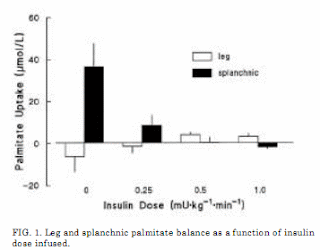
Insulin Regulation of Regional Free Fatty Acid Metabolism Alternate Title:  Why I had a fatter ass before low carb?  :-) This study involved 26 healthy young (21-38) non-obese (BMI 18-27) individuals split evenly by gender.  Excluded were any medications known to influence FFA metabolism.  Radiolabeled palmitate was used as a tracer for FFA's.   All studies were initiated in the 12 hour overnight fasted state and palmitate was infused for the duration of the study.  Patients received insulin infusions of different doses (3M & 3F per group) for 150 min following baseline determinations.  Controls received a saline infusion.  Blood samples were obtained from femoral vein and artery (leg) and hepatic (liver) vein.  This was to assess systemic (whole body), leg and visceral (splanchnic) rates of appearance of FFA's  (release from adipose tissue).

Fatty Acid Trafficking

This post discusses:   Downregulation of Adipose Tissue Fatty Acid Trafficking in Obesity, A Driver for Ectopic Fat Deposition? Fats are continually being cycled in and out of our fat cells.  In the obese, circulating free fatty acids (or non-esterified fatty acids), NEFA, are often elevated.  These are often accompanied by deposition of fat in non-adipose tissues, aka ectopic fat deposition.  This ectopic fat is implicated in various impairments of cell function and even cell death (apoptosis) that result in insulin resistance, beta-cell dysfunction, etc.  This is often referred to as lipotoxicity.   This study sought to determine if this lipotoxicity is due to excessive release of NEFA from adipose tissue or from impaired trapping by adipose tissue of the NEFA released from dietary fat.  This work is from Keith Frayn's group.  It might be worthwhile to read my blog post on  Frayn's paper on adipose tissue as lipid buffer. ...

Adiposopathy

Presented without comment on the content per se: Role of the Adipocyte, Free Fatty Acids, and Ectopic Fat in Pathogenesis of Type 2 Diabetes Mellitus This is probably the most exhaustively referenced review article I've ever come across on the etiology of MetS and T2 Diabetes and the role of adipose tissue.  Too extensive to quote w/o copying the whole darned thing, although I may revisit it at some point to do a bullet point summary type post.  

Diet, Cardio, Resistance Training & Insulin

Image
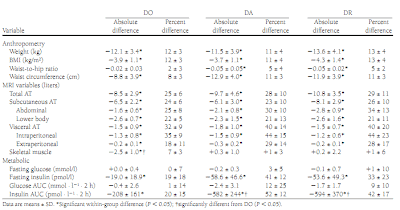
Thanks to Mirrorball for "putting a bug in my ear" regarding the impact of exercise on insulin levels.  The basic thought being that if Taubes' theory that lowering insulin makes you lose weight, then exercise should be very effective, especially if you couple it with carbohydrate restriction.  Because, if you "overeat" protein and fat calories those don't impact body weight right? So I found this study: Effects of Aerobic or Resistance Exercise and/or Diet on Glucose Tolerance and Plasma Insulin Levels in Obese Men   Basically they took three groups of men averaging 40-47 years of age, ~100kg weight, ~32 BMI and did 3 interventions:  DO = diet only DA = diet + aerobic exercise DR = diet + resistance exercise

Ketogenic Diet increases Fat Mass and Fat:Total Body Mass Ratio

Image
Ketogenic diet-fed rats have increased fat mass and phosphoenolpyruvate carboxykinase activity This study looked at body weight, fat mass, blood lipid and glucose levels and PEPCK (rate limiting enzyme in glyceroneogenesis pathway for G3P production for esterification of fatty acids - fat deposition) activity in the liver and fat cells.  Two ad libitum diets were compared, a control standard chow and a ketogenic zero carb chow.  This study was in normal, young (30 days old at start) Wistar rats and lasted 6 weeks. The diet compositions are shown below:

Adipose Tissue Characteristics in Obese Teens & Insulin Resistance

Cellularity and Adipogenic Profile of the Abdominal Subcutaneous Adipose Tissue From Obese Adolescents: Association With Insulin Resistance and Hepatic Steatosis Yes ... I'm going to be on a bit of a bookmarking post spree here :-) This study looked at fat cell size and proliferation in obese teens and compared this to IR and fatty liver.  This study seems to be consistent with the whole "critical threshold" or "normal fat capacity" theories on why some obese are relatively "metabolically healthy" while others are not.  I've not, however, had a chance to read thoroughly. Conclusions:  A reduced lipo-/adipogenic capacity, fraction, and estimated number of large subcutaneous adipocytes may contribute to the abnormal distribution of abdominal fat and hepatic steatosis, as well as to insulin resistance in obese adolescents. Thinking out loud:  It seems more and more to me these days that abdominal fat - visceral in particular - is our short term bu...