Posts

Showing posts with the label Adipose Tissue

Revisiting the Fatty Diets & Diabetes Study ~ How to Make Mickey Fat or Fattier

Image
High Fat Diets!  I'm going to continue bumping up some of the hundreds of blog posts I've written on studies that support the role of dietary fat in obesity and diabetes.   As I do this I'll make some formatting changes for ease of reading, may fix a typo or awkward wording here or there, but won't alter the content meaningfully.  Instead, I'll insert Ed. Notes where I feel an update or clarification is needed. ORIGINAL POST 8/31/2011 In her piece over at MDA on the How Fatty Diets Cause Diabetes , Denise Minger spent a bit of time discussing the strain of mouse used in the study.  That being the not-uncute fella you see pictured here:  A C57BL/6J mouse.   Denise describes these mice as:   "uber-susceptible to obesity, high blood sugar, insulin resistance, leptin resistance, and all that other fun stuff plaguing modern humans."   This didn't really square with my memory from when I blogged on a study involving this crit...

Lessons from the Cafeteria Rat: Adiposopathy ~ How/Why Does Fat Get "Sick"

Image
For today.  Just thoughts.  No references.  Also I will use the term theory, it sounds better, and frankly in the semantics of scientific progression, we've been there for a while now with Adiposopathy (I'll capitalize it for emphasis) anyway. Since offhandedly throwing out the term Adiposopathy in response to a query as to what I consider to be the cause of CVD/diabetes, etc.  -- collectively known as "metabolic diseases" and sometimes "chronic diseases" -- there's been one question raised a few times:  How and/or why do fat cells get "sick".  I think I found the perfect illustration ... take it away Lucy and Ethel ...

Physician Phollies IV: Dr. Cate Asks How Many Calories in Mayo?

Image
I really thought this was a joke, and a silent hat tip goes out to the person who brought this to my attention so's that I don't get them on anyone's bad list for contributing to such a post here at the Asylum.  But OMG . How Many Calories Does Mayo Have? ... now that Mark Sisson is whipping up wonderful mayo, I can get to work on the backlog of tuna salad, pea salad, and deviled eggs I’ve been denying myself. ... I thought I’d enjoy some tuna salad with two heaping spoonfuls of Mark’s zippy mayo—call it research for  lower calorie  meal plans for my new business, the FatBurn Factory.  With the addition of a few capers, instant lunch! But I need to know for, for the sake of my patients, ...    WHAT IS THE CALORIE COUNT OF THIS QUICK AND EASY MEAL  . Yeah I know what you're thinking.  What the heck is pea salad, and is there anyone else on the planet denying themselves of this dish?  

All I Want for Christmas ...

Image
A short break to share some things I've been doing "just for fun".  Some people collect classic works of art.  Some literature.  One thing this blog gig has done to me is it has turned me into a collector of old scientific literature!  Thank you Gary Taubes.  Seriously! Maybe it's my training, but I am a reference hawk.  When I read "new" things, use of quotes to denote that these things are not necessarily new, just new to me, I like to track down sources before proceeding.  This is, after all, the purpose of referencing.  In 1965, the American Physiological Society published an eight-hundred-page Handbook of Physiology dedicated to the latest research on adipose-tissue metabolism. As this volume documented, several fundamental facts about the relationship between fat and carbohydrate metabolism had become clear. First, the body will burn carbohydrates for fuel, as long as blood sugar is elevated and the reserve supply of carbohydrates ...

Partial inhibition of adipose tissue lipolysis improves glucose metabolism and insulin sensitivity without alteration of fat mass.

Image
{shhhhhhhhh .... don't tell Gary Taubes, this might just upset his 21DaySugarDetox approved green apple cart!} You know how the story goes by now, right? In more recent lectures, Taubes is fond of using the slide below. source These are two quotes that Taubes cites from Lehninger's Principles of Biochemistry and he juxtaposes them to convince you how misguided such textbooks are.  How can, on the one hand fat cells "fatten" according to the action of insulin, but human beings get fat due to positive energy balance?   The simple answer is that insulin is not some renegade hormone and your pancreas is not a master organ in the body placating your rebellious adipocyte's every whim. Yes, tis true that insulin has a stimulatory role in the storage of fatty acids by acting on LPL on the intake side, and yes, tis true that insulin "traps" those fatty acids in the adipocytes by suppressing HSL mediated lipolysis and release of same.  Sounds like a sl...

July 4, 2013 Over the Hump Bump: Where does insulin resistance start? The adipose tissue

Image
The readership in this blog continues to grow and it is not lost on me that a vast majority of current readers are unfamiliar with the bulk of my work here on this blog.  I think I'm closing in on 1000 posts which would make me one of the more prolific bloggers around ... for better or worse!  As such, I more than understand that it would be darned near impossible to catch up, etc.  So a few comments in that vein.  

Revisiting Taubes' Four Facts from the Sixties

Image
In Good Calories Bad Calories , Gary Taubes wrote the somewhat shockingly definitive summary paragraph below (I've separated out the numbered statements for clarity):   By the mid-1960s, four facts had been established beyond reasonable doubt: (1) carbohydrates are singularly responsible for prompting insulin secretion; (2) insulin is singularly responsible for inducing fat accumulation; (3) dietary carbohydrates are required for excess fat accumulation; and (4) both Type 2 diabetics and the obese have abnormally elevated levels of  circulating insulin and a “greatly exaggerated” insulin response to carbohydrates in the diet, ...  (Kindle Locations 8010-8014)

Fat Tissue Regulation ~ Part IX: ASP, LPL and the Triglyceride/Fatty Acid Cycle

Image
In this installment, we reunite with our old friend C3KO mouse to learn a little bit more about the role of acylation stimulating protein, ASP, in the regulation of fat tissue (and muscle) from this study:   Differential regulation of fatty acid trapping in mouse adipose tissue and muscle by ASP .  The C3KO mouse was discussed in Part II of this series.  This mouse lacks the gene to produce a protein called C3 (short for Complement 3) which is a precursor for the formation of ASP.  Thus C3KO mice are ASP deficient.  The C3KO is to ASP as a type1 diabetic is to insulin.  These mice are also resistant to obesity.  BTW, hyperASPemia accompanies the hyperinsulinemia and hyperleptinemia of obesity when it's measured. ASP-deficient mice have delayed postprandial triglyceride (TG) clearance and reduced WAT mass. The objective of this study was to examine the mechanism(s) by which ASP deficiency induces differences in postprandial TG clearanc...

Exercise & Fat Mobilization ... and starving cells & hunger

Image
There's no denying it, TWICHOO is down to a broken toothpick where the science is concerned.  (See here for the toothpick reference if you're a newer reader.)   The remaining claim supporting TWICHOO rests on the action of insulin on the fat cell.  Insulin does indeed act to stimulate esterification and suppress lipolysis, favoring deposition and accumulation of triglycerides in fat cells.  They even teach this stuff in some medical schools I'm told!  So these days it's all about how carbs make you hungry and overeat (although overeating is so inane) because they stimulate insulin which traps all your fat calories in your fat starving the rest of your cells of energy.  Now, that part's not true, but let's for the sake of argument assume it is.  What, then, would cause you to lose weight and not be hungry?  Why anything that favors net mobilization of fat stores -- that is stimulates lipolysis and fatty acid release from fat cells.  This wil...

The Triglyceride/Fatty Acid CycleS and the role of Glyceroneogenesis

Image
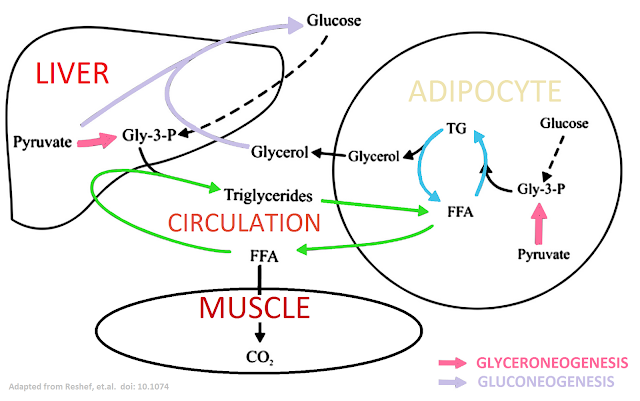
Thanks to a certain journalist, much of the discussion of fat tissue metabolism on the internet presents a very myopic view of things taken out of context.  One example of this, is that in Chapter 22 of GCBC, Taubes lists all of the hormones acting on adipocytes.  The caption on the graphic reads: In 1965, hormonal regulation of adipose tissue looked like this: at least eight hormones that worked to release fat from the adipose tissue and one, insulin, that worked to put it there. Let's leave aside for a moment that in the four subsequent decades preceding the writing and publication of his book, probably the most potent regulatory hormone of fat mass, leptin, was discovered.  Let's also leave aside all of the other adipokines (the term for the collection of hormones and peptides produced by adipocytes most of which appear to be secreted).   There's a lesson to be learned solely from Taubes' narrow, outdated view.  Under the title "Hormones that promo...

Glyceroneogenesis & The Triglyceride/Fatty Acid Cycle Revisited

Glyceroneogenesis and the Triglyceride/Fatty Acid Cycle     (TAG/FA) JBC Papers in Press, June 4, 2003, DOI 10.1074/jbc.R300017200 Lea Reshef, Yael Olswang, Hanoch Cassuto, Barak Blum, Colleen M. Croniger, Satish C. Kalhan, Shirley M. Tilghman , and Richard W. Hanson The above paper is referenced in Good Calories, Bad Calories , and is a paper I believe one cannot read thoroughly and still believe that dietary carbohydrate is required in order to "fix" fat and become obese.  It has been quite a while since I read it in its entirety.  Doing so in recent days I've noticed even more information in this paper that counters the whole notion that more dietary carb leads to more glycerol-3-phosphate leads to more esterification of fatty acids to the storage triglyceride form.   More specifically, these four paragraphs/excerpts were somewhat drowned out for me in my first reading:

Exercise & Adipose Tissue ~ Part I: Adipose Tissue & General Relationship

Image
From the great research group of Keith Frayn, Aging Hippie linked to this article recently: PHYSICAL ACTIVITY AND EXERCISE IN THE REGULATION OF HUMAN ADIPOSE TISSUE PHYSIOLOGY In composing this post, it started to get rather long so I'll break it up into parts.  I'm going to do a bullet-pointed summary and excerpts for you.  Direct quotes will be in italics, regular font is my paraphrased summary, and non-indented/bulleted text is my general commentary.

De Novo Lipogenesis ~ Another Case of an Undeserved Bad Reputation?

OK, let's get back to some science here :-)  In comments on my recent query for evidence that insulin blocks leptin in the brain, Kindke posted a link to the following article:   Yin and Yang of hypothalamic insulin and leptin signaling in regulating white adipose tissue metabolism .   ABSTRACT:   Fatty acids released from white adipose tissue ( WAT) provide important energy substrates during fasting. However, uncontrolled fatty acid release from WAT during non-fasting states causes lipotoxicity and promotes inflammation and insulin resistance, which can lead to and worsen type 2 diabetes (DM2). WAT is also a source for insulin sensitizing fatty acids such as palmitoleate produced during de novo lipogenesis. Insulin and leptin are two major hormonal adiposity signals that control energy homeostasis through signaling in the central nervous system. Both hormones have been implicated to regulate both WAT lipolysis and de novo lipogenesis through the...

Fat Tissue Expansion: Part III ~ Fat Cell Number

Image
Before reading you may wish to read:  Part I ~ Terminology , Part II ~ Overview of How it Can Happen As mentioned in Part II, fat tissue expands by an increase (proliferation) of fat cells and/or a growth of the individual fat cells.  This installment concerns the number of fat cells and is likely the least "actionable" in this series in terms of diet, unless you're planning to have a child and/or have young children.   This does, however, lend some assistance to those formerly obese who are considering liposuction or more drastic surgery that may involve fat cell removal.  Bottom line, the number of fat cells we have is virtually completely out of our control as adults (according to current understanding).  So this post will be rather short, and I plan to expand on the data we have regarding fat tissue development in infancy, puberty and other periods of childhood in subsequent installments.  It would appear that the number of fat cells we are bor...

Insulin Resistance ~ Part I: A condition in dire need of diagnostic clarity

I've written many times about how we need some new disease classifications, names or something for the various conditions that are currently termed "diabetes".  This is because hyperglycemia -- the predominant symptom that garners a diabetes diagnosis -- can have many underlying physiological bases.   In this post I'm going to make the same case for the pathologies lumped together under the term "insulin resistance" (from hereon, IR).   The problem with discussions of IR are similar to those of diabetes.  In a nutshell, hyperglycemia is to diabetes as glucose transport/disposal is to IR.  Just as blood glucose is the myopic focus of many discussions of diabetes, so, too, insulin's role in glucose transport is the myopic focus of many discussions of IR.    Let's begin with a diagnosis of insulin resistance.  The most commonly used single diagnostic parameter for this is something called the HOMA-IR .  This ratio is determined from fasting pla...

Of Mice & Men: My Rodent Study Disclaimer

Image
The purpose of this post is to have a sort-of "disclaimer" to link to (if I can remember) whenever I discuss a rodent study here at the Asylum ... A small manifesto if you will, on my feelings on the utility and limitations of rodent studies in relation to human beings.   Also, I look at this post as a way to remind older readers and/or inform newer readers as to my background.  I spent roughly five years in the company of countless rats and mice, working for Big Pharma, and when I speak of rats, I'm not talking about my colleagues ;-)  My job was half analytical chemistry, half metabolism.  I worked on mostly discovery level drug candidates (a level before development) characterizing the absorption, metabolism and routes of excretion of these drugs, mostly antidepressants.  As such I've chopped the heads off of more rats than I care to recollect, opened up countless abdomens of mice to get maximum blood samples from the vena cava, removed/homogenized and analyz...

Fat Tissue Expansion: Part II ~ Overview of How it Can Happen

In Part I , I laid out some terminology that we'll use in the discussion of how we get fat.  In this installment, I'm mostly going to list the various means by which fat tissue can expand, emphasis on the word can.  Because as future installments will lay out, while some of these mechanisms are plausible, some of these mechanisms contribute very little if at all to the fattening process.  So what mechanisms might be involved in the expansion of fat tissue?  It is not controversial that fat tissue expands by two means: Adipocytogenesis:  The growth of new fat cells, increased fat cell number Adipocyte growth:  Increased size of adipocytes

Fat Tissue Expansion: Part I ~ Terminology

One of the things that irks me about discussions of various obesity related topics is the inappropriate use of terminology.  I would like to give the benefit of the doubt and presume that for most who do this, it is inadvertent.   Often this is due to not having a complete understanding of human metabolism and physiology (cough ... ahem ... Mr. Gary Taubes) , but at some point, when speaking from a presumed position of authority, this excuse doesn't cut it.  To be fair, the peer review literature and higher level texts are rife with inconsistencies of their own.  Most authors are likely simply using the term they are most familiar with not realizing that those terms mean different things in different contexts.  Still, a careful reading of said literature is all that is needed to understand how they are using the terms and the process to which they are referring.   This has been briefly addressed here previously .   As with insulin res...

Fat Tissue Regulation ~ Part VI: Journey & Fate of Dietary Fat

Image
Regulation of fatty acid transport and storage: influence of acylation-stimulating protein Katherine Cianflone and Sabina Paglialunga, 2006 Commonly, the dietary sources of fat exceed the actual needs and the tissues are faced with dealing with the excess. Under these circumstances, the removal process of dietary triglycerides and fatty acids becomes overloaded, resulting in excessive postprandial lipemia and accumulation of chylomicrons, remnant particles and non-esterified fatty acids. These particles are associated with disruptions in lipoprotein metabolism and changes in inflammatory factors, thus their association with cardiovascular disease, metabolic syndrome and diabetes is not surprising. Dietary factors, not just fat, influence postprandial fluxes. This leads to the question: do we need a standardized fat tolerance test? I've been reading a lot of studies lately dealing with postprandial clearance of fats from the blood and it certainly seems to me that these are coales...

Glycine Power?!

One of the things I've been doing regularly for the past year or so is making carcass broths and bone broths and making stews and soups with it.  I make the distinction of carcass v. bone because I mostly make two versions:  (1) pork from pork shoulder bones my amazing pork guy provides me free by the bagful (so I don't have to save up bones in the freezer which is a huge bonus!) and (2) chicken from the whole carcass from chickens or everything from the parts -- e.g. a fair amount of skin and cartilage and "stuff".   There was a question about pork rinds and satiety the other day on PaleoHacks that reminded me of a few things.  One was that whenever I would hear of the health bennies of gelatin protein, I always remembered reading that it was not a good major protein source because it is not a complete protein.  Well, the protein from such broths may not be complete, but it is special indeed.  I'm not one for anecdotes but my less-than-perfect-diet hubby ...