Posts

Showing posts with the label Adiposopathy

Lessons from the Cafeteria Rat: Adiposopathy ~ How/Why Does Fat Get "Sick"

Image
For today.  Just thoughts.  No references.  Also I will use the term theory, it sounds better, and frankly in the semantics of scientific progression, we've been there for a while now with Adiposopathy (I'll capitalize it for emphasis) anyway. Since offhandedly throwing out the term Adiposopathy in response to a query as to what I consider to be the cause of CVD/diabetes, etc.  -- collectively known as "metabolic diseases" and sometimes "chronic diseases" -- there's been one question raised a few times:  How and/or why do fat cells get "sick".  I think I found the perfect illustration ... take it away Lucy and Ethel ...

Insulin Resistance ~ Taubes v. Frayn aka Adiposopathy 101

Image
I thought in the interim of doing something more formal, I'd bump this post from October of 2010.  Keith Frayn, for newer readers, is recently retired prominent Oxford scientist who wrote one of the books Gary Taubes likes to use pictures from these days in his lectures (you're welcome Gary, if only you'd read the book more thoroughly).     Metabolic Regulation.    {as textbooks go this one is relatively economical though I probably wouldn't recommend it unless you've got some scientific background in the subject ... or a lot of patience, because it should be manageable if tackled in smaller doses } He lays out the basics of Adiposopathy - pathological fat - sick fat - though doesn't use the term.  The evidence for this is overwhelming, and although this is just an outline of sorts, it only needs some clarifications and fleshing out with evidence of various components and the mechanisms involved.  In that regard, much progress has been made enfor...

Aug. 1 Over the Hump Bump: Baby your Pancreas? Part I: The Tired Pancreas

Another two-fer for the Thursday post bumps again this week.  More explanation for why this set in the next bump. Original Publish Date:  7/26/11 In the comments on  a recent post on beta cell lipotoxicity , Ned Kock (of Health Correlator blog) posted a link to a post he made a while back entitled:   Lipotoxicity or tired pancreas? Abnormal fat metabolism as a possible precondition for type 2 diabetes .  This article deals with the concept of the "tired pancreas" in the development of diabetes.  It seems that (and hopefully he corrects me if I'm wrong here) Ned and I agree that this is not a likely explanation for diabetes.   Ned summarizes the progression of obesity induced T2 diabetes from  Unger & Zhou, 2001 .  It is worth mentioning that Unger is often summarily dismissed from the "scientific discussion roundtable" by low carbers because of the unfortunately titled "Gluttony and Sloth" paper, that, even more unfortunatel...

Why We Get (Sick) Fat (and Sick Livers) - Lessons from a Cafeteria Rat

Image
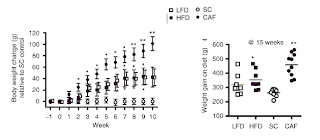
Since we're talking about fructose and the liver of late, I thought I'd bump this post.  In this study groups of rats were fed one of four diets.  The "low fat" diet is better described as a high sucrose diet as 35% of the diet was sucrose.  This replaced 35% of the fat in the 45% "high fat" diet.  While the LF and HF rats gained a little more weight than the standard (also LF at 12%) chow rats, it is clear that the high fat has rather more negative metabolic effects.  I don't think the 35% sucrose diet was beneficial, rather the contrary, but that level of sucrose consumption, every single day for 10-15 weeks (which is quite a long time for a rat) is also hardly indicative of even SAD consumption. Original Posting:  3/8/11 It seems fairly generally accepted that whatever the cause or progression, the so-called Metabolic Syndrome, Syndrome X and Type 2 Diabetes are associated with a dysregulation of adipose tissue metabolism, and fat tissue that ...

Insulin Resistance ~ Part I: A condition in dire need of diagnostic clarity

I've written many times about how we need some new disease classifications, names or something for the various conditions that are currently termed "diabetes".  This is because hyperglycemia -- the predominant symptom that garners a diabetes diagnosis -- can have many underlying physiological bases.   In this post I'm going to make the same case for the pathologies lumped together under the term "insulin resistance" (from hereon, IR).   The problem with discussions of IR are similar to those of diabetes.  In a nutshell, hyperglycemia is to diabetes as glucose transport/disposal is to IR.  Just as blood glucose is the myopic focus of many discussions of diabetes, so, too, insulin's role in glucose transport is the myopic focus of many discussions of IR.    Let's begin with a diagnosis of insulin resistance.  The most commonly used single diagnostic parameter for this is something called the HOMA-IR .  This ratio is determined from fasting pla...

Adiposopathy

Presented without comment on the content per se: Role of the Adipocyte, Free Fatty Acids, and Ectopic Fat in Pathogenesis of Type 2 Diabetes Mellitus This is probably the most exhaustively referenced review article I've ever come across on the etiology of MetS and T2 Diabetes and the role of adipose tissue.  Too extensive to quote w/o copying the whole darned thing, although I may revisit it at some point to do a bullet point summary type post.  

Adipose Tissue Characteristics in Obese Teens & Insulin Resistance

Cellularity and Adipogenic Profile of the Abdominal Subcutaneous Adipose Tissue From Obese Adolescents: Association With Insulin Resistance and Hepatic Steatosis Yes ... I'm going to be on a bit of a bookmarking post spree here :-) This study looked at fat cell size and proliferation in obese teens and compared this to IR and fatty liver.  This study seems to be consistent with the whole "critical threshold" or "normal fat capacity" theories on why some obese are relatively "metabolically healthy" while others are not.  I've not, however, had a chance to read thoroughly. Conclusions:  A reduced lipo-/adipogenic capacity, fraction, and estimated number of large subcutaneous adipocytes may contribute to the abnormal distribution of abdominal fat and hepatic steatosis, as well as to insulin resistance in obese adolescents. Thinking out loud:  It seems more and more to me these days that abdominal fat - visceral in particular - is our short term bu...

Adipocyte Size & Adipokine Secretion

Image
Relationship between Adipocyte Size and Adipokine Expression and Secretion Context : Adipocytes are known to release a variety of factors   that may contribute to the proinflammatory state characteristic   for obesity. This secretory function is considered to provide the basis for obesity-related complications such as type 2 diabetes   and atherosclerosis. Objective : To get a better insight into possible underlying   mechanisms, we investigated the effect of adipocyte size on   adipokine production and secretion. Design, Patients, and Main Outcome Measures : Protein secretion   and mRNA expression in cultured adipocytes separated according   to cell size from 30 individuals undergoing elective plastic   surgery were investigated. Results : The mean adipocyte volume of the four fractions ranged   from 205 ± 146 to 1.077 ± 471 pl. There were strong linear correlations for the secretion of adipokines over time.   Secr...

Insulin Resistance and Inflammation

Chronic inflammation in fat plays a crucial role in the development of obesity-related insulin resistance This is yet another paper demonstrating that the evidence strongly points to the fat cells being the origin of the sequences of events leading to peripheral insulin resistance.  This paper looked at inflammation. Abstract: Insulin resistance arises from the inability of insulin to act normally in regulating nutrient metabolism in peripheral tissues. Increasing evidence from human population studies and animal research has established correlative as well as causative links between chronic inflammation and insulin resistance. However, the underlying molecular pathways are largely unknown. In this report, we show that many inflammation and macrophage-specific genes are dramatically upregulated in white adipose tissue (WAT) in mouse models of genetic and high-fat diet-induced obesity (DIO). The upregulation is progressively increased in WAT of mice with DIO and precedes a drama...

Adiposopathy v. Obesity ~ I

I just came across the following article, and haven't quite digested the whole thing just yet.  Still, it is interesting so I thought I would share it here.  This post will be about the most curious topic in this paper, but I hope to revisit this in a series of future blog posts (hence the "I" in the title).   Adiposopathy Is a More Rational Treatment Target for Metabolic Disease than Obesity Alone Near as I can tell, the lead author, Harold Bays, is the doctor who coined the term "adiposopathy" or "sick fat".   Adiposopathy is pathologic adipose tissue dysfunction that may be initiated and/or exacerbated by fat accumulation (adiposity) in genetically susceptible patients [1••].  Adipocytes are metabolically active and adipose tissue is an important endocrine organ (Table 1) [2••]. Abnormalities of adipocyte factors contribute to dysmetabolism (Fig. 1), and adiposopathy [1••,3•] promotes some of the most...