Posts

Showing posts with the label Fatty Acid contents

Nina Teicholz Distorts the Fatty Acid Content of Wild Animals

Image
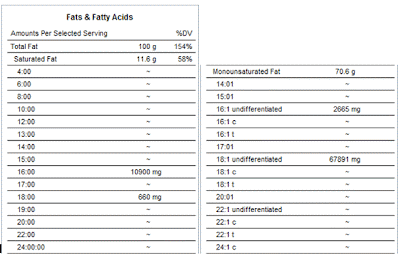
direct link   African Buffalo I have recently revisited Chapter 1, The Fat Paradox, in The Big Fat Surprise , and it's safe to say that Nina Teicholz's contentions about the diets of Native Americans are grossly inaccurate.  The "all the Indians ate meat" is rounded out by a British physician named Prentice who visited South Central Africa and attributed rampant meat eating to the natives there as well.  An then (begins at location 327 of 12033 in Kindle version) : ... no savvy heart disease researcher can read these historical observations without raising a standard and reasonable objection, namely, that the meat from today’s domesticated animals is far more fatty— and a greater proportion of that fat is saturated— than was the meat from wild animals roaming around a hundred years ago. Experts argue that the meat from wild animals contained a higher proportion of polyunsaturated fats, which are the type found in vegetable oils and fish. IV   If wild anim...
Nutritional Content of Some Specialty/Organ Meats

Image
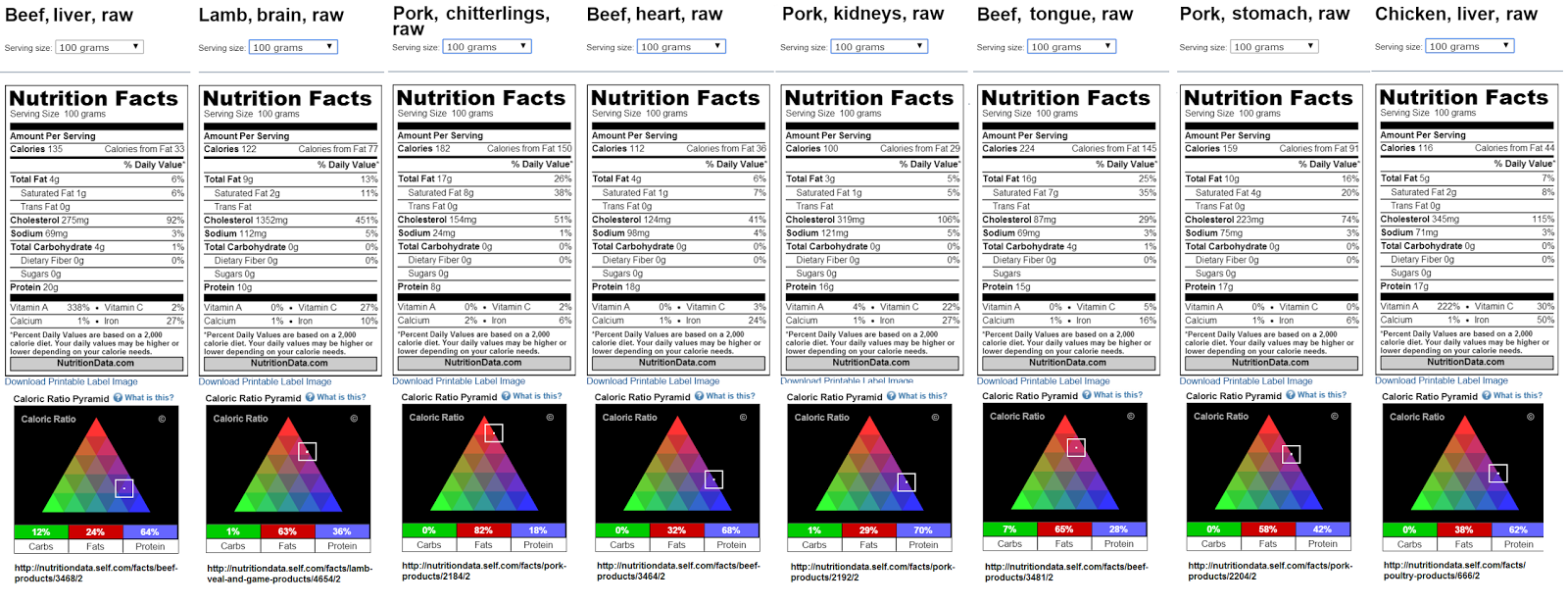
I have long been troubled by the "they ate nose to tail", and all of the fatty organs.  By FAR, the most common organ mentioned is the liver.  Ahem.  The liver is not supposed to be fatty, and I don't think these people are really so hypocritical as to eat foie gras and claim that's what they mean.  Well .... As the fauxtrage over the not-yet-released 2015 Dietary Guidelines rages on over on Marion Nestle's blog , George carries the fatty offal flag in to blame American health issues on our Orwellian fear of the fat in organ meats ... at the hands of the DGAC.  Yeah, if by that he means we've been avoiding tongue, tripe and brains (classic American fare!), I guess he has a point.  Actually, as you'll see, many of these meet the DGAC's definition of "lean" (< 10 grams per 100 grams weight), but are not "low fat" by percentage.    So just a little sampling of some specialty/organ meats.  You can click, resize in browser, ...

Fatty Acid Contents of Some Fats: Avocado, Coconut, Olive, Walnut, Butter, Lard, Beef Tallow, Salmon, Seal

Image
Almost all of these are for 100 grams fat.  For comparison only.  Click on image and resize in browser.  Compiled from nutritiondata.com.

It's Question Time Again ... Saturated Fats

I have a few questions, but will stick to two.  Feel free to chime in with anything even remotely related! Also, let me preface this by stating that I haven't had the time to deeply digest the various studies that have come down the pike lately exonerating saturated fats.  Any summaries or links to summaries would be greatly appreciated in this regard.  That said ... 1.  Has there ever been an RCT -- or even an uncontrolled trial -- where saturated fat intake was increased on an absolute level (preferably on a weight stable diet) and improvements were seen in cardiometabolic risk factors (or other health measures)? 2.  It is my understanding that mostly the effect (or lack thereof) of saturated fats have been assessed mostly in that 30-to-40% total fat range of the typical Western diet which usually puts sat fat in the 10-15% range.  Would you say this is correct?  If not, are there studies comparing a true low saturated fat diet to a hig...

Fatty Acid Content of Avocado Oil

Image
From nutritiondata.com  (using 100g) for avocado oil: Summary: ~71% MUFA, Predominantly oleic acid (>95%) ~12% Saturated Fat, Predominantly palmitic acid (almost 95%) ~14% PUFA  Omega 6:Omega 3 ratio = 13:1 Yes, as sometimes happens with the data from this website, the numbers don't add up exactly.

Fatty Acid Contents of Foods: Chicken Fat

Image
This surprised me somewhat :( From  http://www.nutritiondata.com/facts/fats-and-oils/598/2 Roughly 20% PUFA with a 19.5:1 ratio of O6:O3

Fatty Acid Contents of Foods: Lard / Pork Fat

Image
Per 100g Lard

Fatty Acid Contents of Foods: Olive Oil

Image
For 1tablespoon  Detailed FA profile of  Olive Oil   per 100g  Olive oil is almost 75% MUFA, 15% SF and 10% PUFA.  1T contains a little over 1g of O6 and about 100 mg of O3.  The O6:O3 ratio is just < 13:1  (12.8)

Fatty Acid Contents of Foods: Eggs

Image
From  NutritionData.com for 1 Large (50g) Egg, Poached Note the O6:O3 ratio   572 mg/37 mg amounts to a >15:1 ratio! A whole egg is ~10% fat by weight, 63% by calories (likely a bit less as grams are rounded)

Fatty Acid Contents of Foods: Beef Fat vs. Seal Oil

Image
Another random listing from fatty acid compositions at www.nutritiondata.com This post was precipitated by the oft cited Inuit as an example of the benefit of an almost all "meat", very high fat diet.  I've noticed that many of those practicing this version of a "Paleolithic" diet, tend to consume a lot of beef and rarely eat even the fish which are another staple of the Inuit diet.  So I decided to compare beef fat to that in seal oil.  The contrasts are quite stark!!

Fatty Acid Contents of Foods: Butter & Coconut Oil

Image
On occasion I look up this type of info on www.nutritiondata.com -- it comes from the pull-down analysis of the fats.  This is for one ounce (28g) of butter.  (NOTE:  I suspect there is an error here on the serving size vs. fat content.  Normally 1T butter has ~11g total fat) Of note, a little more than 3% (~1/2 g) of the total fat is butyric acid, the short chain fatty acid product that is the byproduct of some soluble fiber metabolism.  Butter also contains 3.6% of capric and caprylic acids combined -- these are the 8 & 10 carbon medium chain triglycerides in "MCT oil".  Lauric acid (12C)  is 2.7% (this is the longest chain length characterized as medium chain, that is almost 50% of the fatty acid content of coconut oil).  All in all, the short and medium chain triglyceride content of butter is 11.6%, of which ~8.4% are classified as MCT's.  By contrast, coconut oil (source: wikipedia) is a little more than 60% MCT's. The PUFA's a...