Posts

Showing posts with the label Triglyceride/Fatty Acid Cycle

Insulin Treatment in Diabetes ~ Why Does It Often Cause Weight Gain?

S ummary: Diabetes, whether Type 1 or Type 2, is a dysfunctional, wasteful metabolic state.  As a result, an uncontrolled diabetic either uses or loses more energy than their non-diabetic selves would otherwise use.  As such, the untreated diabetic is essentially "underweight" compared with the body weight that the same energy intake would produce were they not diabetic. There are differences in endogenous insulin production between the two types of diabetes.  In Type 1, there is effectively no insulin production.  In Type 2, there is usually elevated basal insulin production, but a relative deficiency in acute insulin secretion, specifically an impaired early insulin response to glucose (GSIS).  The absolute or relative insulin deficiency results in the following to a greater or lesser degree: Excessive lipolysis resulting in an increased cycling of the Triglyceride/Fatty Acid cycle.   Impaired suppression of glucose production in t...

The Great Cholesterol Con-Artist: Malcolm Kendrick

Image
There has been a spate of studies and commentaries coming out of late related to plasma saturated fatty acid content, dietary sat fats and carbohydrates.  It gets mightly frustrating to hear the same arguments made over and over, when some basic calculations and critical radiolabel-tracer studies have shown otherwise for over 15-25 years now (and longer, I'm talking major summary papers and supporting studies).  And still .... What Happens to the Carbs Kendrick is a Scottish physician, author of The Great Cholesterol Con , hence my title.  He's also a card carrying member of  and spokesman for THINCS:  THe International Network of Cholesterol Skeptics.    Sadly, his skepticism and paranoia have turned him into quite the con artist ... feet planted firmly in denial. Professors, who shall be nameless, appear unable to admit how basic human physiology works. For example, they may concede a few steps here and there, but they will never...

The 2005 Biochemistry of Obesity, Marks' Basic Medical Biochemistry

Image
A short "image park" in my ongoing effort to document the state of the textbook science of fat storage, obesity and adipocyte function circa the writing of a three PhD thesis worthy tome.   This from Marks' Basic Medical Biochemistry , 2nd Edition, 2005.  Thus, although activation of hormone-sensitive lipase during fasting results in the release of fatty acids from adipocytes, the release is carefully modulated through glyceroneogenesis and re-synthesis of triglycerides.

Where do triglycerides come from? Part I (Updated)

Image
This post contains sufficient updates from the original (dated 5/11/11) that I consider it more of a fully updated version vs. a bump.   This began with my intent to link to this post in an upcoming discussion of triglycerides, when I noticed that Dr. Ronald Krauss was amongst the authors.   This study originally caught my eye because of    Marc Hellerstein 's name, he of  DNL not a major pathway in humans fame , that I've  blogged on  previously. Now I have excerpted copiously from the discussion because the authors make several points relevant to the discussion of what comprises a healthy lipid profile.  As part of updating, I am breaking those excerpts up a bit more and adding some/more emphasis and additional commentary.

Aug. 1 Over the Hump Bump: Baby your Pancreas? Part I: The Tired Pancreas

Another two-fer for the Thursday post bumps again this week.  More explanation for why this set in the next bump. Original Publish Date:  7/26/11 In the comments on  a recent post on beta cell lipotoxicity , Ned Kock (of Health Correlator blog) posted a link to a post he made a while back entitled:   Lipotoxicity or tired pancreas? Abnormal fat metabolism as a possible precondition for type 2 diabetes .  This article deals with the concept of the "tired pancreas" in the development of diabetes.  It seems that (and hopefully he corrects me if I'm wrong here) Ned and I agree that this is not a likely explanation for diabetes.   Ned summarizes the progression of obesity induced T2 diabetes from  Unger & Zhou, 2001 .  It is worth mentioning that Unger is often summarily dismissed from the "scientific discussion roundtable" by low carbers because of the unfortunately titled "Gluttony and Sloth" paper, that, even more unfortunatel...

Revisiting Taubes' Four Facts from the Sixties

Image
In Good Calories Bad Calories , Gary Taubes wrote the somewhat shockingly definitive summary paragraph below (I've separated out the numbered statements for clarity):   By the mid-1960s, four facts had been established beyond reasonable doubt: (1) carbohydrates are singularly responsible for prompting insulin secretion; (2) insulin is singularly responsible for inducing fat accumulation; (3) dietary carbohydrates are required for excess fat accumulation; and (4) both Type 2 diabetics and the obese have abnormally elevated levels of  circulating insulin and a “greatly exaggerated” insulin response to carbohydrates in the diet, ...  (Kindle Locations 8010-8014)

Chronic Exposure to Free Fatty Acid Reduces Pancreatic β-Cell Insulin Content by Increasing Basal Insulin Secretion That Is Not Compensated For by a Corresponding Increase in Proinsulin Biosynthesis Translation

Image
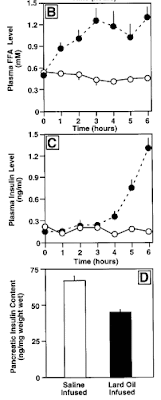
Coming next in the discussion of diabetes I am going to discuss insulin secretion in greater detail.  I was reminded of this post in the writing process.  So ... Bump! Original Publish Date:  4/4/11 Chronic Exposure to Free Fatty Acid Reduces Pancreatic β-Cell Insulin Content by Increasing Basal Insulin Secretion That Is Not Compensated For by a Corresponding Increase in Proinsulin Biosynthesis Translation JD McGarry contributing author. {Please note:  Excerpts from the text will be edited somewhat to avoid "cluttering" references, statistical values, and some rounding of numbers.  Text will sometimes be presented in bullet form or with paragraph breaks to ease reading.  It is not my intent to plagiarize nor to alter the content.  If anyone feels I've altered the content in any meaningful way, do please let me know!}  Direct quotes will be indented. FFA are an important physiological fuel for islets, and act as a sup...

Hacking Jimmy Moore's Latest Lipid Report

Image
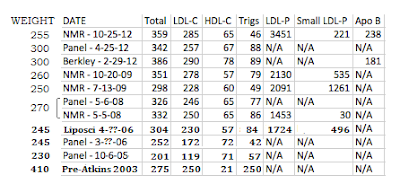
So Jimmy Moore has released his latest lipid panels , after losing 50-or-so pounds in 5 or so months of his nutritional ketosis experiment.  Before I comment on these, a huge revelation was made in the post: Interestingly, before I started on the Atkins diet in January 2004, my highest total cholesterol was only about 230. Of course, my doctor put me on both Lipitor and Crestor to lower that number and it did get down to 130 at some point (don’t know what the breakdown was of HDL and LDL nor do I know what my triglycerides or LDL-P were at the time either). Ummm ... Jimmy, do you even bother to look back at your own blog? Seems not, which is a darned pity for someone so darned and determined to figure all of this out, but who doesn't even look at his own data.   Before I started livin’ la vida low-carb , my HDL was a dismal 21 and my triglycerides hovered over 250. My LDL was about 250 which brought my total cholesterol to around 275. It wasn’t a pretty picture.

Insulin Doing Its Thang! And Still No Starving Cells

Image
In comments yesterday, Wayne/ProudDaddy wondered whether triglycerides might be the bad guy instead of NEFA based on this study from Keith Frayn's research group: Adipose tissue fatty acid metabolism in insulin-resistant men . Aims/hypothesis   Increased NEFA production and concentrations may underlie insulin resistance. We examined systemic and adipose tissue NEFA metabolism in insulin-resistant overweight men (BMI 25–35 kg/m 2 ).

Fat Tissue Regulation ~ Part IX: ASP, LPL and the Triglyceride/Fatty Acid Cycle

Image
In this installment, we reunite with our old friend C3KO mouse to learn a little bit more about the role of acylation stimulating protein, ASP, in the regulation of fat tissue (and muscle) from this study:   Differential regulation of fatty acid trapping in mouse adipose tissue and muscle by ASP .  The C3KO mouse was discussed in Part II of this series.  This mouse lacks the gene to produce a protein called C3 (short for Complement 3) which is a precursor for the formation of ASP.  Thus C3KO mice are ASP deficient.  The C3KO is to ASP as a type1 diabetic is to insulin.  These mice are also resistant to obesity.  BTW, hyperASPemia accompanies the hyperinsulinemia and hyperleptinemia of obesity when it's measured. ASP-deficient mice have delayed postprandial triglyceride (TG) clearance and reduced WAT mass. The objective of this study was to examine the mechanism(s) by which ASP deficiency induces differences in postprandial TG clearanc...

Exercise & Fat Mobilization ... and starving cells & hunger

Image
There's no denying it, TWICHOO is down to a broken toothpick where the science is concerned.  (See here for the toothpick reference if you're a newer reader.)   The remaining claim supporting TWICHOO rests on the action of insulin on the fat cell.  Insulin does indeed act to stimulate esterification and suppress lipolysis, favoring deposition and accumulation of triglycerides in fat cells.  They even teach this stuff in some medical schools I'm told!  So these days it's all about how carbs make you hungry and overeat (although overeating is so inane) because they stimulate insulin which traps all your fat calories in your fat starving the rest of your cells of energy.  Now, that part's not true, but let's for the sake of argument assume it is.  What, then, would cause you to lose weight and not be hungry?  Why anything that favors net mobilization of fat stores -- that is stimulates lipolysis and fatty acid release from fat cells.  This wil...

The Triglyceride/Fatty Acid CycleS and the role of Glyceroneogenesis

Image
Thanks to a certain journalist, much of the discussion of fat tissue metabolism on the internet presents a very myopic view of things taken out of context.  One example of this, is that in Chapter 22 of GCBC, Taubes lists all of the hormones acting on adipocytes.  The caption on the graphic reads: In 1965, hormonal regulation of adipose tissue looked like this: at least eight hormones that worked to release fat from the adipose tissue and one, insulin, that worked to put it there. Let's leave aside for a moment that in the four subsequent decades preceding the writing and publication of his book, probably the most potent regulatory hormone of fat mass, leptin, was discovered.  Let's also leave aside all of the other adipokines (the term for the collection of hormones and peptides produced by adipocytes most of which appear to be secreted).   There's a lesson to be learned solely from Taubes' narrow, outdated view.  Under the title "Hormones that promo...

Glyceroneogenesis & The Triglyceride/Fatty Acid Cycle Revisited

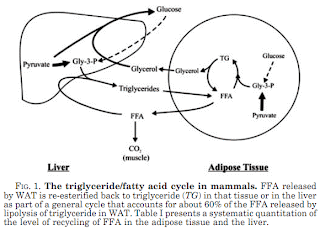
Glyceroneogenesis and the Triglyceride/Fatty Acid Cycle     (TAG/FA) JBC Papers in Press, June 4, 2003, DOI 10.1074/jbc.R300017200 Lea Reshef, Yael Olswang, Hanoch Cassuto, Barak Blum, Colleen M. Croniger, Satish C. Kalhan, Shirley M. Tilghman , and Richard W. Hanson The above paper is referenced in Good Calories, Bad Calories , and is a paper I believe one cannot read thoroughly and still believe that dietary carbohydrate is required in order to "fix" fat and become obese.  It has been quite a while since I read it in its entirety.  Doing so in recent days I've noticed even more information in this paper that counters the whole notion that more dietary carb leads to more glycerol-3-phosphate leads to more esterification of fatty acids to the storage triglyceride form.   More specifically, these four paragraphs/excerpts were somewhat drowned out for me in my first reading:

Fructose, Fat & Obesity

Image
The other day, Stephan Guyenet shared some of his own thoughts on David Despain's can't-say-enough-nice-things-about-it interview with Dr. John Sievenpiper.  In case you missed it, Stephan discusses his post looking at the links or lack thereof  between sugar consumption per se and obesity.  See:   Is Sugar Fattening?   At the end of the current post is the following footnote: ** If fructose is fattening due to its ability to become fat, then dietary fat should be even more fattening because it doesn't have to undergo an inefficient conversion process-- it's already fat. Excellent point!  I might add that if saturated fat is such a healthy fat for your body, fat produced by de novo lipogenesis -- mostly palmitic acid in the liver -- would be an even better source of that fat as it would give you a "metabolic advantage"!   It takes almost no calories to digest and store dietary fat in body fat.  It is highly energy intensive to convert fruct...

Fat Tissue Expansion: Part I ~ Terminology

One of the things that irks me about discussions of various obesity related topics is the inappropriate use of terminology.  I would like to give the benefit of the doubt and presume that for most who do this, it is inadvertent.   Often this is due to not having a complete understanding of human metabolism and physiology (cough ... ahem ... Mr. Gary Taubes) , but at some point, when speaking from a presumed position of authority, this excuse doesn't cut it.  To be fair, the peer review literature and higher level texts are rife with inconsistencies of their own.  Most authors are likely simply using the term they are most familiar with not realizing that those terms mean different things in different contexts.  Still, a careful reading of said literature is all that is needed to understand how they are using the terms and the process to which they are referring.   This has been briefly addressed here previously .   As with insulin res...

Fat Tissue Regulation ~ Part VI: Journey & Fate of Dietary Fat

Image
Regulation of fatty acid transport and storage: influence of acylation-stimulating protein Katherine Cianflone and Sabina Paglialunga, 2006 Commonly, the dietary sources of fat exceed the actual needs and the tissues are faced with dealing with the excess. Under these circumstances, the removal process of dietary triglycerides and fatty acids becomes overloaded, resulting in excessive postprandial lipemia and accumulation of chylomicrons, remnant particles and non-esterified fatty acids. These particles are associated with disruptions in lipoprotein metabolism and changes in inflammatory factors, thus their association with cardiovascular disease, metabolic syndrome and diabetes is not surprising. Dietary factors, not just fat, influence postprandial fluxes. This leads to the question: do we need a standardized fat tolerance test? I've been reading a lot of studies lately dealing with postprandial clearance of fats from the blood and it certainly seems to me that these are coales...

Fat Tissue Regulation: Part IV ~ How Acylation Stimulating Protein Works

Image
Lipases are a tricky bunch of enzymes when one is looking to the action of an enzyme to extrapolate to overall regulation of fat mass.    What do lipases do?  They are enzymes that facilitate lipolysis, which is the breaking apart of triglycerides into glycerol and three fatty acids.  We have digestive lipases that break dietary triglycerides down so that they can be absorbed, but once absorbed they are packaged again back into triglycerides for transport to cells.  These triglycerides are packaged in chylomicrons.  There are lipases both in circulation and attached to all of our different cells, called lipoprotein lipases (LPL's) that break down triglycerides to free up fatty acids.  Those associated with the cells are doing so to facilitate uptake of the fatty acids.  Here's where it gets tricky, because lipases associated with, say, muscle cells, are acting to bring fatty acids into the cell to be oxidized for energy.  But the lipases asso...

The Dietary Source of Body Fat

Image
Over on Stephan Guyenet's blog, in the comment section of his post on Humans on a Cafeteria Diet , a little discussion was started by one disgruntled reader (or I suppose ex-reader since this post apparently pushed him over the edge to unsubscribe) regarding where the fatty acids in our body fat came from.   Stephan wrote:   When a diet of mixed macronutrient composition is eaten to excess, the carbohydrate is preferentially burned off, while the fat is mostly shunted into fat tissue. This makes sense, because why would the body go through the inefficient process of converting carbohydrate to fat for storage when it can just shunt dietary fat directly into fat tissue? Said reader commented:   "This post has good info, but suggesting the fat is stored as fat is absolutely wrong and is bad science."     A discussion, contributed to by yours truly, ensued.  I think this is illustrative of just how damaging towards ultimate progress in the realm of understandi...

What Does Insulin Regulate Anyway?

Image
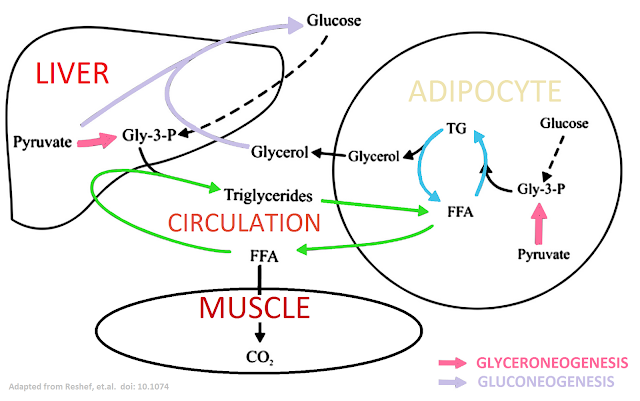
I'm not a fan of arguments over semantics, but at the same time I can be a stickler for the notion that "words count" at times.  When I hear the word regulate, as in A regulates B, I substitute the word control.  So A controls B.  And this ultimately means that A determines what B is.   Part of TWICHOO* is that insulin "fundamentally regulates" fat accumulation.  What Taubes is saying is that insulin regulates fat tissue mass.  Insulin controls fat tissue mass, and ultimately that means that insulin levels determine how fat you are.    *Taubes Wrong Insulin Carbohydrate Hypothesis Of Obesity The TAG/FA Cycle To state his case, Taubes zeros in on the TAG/FA cycle that occurs continually in the fat cell, and the known fact that insulin plays a role in  this cycle.  This is not in dispute, although the relative weight of insulin's actions on the outcome may be somewhat argued in these circles. The full TAG/FA cycle is pict...

Of Microscopes and Myopic Hypotheses

Image
Surely somewhere somehow in your life you've used a microscope.  If this was in grade school, perhaps the teacher set it up for you, but most do not escape high school or college, even as non-science types, without using one at some point.  Here is your basic microscope you might encounter in a biology or forensic chemistry lab or such.    The light shines up from the bottom, through your sample, up through the objective lens that magnifies the image and through the eye tube to your eye.  The eyepiece usually adds additional magnification (10X).  A choice of three objective lenses that can be "dialed in" is quite common.  Note the different lengths of these.   The shortest lens is the lowest magnification lens and is often called the low power objective.  As lens length increases so does the magnifying power of the lens.  The technique for using the microscope is pretty universal and begins with something that sounds rather silly: ...