Posts

Showing posts with the label Metabolic Rate

The $12M NuSI/Ludwig Study ~ Part V: Intake, REE and TEE Measures

Image
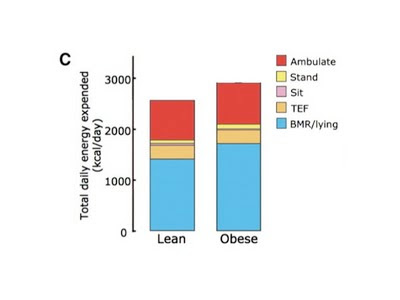
S ummary: Continuing on with discussion of:   Effects of a low carbohydrate diet on energy expenditure during weight loss maintenance: randomized trial Previous posts in this series: Part I: Critique of the Study Design Part II: $12 Million for 12% Weight Loss? Part III: Some "Early" Lessons Part IV: Insulin Resistance Does Not Hamper Weight Loss This post should perhaps have come first, but it has taken a while to look deeply at the data for the primary outcome -- total energy expenditure measured by doubly labeled water -- and related outcomes of intake and resting energy expenditure. In this study, all participants were paid to participate, AND provided free food for ~8 months.  Said food was professionally and meticulously prepped, weighed, measured, individualized to provide each subject with some pretty exact caloric level and macronutrient composition.  The test phase (in other words, the study proper) involved maintaining a consiste...

The $12M NuSI/Ludwig Study ~ Part III: Some "Early" Lessons

Image
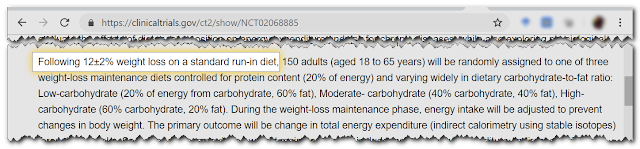
S UMMARY Continuing on with discussion of: Effects of a low carbohydrate diet on energy expenditure during weight loss maintenance: randomized trial In Part I , I discussed some issues with methodology, mostly focusing on the reduced Run-In Phase that likely compromised the outcomes irreparably. In Part II ,  I highlighted a serious issue with the Run-In Phase, the purpose of which was to produce a somewhat homogeneous "reduced weight state" to test various diets in maintenance of that state. Ultimately,  randomization to the various test diets occurred after weight loss (PWL) all subjects lost weight on the same 45% Carb / 30% Fat / 25% Protein diet targeting a weight loss of 12% ± 2% initial body weight. The researchers do not appear to have made many adjustments in the weight loss phase to produce a more uniform weight loss.   Rather than 12% ± 2%  (from 10% to 14%)  losses, the actual outcome was roughly 10.5% ± 5% (actual ...

The $12M NuSI/ Ludwig Study ~ Part II: $12 Million for 12% Weight Loss?

Image
U PDATE:   12/17/2018      Original Posting: 12/3/2018    During the writing of a new installment in this se ries, I revisited the following paper: A randomized study of dietary composition during weight-loss maintenance: Rationale, study design, intervention, and assessment Yes, folks, so full of themselves were these researchers, that they felt the need to write an entire paper (submitted approx. one year in advance of the "real study") outlining their amazing study. Regarding this post, focusing on the OUTRIGHT FAILURE TO IMPLEMENT THEIR STUDY DESIGN AS STATED , I stress the following from the previous paper. ONCE AGAIN, the stated goal of the weight loss run in is 12% ... not 10 or 5 or 15 or whatever ... 12%.  I'm just going to quote the relevant part here (cleaned of references, etc. and formatted for readability, all emphasis mine) Energy intake was restricted to 60% of estimated needs to achieve a target weight loss equ...

Are the Super-Obese the Ones Who Are Metabolically Adapted?

Image
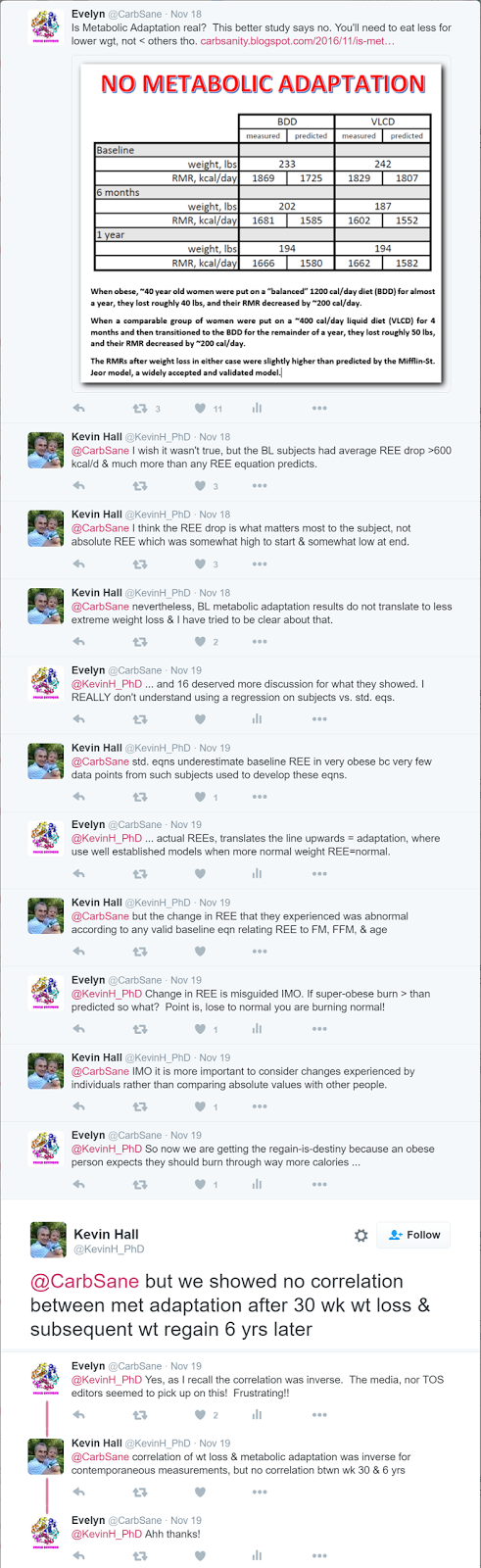
Introduction The current theme of metabolic research seems to have settled on physiological changes, post-weight-loss in the obese, that set the person up for almost assured failure and regain.  It has been reported that the super-obese (usually a term for BMI>40) tend to have REEs that are higher than would be predicted by standard, generally accepted models such as Harris-Benedict or Mifflin-St.Jeor.  This is both what was seen in the Biggest Losers "before" weight loss, and was reported in comments on this blog by Dr. Yoni Freedhoff, who measures REE in the obese he treats.   In order for a super-obese person to fully reverse their obesity, they will need to lose large amounts of weight -- 100, 200 or more pounds.   To do so, most will need to dramatically cut calories to lose at a rate that is motivating enough to sustain a fairly lengthy time period.  Even "fast" weight loss, reported by many, and especially gastric bypass patients, occurs over...

Is Metabolic Adaptation Real? Study 1 of ?

Image
I am ( STILL ) working on a comprehensive post addressing "The Biggest Loser Regain" study and fallout.  But as I was going along the way, I'm finding some gems that really just need posts of their own.  This is one of them.  I'm also going to do my best to clean out the draft bin for the remainder of 2016!     [If you haven't seen the previous entry referencing this topic, here is a link .  If it is some time past the publish date of this current post, this link should be active for the TBLR post.]

Should we worry so much about preserving "Lean Mass" in people who got obese on the SAD?

Image
A few years ago now, researchers led by George Bray of Pennington did a classic overfeeding study, to interesting result.  I blogged on that study in some depth here , but I'll include a brief summary now: Metabolic ward study Determined weight maintaining caloric intake over a period of 13-25 days on a standard diet P/F/C% of 15/25/60% The average maintenance calories for all participants was 2414 cals.  Overfed ~40% of calories or ~950 cal/day for 8 weeks. Carbs in the overfeed were slightly less than absolute amount at baseline, and were 40% of total overfeed calories. Total caloric intake for overfeed averaged 3375 cal/day, where excess calories came from fat and protein only.  The macro ratios of the overfeed diets in P/F/C% were: LP-6/52/42, NP-15/44/41 and HP-26/33/41. Below is the summary table I made for the calories and absolute quantities (grams) of the three macros:

The Latest Metabolic Adaptation Study

Image
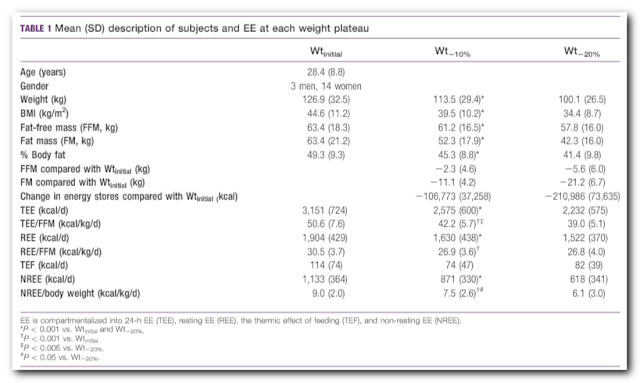
A quick post here just to get it out there, and I'm already a couple weeks behind the curve.  Oddly haven't heard too much about this, or perhaps it's because I've lost the will to deal with the community that would jump on this?  Who knows :-) There is a new NIH funded study out of Columbia (Rosenbaum & Leibel) published this month:   Models of Energy Homeostasis in Response to Maintenance of Reduced Body Weight I'm going to limit this post to just one of the three experiments conducted: In 17 subjects (14 women, 3 men) weight stable energy expenditure and body composition  was determined following a period of 6-8 weeks of weight stability.  They were then put on an 800 cal/day diet until they had reduced their weight by 10% of initial weight.  This took 7-13 weeks, after which their food intake was increased to achieve weight stability at the 10% reduced weight for 6-8 weeks.  Energy expenditure and body composition were measured her...

It's TOTAL Energy Expenditure that Matters, and RMR Doesn't Necessarily Predict It!

Image
Post Overview: In the context of weight loss, maintenance or gain, eventually all roads lead to the acceptance that *calories matter* ... you must be in deficit, balance or surplus respectively. In the wake of the recent The Biggest Loser Regain study , there has been a lot of doom-and-gloom reporting, led by Gina Kolata and Sandra Aamodt  in the New York Times .   I've distilled the results down to the bare bones: Summarized from Table 1 from Fothergill et.al.   14 Contestants (6 Men , 8 Women) The "alarming outcome" was that resting metabolic rate was reduced as might be expected, but seemingly remained suppressed and even further declined despite significant re-gain (70% re-gain/loss for the mean) after 6 years.   However the TEEs -- the TOTAL energy expenditures for the day -- tell a different tale.   These were measured over a roughly two week period by doubly labeled water in free-living conditions. The TEEs remained high at 30 weeks...

Metabolic Lessons from Anorexia Nervosa

Image
I've been poking around some eating disorder research recently due to the recent Elizabeth Licorish-Tara Lipinski kerfuffle (see also the follow-up ). But something else, that's seemingly always a hot topic when calories are discussed, is this concept of metabolic adaptation.  Quite often this gets referred to as having a "damaged metabolism".   I'm just going to use that term (and w/o quotes), and don't mean to imply that it is necessarily appropriate or justified, just that it's easier than explaining it repeatedly.  The damaged metabolism is thought to develop from frequent, chronic, and/or severe calorie restriction.  The mechanism is that the body down-regulates basal metabolic rate such that a 150 lb person who has dieted down from 250 lbs will require fewer calories to maintain that weight compared with a person whose normal, stable weight is 150 lbs.    So I was looking for some additional references about the "hamster wheel" (i...

How Do You Develop or Trigger an Eating Disorder?

Image
When Elizabeth Licorish was 9 years old, she read a skating reference book that revealed that 12 year old Tara Lipinski trained five hours each day, enjoyed a diet rich in spaghetti and marinara sauce, stood 4 feet 8 inches tall and weighed 68 pounds. When she put the book down, did she .... (a) Hop on a bathroom scale (b) Ask Mom to make more pasta with marinara (c)  Request a longer training schedule. The answer to this is the subject of this post.  Apologies for the somewhat longer than intended delay in publishing.  Part I of sorts:   Women, Athletes & Calories -- Does Tara Lipinski Eat Enough? This post was inspired by a reaction piece in Philly Voice by freelance journalist Elizabeth Licorish entitled:   Dear female athletes: Please don’t follow Tara Lipinski’s 1,200-calorie diet.    In Part I, I tried to limit commentary mostly to answering the question in my title, though I did touch on other topics.  I'm h...

Women, Athletes & Calories -- Does Tara Lipinski Eat Enough?

Image
Yes. Blogstress Note:  This post has been brewing ... in my head and in the Blogger draft, for a few days now.  This issue really hit a nerve, but every time I started writing, things got even longer than my usual.    I didn't want it to be unmanageably long, but I also didn't want to start a whole series.  I think I may have found a way to cut this to two somewhat manageable parts, without straying too far off of blog topic. This will be a departure from normal events here, and yet ties in with topics I discuss with some degree of regularity, both in general and within the IHC:  Calories and Eating Disorders. click to enlarge Part I will deal with Calories Part II will deal with Eating Disorders This is going to be female-centric.  Sorry male readers! Without further ado: Yes, something got under my skin the other day on Facebook, and since this is my major outlet for sharing thoughts, I'm blogging about it here.   Apparen...

Energy Expenditure Correlations to Various Factors in Women

Image
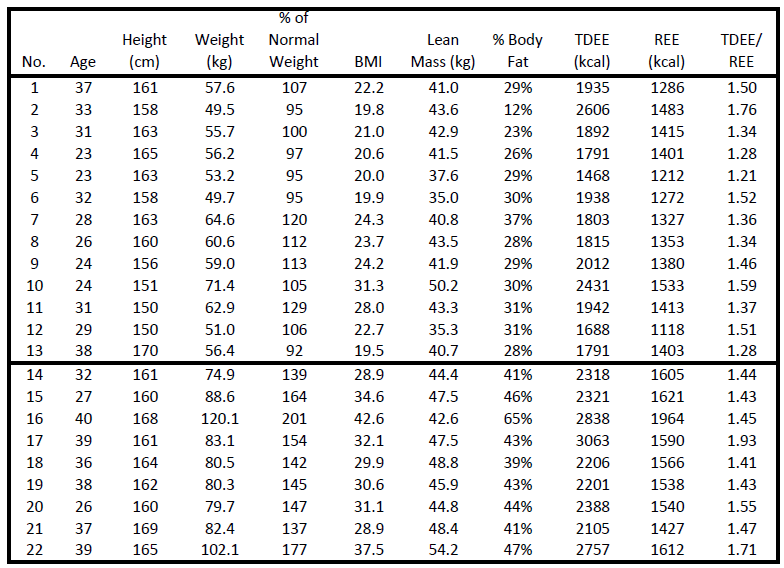
I'm working on a post to tie together some thoughts on calories and what "appropriate" intake generally is for women.  In doing so I came across the following study -- High levels of energy expenditure in obese women -- crunched some of the data into a giant Excel table, and did a few linear regression analyses.  I'm certainly not attempting to create yet another model for all of this, but I did find some interesting things.

Calorie Needs & Expenditure

Image
Hello all! Just a quick follow on post to my previous one on caloric needs inspired by a recent diet comparison RCT.   In comments there, Yoni Freedhoff of Weighty Matters blog (and author of the new book  The Diet Fix: Why Diets Fail and How to Make Yours Work ) made the following comment: The Journal of the American Dietetic Association (I believe) once had a study looking at all of the various calculators (not including Hall's) and it crowned the Mifflin-St Jeor the best as compared with indirect calorimetry results.

Lessons from Diet RCTs I: Calories

Image
Researchers in Sweden have just published the results of a two year dietary intervention involving obese postmenopausal women.   The results and implementation leave much to be desired in terms of providing any useful information vis a vis the diets tested.  I blogged on this HERE .  But if one looks past the diet comparisons, I believe there is some useful information to be had.  I would like to highlight this in this post and however many more I have the time for or choose to break it up into.   The study began with 70 mildly obese women as assessed by BMI.  Here's the tabulation:

The NEAT part about Moving More

Image
Random Bump! Original publish date:  4/21/12 In writing up a post on metabolic rate and weight loss, I couldn't help but come across a ton of stuff I had in my draft bin and hard drive vis a vis exercise, lean body mass and metabolic rate.  This got me thinking about the usefulness of ELMM = Eat Less Move More as a strategy to flip the CICO balance along with other things we can do.  

It's official. Jimmy Moore & Co. aren't interested in solving metabolic mysteries after all

Image
UPDATE 9/14/13:  I am in the process of deciding exactly how to deal with one Dr. William L. Wilson, discoverer of the imaginary CARB Syndrome.    This appears to have been the only post of mine he links to in his unsolicited diagnosis of yours truly with this made up mental illness.   Further he offered treatment in the the form of his Carb-22 supplement.   My purpose for this update is that some have -- rightfully, IMO -- taken him to task for making this bizarre diagnosis on the internet, of someone he has not only not met in person, but apparently knows very little accurate information about based on skimming a few blog posts.  After the fact he emailed me a link to the post, and posted one on another post on this blog.  He is busy answering many challenges to his post on his FB page at the moment.   Rather than re-evaluate the prudence of his actions, he seems to be digging a hole.  One way he is doing that is claiming I am so...

The Hadza Hunter Gatherer Energy Expenditure Study

Image
I've been asked by a few people to weigh in on a recent NYT article,  Debunking the Hunter-Gatherer Workout , that discusses the following study (free full text):   Hunter-Gatherer Energetics and Human Obesity .  I didn't have a whole lot to say until I wrote this, and now it's rather long ... so I guess I did have quite a bit to say after all ;-)   But first, a little link love for Colby Vorland of nutsci.org who discussed this back in July:   Westerner energy expenditure compared to a hunter-gatherer population is equivalent .  In addition, Colby had discussed  Energy expenditure and physical activity level are not higher in developing countries compared to industrialized .  I encourage reading both. So from the NYT article: We found that despite all this physical activity, the number of calories that the Hadza burned per day was indistinguishable from that of typical adults in Europe and the United States. We ran a number of statistical tests,...

A Modest Proposal for Peer Review Research

Image
With the advent of, and inexpensive nature of online sharing of information, I propose that all peer-review research should include (anonymous) raw data for each subject.  At the very least, there should be scatter plots presented for the individual data points for the main outcomes. I frequently teach statistics, and one of the first things we discuss in that class is sort of the "first purpose" of it all.  Because before we can analyze data, first we must summarize and present the data in such a way that the "consumer" can readily glean information.  In one classic stats text -- Triola -- this part is given the acronym CVDOT.  C = Center, V = Variation, D = Distribution, O = Outliers and T = Time.  So we go through the various ways we can convey the center of a data set, it's variability, distribution, etc.  In most of the studies we discuss here, data is presented as a mean value +/- either the standard deviation or standard error (C +/- V in the acrony...

Rapid Weight Loss Tanks Metabolism? The TBL Study

Image
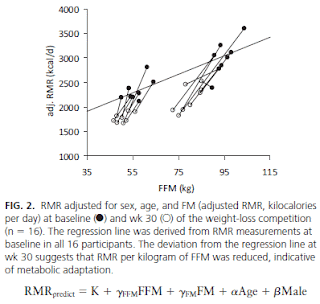
Thanks to Yoni Freedhoff of Weighty Matters blog for providing me with the full text of this one.  Check out his take on the results.  Update 11/11/13:  Full text now available free HERE . Context:  An important goal during weight loss is to maximize fat loss while preserving metabolically active fat-free mass (FFM). Massive weight loss typically results in substantial loss of FFM potentially slowing metabolic rate. Objective:  Our objective was to determine whether a weight loss program consisting of diet restriction and vigorous exercise helped to preserve FFM and maintain resting metabolic rate (RMR). Participants and Intervention:  We measured body composition by dual-energy x-ray absorptiometry, RMR by indirect calorimetry, and total energy expenditure by doubly labeled water at baseline (n = 16), wk 6 (n = 11), and wk 30 (n = 16). Results:  At baseline, participants were severely obese (×± sd; body mass index 49.4 ± 9.4 kg/m 2 ...

Random Thoughts: Obesity, Weight loss, Metabolism, Diet & Exercise

In the interests of saving a bit of time and gathering thoughts, I thought I'd jot down some would-be comment replies in a blog post instead.  First, so we're all (newer readers especially) on the same page, I did no formal exercise during the active weight loss phase and long plateau from sometime summer 2007 through spring 2009.  This was not really by design, but more out of fear as the last time I low carbed I experienced the racing heart mostly when doing rather short periods of pilates and such.  So I kept meaning to up the activity level a bit but never really managed to get around to it.  In 2009 I did start doing concerted cardio -- walking and biking -- and later some more cardio-like exercise DVD's.  As for strength training, the only formal training I have done was that 100 pushups thing that was popular in 2010.  I got to 100 "girlie" pushups and was on my way with the regular ones when I pulled something in my side that made rolling over in b...