Posts

Showing posts with the label Gluconeogenesis

Bio-HACK-ing Chronicles Ep.2: Maybe Jimmy Moore Has Hepatic Encephelopathy

Image
No ... this blog will not become all Jimmy Moore, all the time.  I do have some posts in the works that just need some polish ... including one on the study Ted Naiman bases his 3:1 ratios of grams protein to fat that Jimmy was following.  That said, I can't help but put together a few comments on the Drama Llama supreme's latest n=1. This Episode's n=1 bioHACK:    7 days of "Carnivore" , High Protein (mostly meat) 3:1 grams protein:grams fat.    1.5 grams of protein per pound of lean body mass equaled 270 g protein:90 g fat.   (if you use 40% body fat, that puts his current weight at 300 ... ) RESULT:   Fail.  If you listen at the 43 minute mark of this episode of The Keto Savage podcast , you'll see that it was Jimmy's every intention for this TO fail. The purpose of biohacking is SUPPOSED to be about seeking out ways to improve one's overall health ... to achieve meaningful goals.  This nonsense o...

Insulin Treatment in Diabetes ~ Why Does It Often Cause Weight Gain?

S ummary: Diabetes, whether Type 1 or Type 2, is a dysfunctional, wasteful metabolic state.  As a result, an uncontrolled diabetic either uses or loses more energy than their non-diabetic selves would otherwise use.  As such, the untreated diabetic is essentially "underweight" compared with the body weight that the same energy intake would produce were they not diabetic. There are differences in endogenous insulin production between the two types of diabetes.  In Type 1, there is effectively no insulin production.  In Type 2, there is usually elevated basal insulin production, but a relative deficiency in acute insulin secretion, specifically an impaired early insulin response to glucose (GSIS).  The absolute or relative insulin deficiency results in the following to a greater or lesser degree: Excessive lipolysis resulting in an increased cycling of the Triglyceride/Fatty Acid cycle.   Impaired suppression of glucose production in t...

The Protein Power Plan: Keto? Paleo Inspired?

Image
A little detour into the Protein Power  book by Drs. Mike and Mary Dan Eades, 1996.  Was looking at a few things sparked by the thermodynamics posts he's made, and was surprised by a few things in the PP book that I had never even skimmed until now.  This post didn't fit the thermo topic, so I thought I'd mention this separately (and there may be another post or two coming as time permits). I had never heard of the Eades or their books until I found the low carb community in 2009.  While Atkins remains the primary low carb diet, the PP book/plan is high up on the list for second place, and Eades' blog was still uber popular at that time. Circa 2009 the low carb mantras of the day were largely focused on: Up the fat intake Fat can't make you fat You can't get fat or gain fat weight without eating carbs, so even if you don't lose more weight, at least you won't gain.

The 2014 Reversing Diabetes Knowledge Summit

Image
If you've been around the internet the past couple weeks or so, you're aware that it is apparently Summit Season!  Lots of videos (really audios) that you get to listen to free as a marketing pitch.  Nothing inherently wrong with this, but many of the recent ones have really gotten to the point of ridiculousness.  I mean Jack Kruse was supposed to do a talk for a weight loss summit ... along side Jaminet, Bowden and the Alphabet Soup Couple (the Caltons)?  Ben Greenfield?  Mr. Keto-bonking triathlete is everywhere these days -- fat loss, thyroid, diabetes?  This man sells superencoder bracelets and magic water drops !  What the ......    So yesterday, the " 2014 Reversing Diabetes Summit " began hosted by "Dr." Mowll, and ... get this ... Jimmy Moore.  Forget Jimmy's lack of any credentials or credibility to be hosting such an event, let's look at Dr. Mowll : He graduated from Brandywine High School, the University of Delaware, ...

There's no dietary need for saturated fat ...

Image
Random Bump! Original Publish Date:  6/15/12 There's no dietary need for saturated fat ... ... or monounsaturated fats, MUFA, for that matter.  Therefore low fat diets, where most of the fat is essential PUFA, are optimal.  The body can make all the SF and MUFA we need from carbohydrates.  Furthermore, relying on this metabolic pathway as a source of body fat is metabolically advantageous for weight management as making fat from carbohydrate is an energy intensive process.   Sounds a little silly, right?  I think so.  But so, too, is the ridiculous mantra from low carbers citing the fact (true) that there's no dietary necessity for carbohydrate.  You know the drill, we can make all the glucose we need by gluconeogenesis (just saying that makes me feel smarter) therefore LC diets are optimal.  There is a metabolic advantage built into LC diets because gluconeogenesis requires energy to convert protein to glucose.

Aug. 1 Over the Hump Bump: Baby Your Pancreas? Part II: Go all Jillian Michaels on your Liver?

Image
On Facebook today, Mark Hyman MD (functional medicine doc) posted : There are no essential carbohydrates. There are essentials fats and essentials proteins, but if you never had any carbohydrates again, you would survive. The Teaspoon Party This was brought to my attention but also reminded me that Richard Feinman is at it again with a recent blog post on this no essential dietary carb canard, couched in a history lesson of sorts:   Revolutions. Political and Scientific .  He discusses Claude Bernard finding sugar in a dog that hadn't been fed any carbohydrate.  The question is why ... again ... why ... now?   This idea has earned him an honored place in the group at right.

Hacking Jimmy Moore's Latest Lipid Report

Image
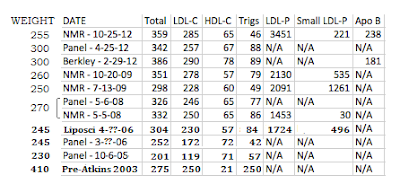
So Jimmy Moore has released his latest lipid panels , after losing 50-or-so pounds in 5 or so months of his nutritional ketosis experiment.  Before I comment on these, a huge revelation was made in the post: Interestingly, before I started on the Atkins diet in January 2004, my highest total cholesterol was only about 230. Of course, my doctor put me on both Lipitor and Crestor to lower that number and it did get down to 130 at some point (don’t know what the breakdown was of HDL and LDL nor do I know what my triglycerides or LDL-P were at the time either). Ummm ... Jimmy, do you even bother to look back at your own blog? Seems not, which is a darned pity for someone so darned and determined to figure all of this out, but who doesn't even look at his own data.   Before I started livin’ la vida low-carb , my HDL was a dismal 21 and my triglycerides hovered over 250. My LDL was about 250 which brought my total cholesterol to around 275. It wasn’t a pretty picture.

AHS(?) Bumpity Bump Bump: When is Fat a Fat?

Image
Soooo ... I've been following the #AHS12 hashtag on Twitter, and I'm not sure this came directly from there or from me clicking on an ID on one of the tweets and then checking out other tweets ... but anyway, I stumbled across this exchange between Aaron Blaisdell and Robb Wolf: 9 Aug Robb Wolf  ‏ @ robbwolf Ruminant fermentation converts cellulose to fats. Cows actually run on a 60-70% FAT diet. Expand   Reply     Retweet     Favorite 16h Aaron Blaisdell  ‏ @ AaronBlaisdell @ robbwolf  Paul Jaminet wrote the same thing in his book Perfect Health Diet Expand   Reply     Retweet     Favorite 7h Evelyn  ‏ @ CarbSane @ AaronBlaisdell   @ robbwolf  SCFA are not metabolized as "fats" . Ruminants convert the bulk of these via DNL to LCFA. http://carbsanity.blogspot.com/2011/02/when-is-fat-fat.html FWIW, Robb retweeted this.  Now I'm pretty sur...

Excess protein turned to glucose?

Image
It seems that part of the more recent trend of defining a "proper" low carb diet as being one that is moderate in protein and high (very) in fat is this notion that excess protein will just be turned to glucose.  Quite often I've seen Dr. Richard Bernstein cautions against eating too much protein because it just gets turned to glucose.  (I did look for a link but was unsuccessful, so if I'm misstating Bernstein here, please do correct me in comments.)   I had looked into this long ago, but never really said much about it, but there are two reasons why this never made sense to me. First, a little biochemistry.  There are exceedingly few reactions that occur in our bodies without the involvement of an enzyme.   This includes not only anabolic (synthesis, building, energy storing/requiring) reactions, but also catabolic (break down, energy releasing reactions) reactions.  Glucose and fatty acids no more "spontaneously combust" in our bodies than do...

The Essential Carbohydrate?

I would ask each and every reader to try as best you can to check their nutritional biases at the door here as best you can  and let's just talk semantics.   What does essential mean?   Something that is essential is something that we cannot do (or in the nutritional context live) without.  By this definition, it is clear that yes, for most humans, carbohydrates are non essential.  However, even this is too simplistic, because without looking very far, we can identify a group of humans for whom carbohydrates are "deadly" essential.  As in imminent death kind of essential.  Relatively rare as is their number, I'm talking about people with glycogen storage/breakdown disorders. Now, let's look at the other macronutrients.  Well, we cannot live without protein.  Therefore it is essential.  No argument.   However, proteins are comprised of 21 distinct building block amino acids of which only 8 are actually identified as *essentia...

Join the Discussion On: Metabolic Consequences of Muscle Disuse Atrophy

This is a rather interesting find that Tsimblist posted over at the Meeting Rooms.  I thought I'd post it up here for exposure and comment.  Are these changes relevant to sedentary VLC/HF folks? Metabolic Consequences of Muscle Disuse Atrophy         T. P. Stein and C. E. Wade       J. Nutr. 135: 1824S–1828S, 2005. Abstract : In response to decreased usage, skeletal muscle undergoes an adaptive reductive remodeling.  This adaptive response has been found with disuse during human spaceflight, rat spaceflight, rat hind-limb unloading, bed rest, and aging.  The reductive remodeling of skeletal muscle with disuse is largely independent of the reason for the disuse.  The process involves more than a transition from slow to fast myosin fiber types.  There are associated metabolic changes including a fuel shift toward glycolysis, decreased capacity for fat oxidation, and energy substrate accumul...
I was a bit taken aback by the title on a recent blog post by Dr. William Davis at his Heart Scan Blog Why doesn't your doctor try to CURE diabetes? Dr. Davis paints the medical profession with a rather broad unflattering brush.   Are there docs out there who are more concerned about profit over your health?  Yes.  Are there doctor-drones who reflexively reach for the prescription pad?  Again, yes.   But I believe that most doctors -- and I know several since before they became docs -- do care about their patients and dole out advice based on what they believe to be the best course of action. Certainly the statement that " Adult diabetes is the one chronic disease that nobody cares to cure " goes more than a bit over the top! Davis goes on to say that most docs don't think it can be cured, and that is probably true.  The old school re: type 2 would be based on when the disease was more rare and probably not detected until progressed significantly to ...

Nutrient Fates after Absorption

Nutrient effects: post-absorptive interactions BY ERIC JEQUIER    (1995) After a meal, the metabolic fuel selection at the whole-body level depends on the plasma concentrations of nutrients such as glucose, non-esterified fatty acids (NEFA) , amino acids, and on hormonal responses. Over the last 10 years, there has been great interest in studying the metabolic effects following the ingestion or the intravenous (i.v.) infusion of the three macronutrients, carbohydrate (CHO), fat, and protein (or amino acids for i.v. infusion). The aim of the present brief review  {I'm thinking it's not so brief!}  is to summarize the main mechanisms which determine the post-absorptive interactions between the nutrients. This is an older paper, but still recent enough to provide some good info on the basics.  I'm going to do something a bit different with this one and I otherwise would be quoting huge chunks.  So I'll do bullet point summar...

Of Thermodynamics, Chemistry, Biology and Biochemistry

The detractors of energy balance theory often say something along the lines that thermodynamics goes out the window in living organisms, the rules don't apply.  Nope.  The existence of the Second Law does not violate the First Law! This simply isn't true, and those who say similar must simply not understand these fields.  Humans are not bomb calorimeters or Carnot cycle/combustion engines .  When Dr. Eades tried to discredit Anthony Colpo a while back, he and his compadre Feinman waxed poetic and evoked nightmares of steam tables in their college thermo courses.

Protein for Energy

Image
I've held off on posting this for a while because it's a screen shot and I have no idea whom to credit. But, since the metabolic pathways are common knowledge, I've decided there's no real harm done "publishing" any depiction of them on my li'l old blog. (If anyone recognizes the graphic, please notify me so I can extend credit) An enduring point of controversy exists in the LC community over higher protein intake vs. higher fat. My personal experience is that the former works for me, but there are plenty of folks doing well on high fat controlled protein approaches. One of the advocates of lower protein intake is Dr. Bernstein the diabetes specialist. Most that advocate his approach agree with his central premise that excess protein is converted to sugar or metabolized as such. While theoretically possible, I've been doing some "re-educating" of myself where protein metabolism, specifically what becomes of any excess is concerned. ...

More Biochemistry Animations

Image
Boyer - Interactive Biochemistry A screen shot of the Menu:

A Neat Gluconeogenesis Tutorial

Interactive Gluconeogenesis Tutorial

PEPCK Website

http://pepck-and-the-ketogenic-diet.com/index.html There's some interesting information on this -- apparently -- "amateur" website.  PEPCK is an important enzyme regulating blood glucose and free fatty acid levels.  It is involved in gluconeogenesis and glyceroneogenesis.