Posts

Showing posts with the label Robert Lustig Fat Chance Fructomania

A Collection of "Accidental Experimental Evidences" Against Sugar/Fructose Addiction

Image
This post may be added to from time to time, to collect in one place evidence against the concept of sugar/fructose addiction.   When added to it will be bumped, and the "skip to using browser search" table of contents below will be updated.   Accidental Experimental Evidences Mice Fed 18% Fructose Mice Fed 60% Sugar or Starch Unmotivated Fat Rats

Hypothalamic Damage and Its Role in Obesity ~ Part I: Background and Hypothalamic Obesity

Image
NOTE: It's no secret that my blogging has fallen off. There are a number of reasons for this, but one of them has been that I start some train of thought or down some research rabbit hole, and just never get around to finishing a post to my liking ... then things move on. This post is such a one. Unfortunately Blogger doesn't date drafts (or I didn't note it before I opened the draft with edit), but the original introduction referenced events that would indicate sometime in October 2015!  It was also around that time that Robert Lustig came out with a study on NAFLD in children. Lustig has made a comeback in my comments section here of late. He has parlayed a career as a pediatric endocrinologist into a bizarre career as a celebrity doctor/researcher who blames obesity and all evils on one molecule: fructose. I say bizarre because he makes unfounded claim after unfounded claim after unfounded claim as regards fructose. Many of his offerings are backed by the Uni...

The Slimey Truth About Sugar Slammers ~ Links & Background

Image
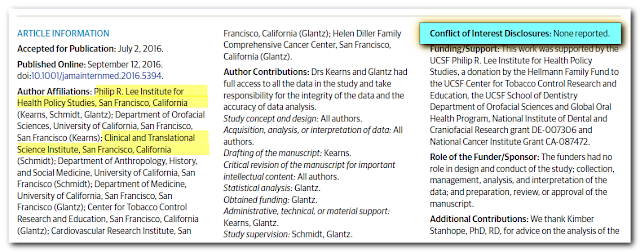
This was initially going to be a monster post, but I'm still struggling to organize it all!  The things uncovered at every turn last week and continuing through this one are astounding, and the hypocrisy of those touting this as some "smoking gun" of great importance is seemingly boundless.  This was all still swirling in my head when I went on Angelo Coppola's Latest in Paleo podcast ... in retrospect not a good idea when I'm wound up! I decided to break this in two to publish something up.  This installment will be linking to background to get something that blogging rock rolling on this.  Unless you've been living under a rock, this happened in the JAMA Internal Medicine : Sugar Industry and Coronary Heart Disease Research A Historical Analysis of Internal Industry Documents Cristin E. Kearns, DDS, MBA 1,2 ; Laura A. Schmidt, PhD , MSW, MPH 1,3,4 ; Stanton A. Glantz, PhD 1,5,6,7,8

Weight Loss on a Very Low Fat High Sugar Diet

Image
A Facebook friend recently posted a screenshot of some papers he'd been reading this past month.  Being the geek that I am, I of course scanned the titles to see if there was anything I might be interested in, and I was shocked to discover this study for the first time!  Shocked in that I'd never seen it before or seen anyone reference it.  Read on and discover that this isn't quite true ...   (As of this post, full text available   HERE . ) Metabolic and behavioral effects of a high-sucrose diet during weight loss  ... 1997  ← Almost two decades ago!!

Sugar Addiction & Minerals ... Accidental Evidence Countering Addiction

Image
Blogstress Note: I wrote most of the analysis in this post around a year ago when I was looking for some additional examples of what I call "accidental evidences" against the concept of sugar addiction (and food addiction in general), just never got to tidying it up.  Therefore this post will be formatted a little oddly as it's what I have time for.  I'll do some general conclusions as regards sugar addiction, and then include the detail afterwards.  Whatever conclusions one might make vis a vis the minerals involved in this study are welcomed in comments, with the understanding that I'll likely not engage on those points due to time constraints.  In the end it seems difficult to arrive at any consistent conclusion  from the study I'll discuss, as results often contradicted themselves from one of the three experiments to the next. While perhaps not as striking as the image I've chosen here, I believe the size (and thus age) differentials of the animal...

With Fructose, Context is Everything

Image
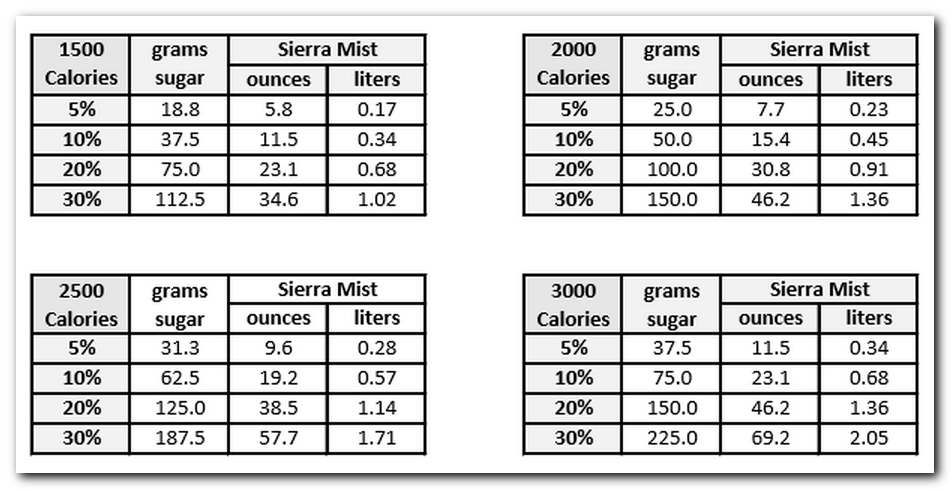
Context is important ... always.  But never so important, it seems, as when we're talking about fructose.  The vast majority of studies used to demonize fructose involve either: Very high doses, and/or An increase in energy intake or overall energy surplus Doing some math, let's use some 500 cal/day increments, a few percentage levels, and  a traditionally sugar sweetened beverage, Sierra Mist ( 26g sugar in 8 oz , or 3.25 g/oz).

Announcing Limited Edition Keto Clarity Commemorative Teaspoons!

Image
Links to scientific background and calculations below.   Oh ... and more teaspoons :-)

Why Fructose is NOT Like Alcohol

Image
Where did this come from? Beginning with his viral YouTube video (I won't link to it, every additional view is one view too many!), and continuing on, Dr. Robert Lustig has been making the claim that fructose is metabolized like alcohol by the liver.  You cannot make your misinformation more clear than to title a section in your book as Lustig did in Fat Chance --   Fructose versus Ethanol:  Pick Your Poison. Before Lustig, I don't think I'd ever heard anyone equate sugar to alcohol on a metabolic level.  A few may have made an addiction analogy, but it was Lustig who "taught" us the "science" that the liver processes sugar just like alcohol. It is shocking to me that his video was produced and distributed by an institution of higher learning as a "Mini Medical School for the Public" presentation.  This implies to me that the content has been somewhat vetted.  Apparently it has not been, and also, nobody within that establishment has...

De Novo Lipogenesis Again (and Science and Science Reporting)

Image
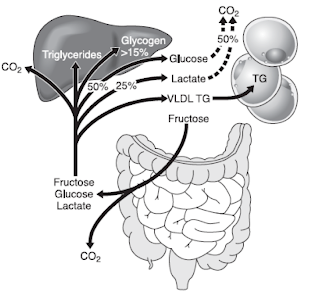
In my last post, I just posted a graphic taken from an "FYI" inset by a scientist, Marc Hellerstein, whose work I've blogged on quite a bit here. (Anyone wanting to refresh can click on the image and enlarge.)  One good post to begin with if you are not familiar with that name is Where do Triglycerides Come From? I would say that between Marc Hellerstein's No common energy currency: de novo lipogenesis as the road less traveled and the works of Eric Jequier such as Nutrient effects: post-absorptive interactions , the case that hepatic DNL is quantitatively insignificant in human energy balance/fat accumulation is strong and has not been refuted by some newer scientific findings.     I do hope to expand on the role of adipose DNL at some future point -- teaser: I have a paper showing that reducing WAT lipolysis upregulates adipose DNL and improves glucose homeostasis in the IGT irrespective of body weight  -- but adipose DNL had not been central to the argu...

Scientific Review of Lustig's Fat Chance

Scientific Review of Lustig's Fat Chance I don't often put blog posts up on someone else's works of this nature, but I'm going to make an exception because Mark Kern has done a thorough job of looking at some of the "science" Lustig puts forth in his book.  {I await the predictable dismissal ;-) }

More Hyperinsulinemia, Insulin-Suppressive Drugs & Obesity (and Lustig)

Image
Building on my last post   on this topic ... So far I've spent most of the blogging on a study comparing 3 doses of octreotide, an insulin suppressing drug, vs. placebo in a subset of obese people pre-tested and determined to be insulin hypersecreters as defined by a corrected ratio for insulin to glucose levels.  This post will focus more on two other studies using this drug, perhaps just the first ... let's see how long this gets ;-)    I think it will be easiest to number the 3 studies, all bearing Lustig's name: Study 1: Suppression of insulin secretion is associated with weight loss and altered macronutrient intake and preference in a subset of obese adults  (2003) Study 2: Obesity, leptin resistance, and the effects of insulin reduction   (2004) Study 3: A multicenter, randomized, double-blind, placebo-controlled, dose-finding trial of a long-acting formulation of octreotide in promoting weight loss in obese adults with insulin hypersecreti...

If you drink OJ, might it just as well be Orange Crush?

Image
I'm sure you've heard it many times -- fruit juices, even unsweetened ones, are still just glasses of sugar, and you might as well be drinking a soda or Tang (remember that?). According to nutritiondata.com, a cup of orange juice contains 21g sugars .  They don't "itemize" in the OJ entry, but if we look at the ratios  oranges we can calculate that of those 21g, roughly 11 g are sucrose, 4.5 g are glucose and 5.5 g are fructose.  Thus for each cup (8 oz) of OJ, you get around 11g of the dastardly fructose poison.  This is roughly the same as you would get in the same amount (small can!) of  orange soda .

The Sugar Twins step in it ... or almost. Part I: Lustig Eats Crap

The Rock'em Sock'em battle of the gurus in Carblandia continued last week as both Lustig and Taubes took to the media airwaves.  I'll now call them the sugar twins because ultimately both hinge their arguments on sugar/fructose.  Lustig says that because fructose is converted to fat in the liver, sucrose is the one food on the planet that is both fat and carb together and that makes it fattening.  That combo is particularly insulinogenic and insulin blinds your brain to leptin so you don't know when to stop eating cheesecake.  Taubes is making his last stand at TWICHOO Bunker Hill by saying that all the bad things he's been telling you for years about carbs -- fat cells going wild, spontaneous horizontal growth spurts, starving cells, etc. -- you may be spared of this forever and eternity so long as you never bathed your liver in fructose.  Fructose causes insulin resistance and sets the wheels in motion for fat accumulation.  Both (misguided) positions hin...

Review & Critique: The Skinny on Obesity ~ Part III Hormones

Image
Previously I've shared my thoughts on Episode I and Episode II in this series.  This third installment in the series is essentially Lustig's version of Adiposity 101.   The video opens with an adamant Lustig declaring that weight management can't be done by eating less and moving more.  It's not doable.  Sigh.  I think at least the vast majority of NWCR members will disagree.  But in any case ...

The Men Who Made Us Fat

Image
Here's the YouTube playlist for the whole thing: The Men Who Made Us Fat    Jacques Peretti A few questions/comments: 1.  Does bread today have more sugar in it (corn syrup), than breads of yesterday?  Talking hamburger buns.  How or why would adding corn syrup to rolls make them last longer as Peretti claims? 2.  Are soft drinks the largest single source of calories in the American diet?  How do we define "source"... 3.  If HFCS (55% fructose/45% glucose vs. 50-50 for sucrose) is sweeter than sugar, is it true what Lustig claims?  If sweeter they should use less in substitute.  Lustig claims they use more.  True?

Bad bad American Science FrUKtion

Image
The topic of this post is a piece by the BBC in advance of blaming two American men for the obesity epidemic in the world today.  So the title comes from that.   So Jacques Peretti weighs in with another piece on how Americans sabotaged the world with sugar  with:   What caused the obesity epidemic in the West?   Jacques is pictured at right behind a ginormous platter of food.  For a piece blaming sugar, one would think the picture would feature pastries and a Big Gulp, but no, it's bread surrounding what appears to be a bunch of dippy fatty stuffs.  Oh ... and we don't just eat too much food, right?  In this latest piece of pseudoscience journalism run amok, Peretti focuses heavily on quotes from Lustig.  I'll come back to some of the rest of that when I get to critiquing the "science" in Part III of the Skinny on Obesity series.  And let's just mention but move on from the most ridiculous statement in that article now shall we?

Contest! Why we get fat ...

Image
... Nah, for a change it's not Gary Taubes or Robert Lustig or any of the other usual suspects hailing from the US making sheet up and mangling facts. No, this article comes from the UK ... if you thought the state of science journalism in the US was bad, wait till you get a load of this specimen of health journalism in the UK!  This one was brought to my attention courtesy of Chris Highcock of Conditioning Research blog. Why our food is making us fat We are, on average, 3st heavier than we were in the 60s. And not because we're eating more or exercising less – we just unwittingly became sugar addicts I count at least 15 glaring inaccuracies, contradictions and/or exaggerations bordering on deceit.  Can you find them?   Winners get free  Gin It Up & Tonic cocktails and Bologna Roll-ups   tonight at the Asylum Bar & Grill!  And, as always, I'm happy to substitute to meet your dietary needs :D image link image link

Review & Critique: The Skinny on Obesity ~ Part II Sickeningly Inaccurate

Image
Previously:   Intro & Part I The second installment of the University of California production, The Skinny on Obesity, featuring Dr. Robert Lustig and colleagues is entitled Sickeningly Sweet .  I've embedded the video at right.  I've entitled this installment of my Review & Critique Sickeningly Inaccurate.  That is, frankly an understatement about the information presented in this episode.  This video epitomizes what's wrong with many of the "anti-establishment" nutritional experts.  You do not counter bad science with more bad science.  This is what Lustig does here.  And it's not controversial -- at least there's some evidence supporting the lipid hypothesis -- but the "science" here is counter to known basic biochemistry and in opposition to the vast majority of the evidence of metabolism such as de novo lipogenesis.

Review & Critique: The Skinny on Obesity ~ Intro and Part I

Image
Staying true to one of the founding missions of the Asylum, there's a YouTube series entitled The Skinny on Obesity, from University of California, that deserves critical attention.   If you're going to put forth science to explain obesity and associated disease, especially in the affirmative sense ("fact", "we know", "is" rather than "possibly", "probably", "evidence supports"), it should be correct to the best of current knowledge.   I've made it through five of the episodes to date, and sad to say, this series falls far short of that mark.   Thus far, there have been three contributors:  Dr. Robert Lustig, Elissa Epel, and Barbara Laraia.  Almost everyone is familiar with Lustig, the last two listed as affiliated with The Center for Obesity Assessment and Study at UC but we learn nothing about their backgrounds.   By far the major contributor to the science is Lustig and he gets some basic things so horrib...

Great Interview on Fructose ~ The "Other" Side

Image
This one is too good just to tweet.  One of those gems I mentioned the other day is David Despain's Evolving Health blog.  He's been posting quite a bit of late on fructose.  His latest:    Fate of fructose: Interview with Dr. John Sievenpiper . It's definitely worth reading the whole thing, but I'll excerpt a few things that address the problems with many of the fructose studies and problems with them, and some nice correcting of Lustig & Co.: The 50th percentile for intake in the United States is 49g per day, which is just a little less than 10 percent per day of energy from fructose. ... the 95 percentile for intake for NHANES for fructose consumes 87g of sugar or little less than 20 percent energy. It seems to me that sugar consumption in the US is often inflated, and the inflation is done by those who seem to have an "crisis agenda" -- by that I mean looking to whip up a crisis for the purpose of enacting legislation or finding a new tax revenue str...