Posts

Showing posts with the label Adipokines

Lessons from the Cafeteria Rat: Adiposopathy ~ How/Why Does Fat Get "Sick"

Image
For today.  Just thoughts.  No references.  Also I will use the term theory, it sounds better, and frankly in the semantics of scientific progression, we've been there for a while now with Adiposopathy (I'll capitalize it for emphasis) anyway. Since offhandedly throwing out the term Adiposopathy in response to a query as to what I consider to be the cause of CVD/diabetes, etc.  -- collectively known as "metabolic diseases" and sometimes "chronic diseases" -- there's been one question raised a few times:  How and/or why do fat cells get "sick".  I think I found the perfect illustration ... take it away Lucy and Ethel ...
Why We Get (Sick) Fat (and Sick Livers) - Lessons from a Cafeteria Rat

Image
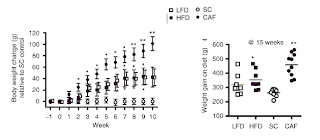
Since we're talking about fructose and the liver of late, I thought I'd bump this post.  In this study groups of rats were fed one of four diets.  The "low fat" diet is better described as a high sucrose diet as 35% of the diet was sucrose.  This replaced 35% of the fat in the 45% "high fat" diet.  While the LF and HF rats gained a little more weight than the standard (also LF at 12%) chow rats, it is clear that the high fat has rather more negative metabolic effects.  I don't think the 35% sucrose diet was beneficial, rather the contrary, but that level of sucrose consumption, every single day for 10-15 weeks (which is quite a long time for a rat) is also hardly indicative of even SAD consumption. Original Posting:  3/8/11 It seems fairly generally accepted that whatever the cause or progression, the so-called Metabolic Syndrome, Syndrome X and Type 2 Diabetes are associated with a dysregulation of adipose tissue metabolism, and fat tissue that ...

Fat Tissue Expansion: Part III ~ Fat Cell Number

Image
Before reading you may wish to read:  Part I ~ Terminology , Part II ~ Overview of How it Can Happen As mentioned in Part II, fat tissue expands by an increase (proliferation) of fat cells and/or a growth of the individual fat cells.  This installment concerns the number of fat cells and is likely the least "actionable" in this series in terms of diet, unless you're planning to have a child and/or have young children.   This does, however, lend some assistance to those formerly obese who are considering liposuction or more drastic surgery that may involve fat cell removal.  Bottom line, the number of fat cells we have is virtually completely out of our control as adults (according to current understanding).  So this post will be rather short, and I plan to expand on the data we have regarding fat tissue development in infancy, puberty and other periods of childhood in subsequent installments.  It would appear that the number of fat cells we are bor...

Fat Tissue Regulation ~ Part VI: Journey & Fate of Dietary Fat

Image
Regulation of fatty acid transport and storage: influence of acylation-stimulating protein Katherine Cianflone and Sabina Paglialunga, 2006 Commonly, the dietary sources of fat exceed the actual needs and the tissues are faced with dealing with the excess. Under these circumstances, the removal process of dietary triglycerides and fatty acids becomes overloaded, resulting in excessive postprandial lipemia and accumulation of chylomicrons, remnant particles and non-esterified fatty acids. These particles are associated with disruptions in lipoprotein metabolism and changes in inflammatory factors, thus their association with cardiovascular disease, metabolic syndrome and diabetes is not surprising. Dietary factors, not just fat, influence postprandial fluxes. This leads to the question: do we need a standardized fat tolerance test? I've been reading a lot of studies lately dealing with postprandial clearance of fats from the blood and it certainly seems to me that these are coales...

24 Hour Leptin Profiles ... Sleep Off Your Spiked Leptinade?

Image
In  Science Krispies ... Spiked Pink Leptinade Anyone? ,  I took on Dr. Ron Rosedale's claim  that "glucose spikes leptin".   The study I highlighted looked at 9-hour insulin and leptin profiles holding protein constant and essentially comparing a near-zero carb meal to a near-zero fat meal and fasting.  I've copied that graphic to this post: A&B = women, C&D = men OK, so we do see that the HC meal results in slightly elevated leptin, more pronounced in women, delayed about 4-5 hours after the meal vs. HF or fasting.  Over on the Perfect Health Diet blog (thanks for the shout out Paul!) , Paul Jaminet wrote:   CarbSane partially confirms Dr. Ron Rosedale: eating carbs does raise leptin levels compared to eating fat, but it is a mild rise over an extended period of time, not a “spike.”

Adipose Tissue & Adipokines

Normally these days I'd put this in the library, since I'm not really going to blog on this, but I thought this paper a good one to share. Adipose tissue and adipokines: for better or worse In recent years, it has been recognized that adipose tissue (WAT) secretes a number of bioactive peptides and proteins, collectively termed “adipokines”.  These WAT-derived factors play a central role in whole body homeostasis by influencing a variety of biological and physiological processes, including food intake, regulation of energy balance, insulin action, lipid and glucose metabolism, angiogenesis and vascular remodeling, regulation of blood pressure and coagulation. The present review is focused on a restricted number of adipokines, which have been implicated in vascular (angiotensinogen, PAI-1) and energy and glucose homeostasis (ASP, TNFα, IL-6, resistin, leptin, adiponectin).  

What Does Insulin Regulate Anyway?

Image
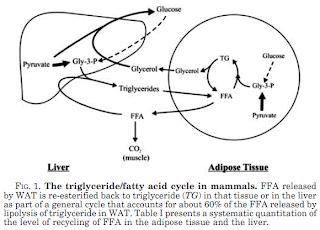
I'm not a fan of arguments over semantics, but at the same time I can be a stickler for the notion that "words count" at times.  When I hear the word regulate, as in A regulates B, I substitute the word control.  So A controls B.  And this ultimately means that A determines what B is.   Part of TWICHOO* is that insulin "fundamentally regulates" fat accumulation.  What Taubes is saying is that insulin regulates fat tissue mass.  Insulin controls fat tissue mass, and ultimately that means that insulin levels determine how fat you are.    *Taubes Wrong Insulin Carbohydrate Hypothesis Of Obesity The TAG/FA Cycle To state his case, Taubes zeros in on the TAG/FA cycle that occurs continually in the fat cell, and the known fact that insulin plays a role in  this cycle.  This is not in dispute, although the relative weight of insulin's actions on the outcome may be somewhat argued in these circles. The full TAG/FA cycle is pict...

The Full Physiological Regulation of Fat Tissue ~ Part I of ?

Image
Look it's late 2011 we have a disorder of excess fat accumulation, and low carb shills are saying that the physiological regulation of fat tissue by hormones secreted by the fat itself is irrelevant.   ~CarbSane channeling her favorite science fiction journalist/author In this series of who-knows-how-many posts, I'm going discuss the full physiological regulation of fat tissue.   This was prompted by the response of the original LC Internet Kindergarten Cop to  CICO vs. Regulation of Fat Tissue ~ Questions for Gary Taubes .  In that post I posed the following question:    How can any hypothesis on the regulation of  fat accumulation not include ASP and leptin?   Indeed Taubes himself acknowledges the plethora of hormones in WWGF.  Note:  It's very easy to imagine how they can be so disturbed so that too much fat gets in and not enough gets out. {click to enlarge} 

Of Microscopes and Myopic Hypotheses

Image
Surely somewhere somehow in your life you've used a microscope.  If this was in grade school, perhaps the teacher set it up for you, but most do not escape high school or college, even as non-science types, without using one at some point.  Here is your basic microscope you might encounter in a biology or forensic chemistry lab or such.    The light shines up from the bottom, through your sample, up through the objective lens that magnifies the image and through the eye tube to your eye.  The eyepiece usually adds additional magnification (10X).  A choice of three objective lenses that can be "dialed in" is quite common.  Note the different lengths of these.   The shortest lens is the lowest magnification lens and is often called the low power objective.  As lens length increases so does the magnifying power of the lens.  The technique for using the microscope is pretty universal and begins with something that sounds rather silly: ...

Free Fatty Acids and Cytokines Induce Pancreatic ß-Cell Apoptosis by Different Mechanisms

Free Fatty Acids and Cytokines Induce Pancreatic ß-Cell Apoptosis by Different Mechanisms (I've scrubbed the distracting reference numbers from some excerpts of the introduction and I'm also going to try to cite only the information pertinent to T2) Hypercaloric diets containing large amounts of fat, also called the Western diet, contribute to a major extent to the increasing prevalence of obesity and type 2 diabetes mellitus (T2DM). T2DM is characterized by peripheral insulin resistance, pancreatic ß-cell dysfunction, and decreased ß-cell mass associated with increased rates of ß-cell apoptosis. Elevated levels of circulating free fatty acids (FFAs) contribute to the pathogenesis of T2DM. High concentrations of FFAs lead to both impairment of insulin action and ß-cell dysfunction.  Moreover, FFAs have been shown to cause ß -cell death, mainly by apoptosis.  Of note, increased adiposity is associated not only with increa...

Adiposopathy

Presented without comment on the content per se: Role of the Adipocyte, Free Fatty Acids, and Ectopic Fat in Pathogenesis of Type 2 Diabetes Mellitus This is probably the most exhaustively referenced review article I've ever come across on the etiology of MetS and T2 Diabetes and the role of adipose tissue.  Too extensive to quote w/o copying the whole darned thing, although I may revisit it at some point to do a bullet point summary type post.  

Adipocyte Size & Adipokine Secretion

Image
Relationship between Adipocyte Size and Adipokine Expression and Secretion Context : Adipocytes are known to release a variety of factors   that may contribute to the proinflammatory state characteristic   for obesity. This secretory function is considered to provide the basis for obesity-related complications such as type 2 diabetes   and atherosclerosis. Objective : To get a better insight into possible underlying   mechanisms, we investigated the effect of adipocyte size on   adipokine production and secretion. Design, Patients, and Main Outcome Measures : Protein secretion   and mRNA expression in cultured adipocytes separated according   to cell size from 30 individuals undergoing elective plastic   surgery were investigated. Results : The mean adipocyte volume of the four fractions ranged   from 205 ± 146 to 1.077 ± 471 pl. There were strong linear correlations for the secretion of adipokines over time.   Secr...