Posts

Showing posts with the label Lipolysis

Ketones for Ketone's Sake?

Image
Minor Update:  Sorry, sometimes I hit Publish instead of Close when I'm in a rush and want to make sure I have most recent version saved.  I had intended to include this video -- Instant Ketosis -- along with this "report" on the MLM angle in my post --  Pruvit Review – Another Ketones Based MLM Company?    My first thought from that title is a question:  "There are others?"  The tagline on this article reads: Will Pruvit's core products and MLM-modeled opportunity have what it takes to make it in the ketones health space? Let's prove it one way or another for you. I want to also make very clear that I am NOT encouraging anyone to get into this or any other MLM -- matters not the code words used to sell something.  Indeed I warn strongly against such.  If you search on MLM truth, or MLM scams, or MLM fraud, or any number of short phrases, you'll hit on ... well hits too numerous to count.  Here's one I suggest:   MLM-theTruth...

Revisiting the Fatty Diets & Diabetes Study ~ How to Make Mickey Fat or Fattier

Image
High Fat Diets!  I'm going to continue bumping up some of the hundreds of blog posts I've written on studies that support the role of dietary fat in obesity and diabetes.   As I do this I'll make some formatting changes for ease of reading, may fix a typo or awkward wording here or there, but won't alter the content meaningfully.  Instead, I'll insert Ed. Notes where I feel an update or clarification is needed. ORIGINAL POST 8/31/2011 In her piece over at MDA on the How Fatty Diets Cause Diabetes , Denise Minger spent a bit of time discussing the strain of mouse used in the study.  That being the not-uncute fella you see pictured here:  A C57BL/6J mouse.   Denise describes these mice as:   "uber-susceptible to obesity, high blood sugar, insulin resistance, leptin resistance, and all that other fun stuff plaguing modern humans."   This didn't really square with my memory from when I blogged on a study involving this crit...

Thermodenyics in the Incestral Health Community: It Began with Atkins

Image
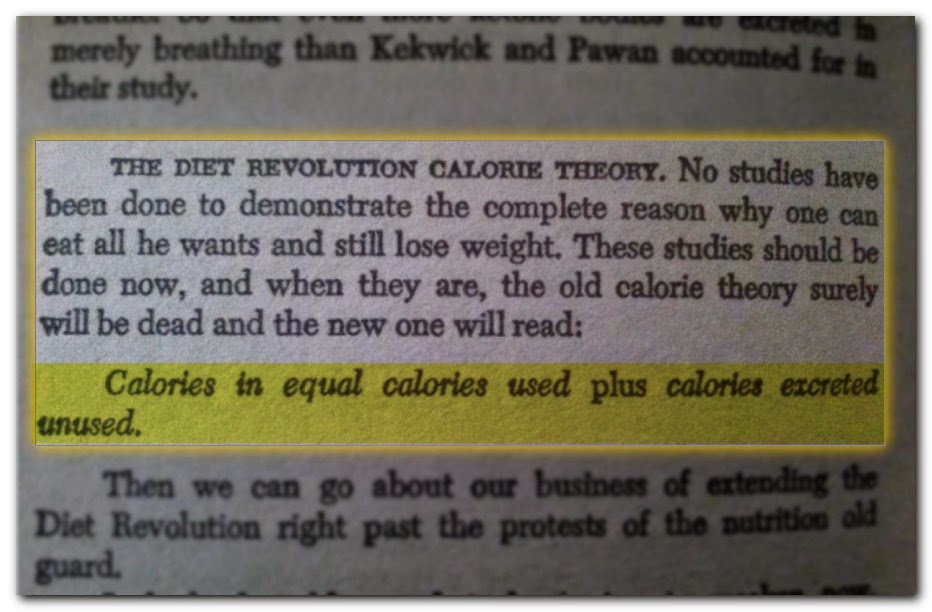
For the past couple of months, I've been somewhat obsessing about thermodynamics having written the AARR piece and a few blog posts, not to mention revisiting several dating back to near the beginnings of this blog.  I began this a while ago as a single lengthy post, but it's gotten out of hand and finding time to tidy up such a post vs. publishing shorter chunks in parts became impossible.  Not sure how many parts this will have.  This series will put several members of the IHC "on the record" so to speak.  While I've done so in the past, the hope is to have it all in one place. Robert Atkins the Calorie Guy!    Surely Atkins is an honorary member of the IHC, even though he passed away over a decade ago before this community reached the level that it has.  Most of the "greats" have learned something (perhaps essentially everything) they know about low carb diets and tangentially about thermodynamics/calorie theory from the "late great one...

Where do triglycerides come from? Part I (Updated)

Image
This post contains sufficient updates from the original (dated 5/11/11) that I consider it more of a fully updated version vs. a bump.   This began with my intent to link to this post in an upcoming discussion of triglycerides, when I noticed that Dr. Ronald Krauss was amongst the authors.   This study originally caught my eye because of    Marc Hellerstein 's name, he of  DNL not a major pathway in humans fame , that I've  blogged on  previously. Now I have excerpted copiously from the discussion because the authors make several points relevant to the discussion of what comprises a healthy lipid profile.  As part of updating, I am breaking those excerpts up a bit more and adding some/more emphasis and additional commentary.

Partial inhibition of adipose tissue lipolysis improves glucose metabolism and insulin sensitivity without alteration of fat mass.

Image
{shhhhhhhhh .... don't tell Gary Taubes, this might just upset his 21DaySugarDetox approved green apple cart!} You know how the story goes by now, right? In more recent lectures, Taubes is fond of using the slide below. source These are two quotes that Taubes cites from Lehninger's Principles of Biochemistry and he juxtaposes them to convince you how misguided such textbooks are.  How can, on the one hand fat cells "fatten" according to the action of insulin, but human beings get fat due to positive energy balance?   The simple answer is that insulin is not some renegade hormone and your pancreas is not a master organ in the body placating your rebellious adipocyte's every whim. Yes, tis true that insulin has a stimulatory role in the storage of fatty acids by acting on LPL on the intake side, and yes, tis true that insulin "traps" those fatty acids in the adipocytes by suppressing HSL mediated lipolysis and release of same.  Sounds like a sl...

Energy deficit w/o LC alters resting carb oxidation and FA availability

Image
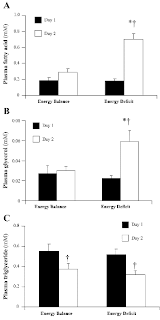
Originally lucky post #13 made on March 23, 2010 In light of all of the "fat burning" , respiratory quotient and mitochondrial mayhem discussions of damaged metabolisms, I thought this might be a fitting post to bump to the top today.  The take home message of this study, IMO, is that the body burns what it needs to burn, and hormone levels adjust accordingly, not so much the other way around.   Energy deficit without reducing dietary carbohydrate alters resting carbohydrate oxidation and fatty acid availability Reduced carbohydrate (CHO) availability after exercise has a potent influence on the regulation of substrate metabolism, but little is known about the impact of fat availability and/or energy deficit on fuel metabolism when dietary CHO availability is not reduced. The purpose of this study was to determine the influence of a postexercise energy deficit, independent of CHO availability, on plasma substrate concentrations and substrate oxidation.

Fat Tissue Regulation ~ Part VII: Changes in Fat Cells with Weight Loss

Image
I came across this one a while back and found it fascinating. The Physiologic Effects of Caloric Restriction Are Reflected in the in Vivo Adipocyte-Enriched Proteome of Overweight/Obese Subjects In this study, 8 overweight/obese individuals (4M/4F, 30-60 y.o.a., BMI ≥ 27, otherwise healthy) were treated with a very low calorie diet (500 cal/day shakes + unlimited veggies) for 5 weeks followed by a weight stabilizing diet for 3 weeks.  Abdominal subcutaneous fat biopsies were taken before and after the 8 week intervention.   There's a lot more here than what I'll address in this post.  I hope to return to this at some future date, but in keeping with this series, I want to focus on the fat storage portions of the study.  I have quite a bit in the pike regarding fatty acid transport and storage in various cell types.  While fatty acids can be transported into (and out of) cells by passive means, it became apparent to me a while ago that the relatively rapid cl...

Fat Tissue Regulation ~ Part VI: Journey & Fate of Dietary Fat

Image
Regulation of fatty acid transport and storage: influence of acylation-stimulating protein Katherine Cianflone and Sabina Paglialunga, 2006 Commonly, the dietary sources of fat exceed the actual needs and the tissues are faced with dealing with the excess. Under these circumstances, the removal process of dietary triglycerides and fatty acids becomes overloaded, resulting in excessive postprandial lipemia and accumulation of chylomicrons, remnant particles and non-esterified fatty acids. These particles are associated with disruptions in lipoprotein metabolism and changes in inflammatory factors, thus their association with cardiovascular disease, metabolic syndrome and diabetes is not surprising. Dietary factors, not just fat, influence postprandial fluxes. This leads to the question: do we need a standardized fat tolerance test? I've been reading a lot of studies lately dealing with postprandial clearance of fats from the blood and it certainly seems to me that these are coales...

Fat Tissue Regulation: Part IV ~ How Acylation Stimulating Protein Works

Image
Lipases are a tricky bunch of enzymes when one is looking to the action of an enzyme to extrapolate to overall regulation of fat mass.    What do lipases do?  They are enzymes that facilitate lipolysis, which is the breaking apart of triglycerides into glycerol and three fatty acids.  We have digestive lipases that break dietary triglycerides down so that they can be absorbed, but once absorbed they are packaged again back into triglycerides for transport to cells.  These triglycerides are packaged in chylomicrons.  There are lipases both in circulation and attached to all of our different cells, called lipoprotein lipases (LPL's) that break down triglycerides to free up fatty acids.  Those associated with the cells are doing so to facilitate uptake of the fatty acids.  Here's where it gets tricky, because lipases associated with, say, muscle cells, are acting to bring fatty acids into the cell to be oxidized for energy.  But the lipases asso...

Diazoxide, Insulin & Obesity

Image
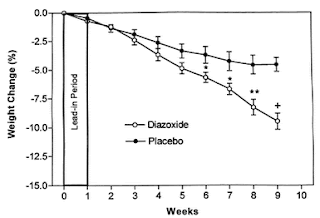
In his recent post on insulin and obesity,  Fat Tissue Insulin Sensitivity and Obesity  , Stephan brings up one of those *nagging* studies that have been touted by TWICHOO advocates for quite some time. Back in May 2008, Peter/Hyperlipid posted  Weight loss when it's hard 2. Diazoxide .  This discusses the following study:   Beneficial Effect of Diazoxide in Obese Hyperinsulinemic Adults . What is diazoxide?  It is a drug that reduces insulin secretion.  As Peter writes: You can simply reduce insulin secretion using diazoxide. Find enough obese people willing to put up with the hunger generating regime supplied by Slimfast and semi starve them for 8 weeks. Half can have a placebo, half get diazoxide in addition to Slimfast starvation. Figure 1 in the results is where you want to look. The idle porkers starving on Slimfast plus diazoxide lost significantly more weight in 8 weeks than the idle porkers starving on Slimfast alone.

Insulin Wars w/ Todd Becker Chat

Newer readers may not remember this exchange from earlier this year, but Todd Becker of Getting Stronger and I had a nice back and forth going on insulin.  Around that time this blog started to get wicked busy, a health issue with a family member was taking a lot of my time and mental energy, etc.  Long story short, despite promises made, I never got around to posting any installments from Todd's last response.  I owe Todd a huge apology for letting this slide this long.  I've got a number of other things going with this blog and related projects so really don't have the time to devote to further installments of the Insulin Wars format, so I thought I'd catch everyone up with the discussion thusfar, and share Todd's last email in full via Google docs and let things go from here! So, here's the series thusfar: Insulin Wars IV: Todd Becker of Getting Stronger Blog Insulin Wars IV.1: Todd Becker of Getting Stronger blog responds More Todd Becker (Getting S...

The Myth of Starving Cells II ~ Lipolysis is not rate limiting

The low carb theory on weight loss revolves on insulin's action on adipocytes.  Specifically, high insulin favors deposition (esterification to form triglycerides) in the fat cells and suppresses lipolysis (breakdown to free fatty acids).   This of course is true.  But the problem with this discussion is that it is incomplete.  You see, lipolysis has little to do with fat burning per se.  That is beta-oxidation occurring in the mitochondria in a series of cyclical reactions commonly called the Fatty Acid Spiral, FAS.  Free fatty acids are constantly delivered to the cells and being taken up.  Those that are not oxidized for energy are re-esterified and stored as triglycerides inside the cells (e.g. IMCL or IMCT).

Triglycerides: Atherosclerotic or SAD-context Biomarker?

Something that's been on my mind a lot over the past couple of years is the meaning of fasting triglycerides in the context of a low carbohydrate diet.  Many, myself included, tend to look at fasting triglycerides and HDL as more important biomarkers and these two both tend to improve rather greatly on a low carbohydrate diet.  But I've always wondered if the reduced triglycerides of LC really indicate a "reduced risk" compared to the generally higher fasting triglycerides of healthy people eating a higher carbohydrate diet. I blogged recently about triglycerides increasing on a high carb/low fat diet .  Basically, the elevated VLDL in the high carbers was attributed to reduced clearance and not overproduction in the liver.  So I got to asking if it's the triglycerides themselves that are atherogenic or if they are merely indicative of an underlying pathology.

Regional Differences in Fat Tissue Fatty Acid Regulation by Insulin

Image
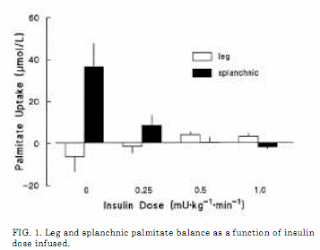
Insulin Regulation of Regional Free Fatty Acid Metabolism Alternate Title:  Why I had a fatter ass before low carb?  :-) This study involved 26 healthy young (21-38) non-obese (BMI 18-27) individuals split evenly by gender.  Excluded were any medications known to influence FFA metabolism.  Radiolabeled palmitate was used as a tracer for FFA's.   All studies were initiated in the 12 hour overnight fasted state and palmitate was infused for the duration of the study.  Patients received insulin infusions of different doses (3M & 3F per group) for 150 min following baseline determinations.  Controls received a saline infusion.  Blood samples were obtained from femoral vein and artery (leg) and hepatic (liver) vein.  This was to assess systemic (whole body), leg and visceral (splanchnic) rates of appearance of FFA's  (release from adipose tissue).

Insulin & Weight/Fat Loss ~ The Long and the Short of It

Image
In the comments of my recent post, On Cherry Picking & Debunking , my "Insulin Warring" partner Todd Becker posted a multi-point commentary.  I'll get to the rest over in the comments section in that post when I get a chance, but one of his points hit on something just a little different as it goes to the core of my issue with the insulin hypothesis. (And I'm reminded I'm long overdue for an installment on the IW exchange with Todd) In any case, here was what I said: G&K demonstrated absolutely no correlation between fasting insulin and weight change. Therefore fasting insulin is not a factor in determining weight loss. Todd challenged:   Your claim that there is "no correlation" between insulin levels and weight looks only at the instantaneous correlation. But fat loss may be a delayed response, as the Woodhouse paper I linked to you indicates. Figures 1 and 2 in G&K suggest that weight either dropped or plateau'd after a slight lag ...

Insulin, Weight & Fat Accumulation

Image
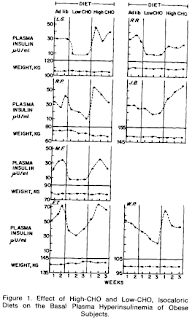
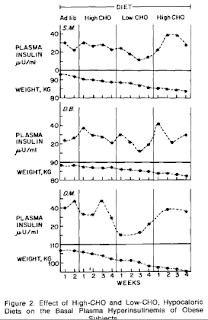
Yes folks, if you go to any Biochemistry or Endocrinology text, you will find that insulin's action is to put fat into fat cells and suppress its release.  Therefore insulin makes us fat.  Lower insulin, lose weight.  Raise insulin, get fat.  Right? I've recently posted on two rat studies ( here and here ) that demonstrate unequivocally that it is not so simple.  I've also previously addressed the study that is the focus of this post in my Insulin Wars series with Todd Becker.  But wanted to further highlight that study here in a separate post.   The Effect of Diet Composition on the Hyperinsulinemia of Obesity

Ketogenic Diet increases Fat Mass and Fat:Total Body Mass Ratio

Image
Ketogenic diet-fed rats have increased fat mass and phosphoenolpyruvate carboxykinase activity This study looked at body weight, fat mass, blood lipid and glucose levels and PEPCK (rate limiting enzyme in glyceroneogenesis pathway for G3P production for esterification of fatty acids - fat deposition) activity in the liver and fat cells.  Two ad libitum diets were compared, a control standard chow and a ketogenic zero carb chow.  This study was in normal, young (30 days old at start) Wistar rats and lasted 6 weeks. The diet compositions are shown below:

Another Hormone Involved in Lipid Mobilization? Atrial Natriuretic Peptide

This article is a bit heady, and I won't go into a detailed analysis but will try instead to present some relevant excerpts to the gist of this post.   That being, adipocyte metabolism, the continual cycling of fats in and out of adipose tissue, the continual cycle of esterification and hydrolysis, is mediated by more than just insulin. Atrial natriuretic peptide contributes to the physiological control of lipid mobilization in humans According to the save date on my computer, I found this one a year ago.  Ever heard of atrial natriuretic peptide?  Me neither.   According to Wikipedia, ANP is: .... a powerful vasodilator, and a protein ( polypeptide )  hormone  secreted by heart muscle cells. [1] [2]  It is involved in the  homeostatic  control of body  water ,  sodium ,  potassium  and fat ( adipose tissue ). It is released by muscle cells in the upper chambers ( atria ) of the heart ( atrial myocytes ), in respo...

Insulin Wars IV.2a: The Discussion with Todd Becker/Getting Stronger continues

Image
If you haven't read the discussion thus far, or just to recap, here are the links: Insulin Wars IV: Todd Becker of Getting Stronger blog Insulin Wars IV.1: Todd Becker of Getting Stronger blog responds More Todd Becker (Getting Stronger blog) on Insulin  (this last one links to his piece on his blog) {Todd quoted the relevant prior exchanges in his email, so most can probably follow along just with this post} I've been putting off posting this for too long, mostly because in its entirety it is very lengthy (15 pages!) and I haven't had the length of uninterrupted time to devote to a thorough point by point response to the entire email.  So I decided to break this installment (IV.2) up into parts (a,b..., however many) so we can keep this discussion alive and continuing.  I'm also likely to address some topics out of order from Todd's email response.   Eventually it will all get up here :-)  I very much appreciate all the hard work Todd put into his response...

Subcutaneous and Visceral Adipose Tissue: Their Relation to the Metabolic Syndrome

Subcutaneous and Visceral Adipose Tissue: Their Relation to the Metabolic Syndrome Another bookmarking post of sorts. One interesting statement: ... in a review of 23 published studies of intervention strategies   to promote loss of visceral adipose tissue... ( 32 ) concluded that   individuals with greater visceral fat mass, either through an increase   in body weight or the propensity to store fat in the visceral depot,   lose more visceral fat when adjusted to the loss of body fat, regardless   of the intervention applied (caloric restriction, pharmacological   therapy, or exercise) because the visceral adipocyte has a higher   lipolytic rate also in the steady state.  For me, this makes my body fat distribution change all the more confusing, except that it does seem I'm talking more subQ belly fat than visceral in my case.