Posts

Could Early Insulin Therapy for T2 be Coming to Canada?
Image
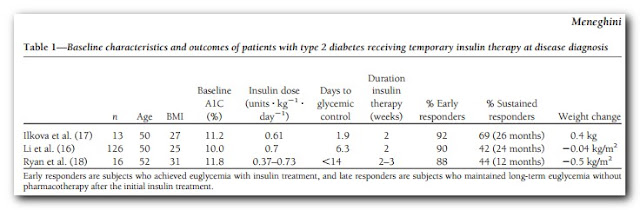
A short post here, because I have no peer review study to refer to. But Nigel Kinbrum recently blogged on this media report:  New treatment might put Type 2 diabetes in remission . This report touted 75% remission from T2 using self-administered insulin of 4 injections per day for one month.  This is less aggressive than reported in other studies (some summarized here , table below)  Most of these used insulin infusions for a couple of weeks and early response rate was around 90%.  This treatment may be more practical (and cost effective?) but perhaps not intensive enough to to get the optimum outcome.  Still, 75% is impressive.  The article discusses that they want to follow up with an oral diabetic drug to "save" the pancreas, which the studies above involved lifestyle "treatment" only. So this article is about a year old and I wondered if it ever made the literature.  I did a PubMed on Dr. Bernard Zinman and got no love. ...

Eating more fat ... Why where ever did anyone get that from?

Image
I received a link to this interesting post by Zoe Harcombe in the Inbox the other day:   What's this 'trying to eat more fat'?!   Zoe writes: Hi all - I've spotted a couple of comments from people saying that they're trying to eat more fat and the second one got me worried enough to start a thread. ... The Harcombe Diet is a diet based on a 5 day Phase 1 which is mostly meats and veggies (unless you are, as Zoe was for 15 years, a vegetarian, then you can substitute some brown rice, which makes no sense from a protein standpoint, but whatever).  Once you've cured your candida overgrowth which is one of the  prime reasons for obesity according to Harcombe, you move to other phases of the diet.  Harcombe believes in the separation of fats and carbs at meals on a metabolic "food combining" basis.  You don't want to eat carbs with fat because ... well ... the insulin!  Despite negativity about low fat diets, Harcombe counsels food separation and ...

First Phase Insulin ~ Physiological Relevance?

Image
Something I've been reading a lot lately would be along the lines of "first phase insulin response is deficient/missing from the early stages of diabetes".   This is true, but even in the peer review literature that term seems to be misused to equate with the acute spike in insulin levels to a high oral glucose load.  However the first phase insulin response, hereinafter FPIR, is a non-physiologic phenomenon sometimes used to assess pancreatic function.   First-phase insulin secretion: does it exist in real life?  Considerations on shape and function   (decluttered  of references, please see origina, some parts bullet-pointed, etc. for clarityl) IN THE PAST THREE DECADES, the relevance of insulin secretion abnormalities in the pathogenesis of type 2 diabetes mellitus have been extensively debated, and a consensus has been reached that, to fulfill its pivotal role in regulating glucose metabolism, insulin secretion must not only be quantitatively app...

Processed ... Refined ... Definitions?

Image
A comment by Jane prompted this quick post here.  Often the terms processed food or refined food tend to be used interchangeably in the general nutritional discourse.  I get the general idea -- eating steak, broccoli and a baked potato is eating real, whole, unprocessed and unrefined foods.  Same meal but substitute brown rice for that potato and you have added what I would call a processed food.  The rice "kernel" had to be extracted from the plant.   So loosely speaking "processing" would include shucking, grinding, cracking, rolling, soaking, fermenting, and ... cooking!  So then that original meal was actually processed food because we didn't just slice off a slab of meat, wash the dirt off of a tuber and some broccoli and eat them.

Paleo on Oz ... Notes & Comments

UPDATE:   Link to Transcript Dr. Loren Cordain and Nell Stephenson (the Paleoista, who co-authored a cookbook with Cordain) were on The Dr. Oz show today.  I taped it.  Cordain describes the diet of having all healthy aspects including: high protein diet  (say what?) lots of fruits and veggies that contain beneficial phytochemicals, vitamins and minerals high in long chain omega 3 fatty acids Nell takes over with the nos -- classifying these as inflammatory foods dairy grains legumes refined sugars

Paleo™ *IS* a Fad Diet

... or rather a collection of fad diets. I remember back in 2009 when I found the LC online community and one of my wishes at the time.  Quite simply, I wanted to be able to tell my doc I was eating a very low carb diet most of the time and not have him/her gasp and presume I was eating caricaturistic Atkins.  You know -- pounds of bacon, steaks and butter on a stick (or by the stick).  Despite the prevalence of TWICHOO, there was (and is) a goodly sized body of scientific literature in support of low carb diets.  The problem with this body of work is that it doesn't answer the burning questions regarding whether the diet is healthy in maintenance over the long term.  I think the longest study on VLC was done by Dr. Eric Westman's group at Duke.  It involved diabetics following a VLC weight loss diet for 6 months.  

Ancestral Rabbit Starvation Medical Vacations! The next craze?

Image
I came across this study a bit ago and it caught my eye as I was transfering some stuff between computers:   Marked Improvement in Carbohydrate and Lipid Metabolism in Diabetic Australian Aborigines After Temporary Reversion to Traditional Lifestyle The rationale for the present study was that temporarily reversing the urbanization process in diabetic Aborigines should improve all aspects of their carbohydrate and lipid metabolism that are linked to insulin resistance. Ten full-blood, diabetic Aborigines from the Mowanjum Community (Derby, Western Australia) agreed to be tested before and after living for 7 wk as hunter-gatherers in their traditional country in northwestern Australia. They were middle aged (53.9 ±1.8 yr) and overweight (81.9 ± 3.4 kg), and all lost weight steadily over the 7-wk period (average, 8 kg). A detailed analysis of food intake over 2 wk revealed a low energy intake (1200 kcal/person/day). Despite the high contribution of animal food to the total ene...