Posts

Showing posts with the label C-reactive protein

Cholesterol or Inflammation?

Image
I wanted to share this study with my blog readers that I had found and shared a bit of on Twitter a little while ago.  This has been prompted by ongoing discussions there and elsewhere on social media regarding blood lipids.  By "cholesterol" I am of course using the general term that in today's terms refers mostly to the low density lipoproteins or LDL. C-Reactive Protein A Simple Test to Help Predict Risk of Heart Attack and Stroke This is not so much a study as a communication.  It is also on the "Cardiology Patient Page" of the journal Circulation , and as such quite readable.  I'd suggest any and all interested do so as I don't really have the time to go in depth into the entire thing.

A Modest Proposal for Peer Review Research

Image
With the advent of, and inexpensive nature of online sharing of information, I propose that all peer-review research should include (anonymous) raw data for each subject.  At the very least, there should be scatter plots presented for the individual data points for the main outcomes. I frequently teach statistics, and one of the first things we discuss in that class is sort of the "first purpose" of it all.  Because before we can analyze data, first we must summarize and present the data in such a way that the "consumer" can readily glean information.  In one classic stats text -- Triola -- this part is given the acronym CVDOT.  C = Center, V = Variation, D = Distribution, O = Outliers and T = Time.  So we go through the various ways we can convey the center of a data set, it's variability, distribution, etc.  In most of the studies we discuss here, data is presented as a mean value +/- either the standard deviation or standard error (C +/- V in the acrony...

Fiber and CRP

Came across this so just putting it out there.  It's a meta study of 7 clinical trials in which fiber was studied or reported.  In 6 of 7 CRP was reduced.  One study involving just psyllium showed no effect. The effects of dietary fibre on C-reactive protein, an inflammation marker predicting cardiovascular disease Conclusions: In the presence of weight loss and modified saturated, monounsaturated and polyunsaturated fat intakes, significantly lower CRP concentrations (25–54%) are seen with increased fibre consumption 3.3 g/MJ). Mechanisms are inconclusive but may involve the effect of DF on weight loss, and/or changes in the secretion, turnover or metabolism of insulin, glucose, adiponectin, interleukin-6, free fatty acids and triglycerides. Clinical studies of high- and low-fibre diets are needed to explore the potential favourable effects as observed epidemiologically, and to understand individual susceptibility to its anti-inflammatory effect and long-term cardiova...

C-Reactive Protein and Cardiovascular Disease Risk: Still an Unknown Quantity?

Just putting this one out there: C-Reactive Protein and CVD Risk    (full text article available at link, abstract below) The role of C-reactive protein (CRP) in cardiovascular disease risk remains controversial, and several interrelated questions are unresolved. Although it is clear that higher circulating CRP levels are associated with coronary heart disease (CHD) incidence and mortality rates in prospective studies, the magnitude of this association has been downgraded in recent years (1). It is also clear that CRP levels are strongly related to many potential confounding factors that influence CHD incidence and mortality rates. In predictive models that appropriately account for these confounders, the magnitude of the association between CRP levels and CHD outcomes is considerably attenuated toward the null (2). Whether CRP is a marker of cardiovascular disease risk or is causally related to cardiovascular disease is uncertain. Nonetheless, some authors have recently cl...

Low Carbohydrate, High Fat Diet Increases C-Reactive Protein during Weight Loss

Image
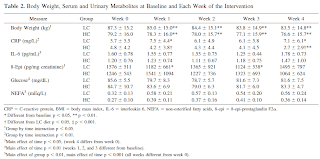
Low Carbohydrate, High Fat Diet Increases C-Reactive Protein during Weight Loss Janet W. Rankin, PhD and Abigail D. Turpyn  Journal of the American College of Nutrition, Vol. 26, No. 2, 163-169 (2007) Studied Variable: Dietary Carbohydrate Variables Measured: Body weight, IL-6, CRP, urinary 8-epi-prostaglandin, FBG, FFA (fasting) Variables controlled for: Caloric intake Protocol Summary: Subjects were ed into two groups followed calorie restricted (~1360 kcal/d) diets varied in composition: LC = 58F/12C/30P ; HC = 24F/59C/18P. Weight, inflammatory markers (IL-6 and CRP) and oxidative stress (8-epi) were measured weekly. Human Study Gender:  Women Age:  adult, premenopausal Number of Participants: 29 Weight Status: Overweight BMI 32.1 ± 5.4 kg/m2 Health Status: weight stable for at least 6 months, nonsmokers, sedentary, otherwise healthy and unmedicated Study Duration: 4 weeks Summary of results: * LC lost a bit more weight (3.8 ± 1.2 kg LC vs. 2.6 ± 1...