Posts

Showing posts with the label Glycemic Index

The $12M NuSI/Ludwig Study ~ Part III: Some "Early" Lessons

Image
S UMMARY Continuing on with discussion of: Effects of a low carbohydrate diet on energy expenditure during weight loss maintenance: randomized trial In Part I , I discussed some issues with methodology, mostly focusing on the reduced Run-In Phase that likely compromised the outcomes irreparably. In Part II ,  I highlighted a serious issue with the Run-In Phase, the purpose of which was to produce a somewhat homogeneous "reduced weight state" to test various diets in maintenance of that state. Ultimately,  randomization to the various test diets occurred after weight loss (PWL) all subjects lost weight on the same 45% Carb / 30% Fat / 25% Protein diet targeting a weight loss of 12% ± 2% initial body weight. The researchers do not appear to have made many adjustments in the weight loss phase to produce a more uniform weight loss.   Rather than 12% ± 2%  (from 10% to 14%)  losses, the actual outcome was roughly 10.5% ± 5% (actual ...
The $12M NuSI/ Ludwig Study ~ Part II: $12 Million for 12% Weight Loss?

Image
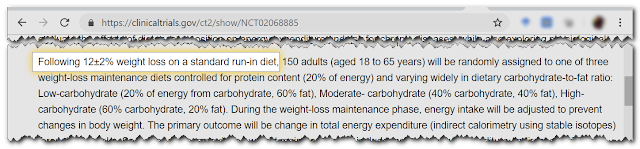
U PDATE:   12/17/2018      Original Posting: 12/3/2018    During the writing of a new installment in this se ries, I revisited the following paper: A randomized study of dietary composition during weight-loss maintenance: Rationale, study design, intervention, and assessment Yes, folks, so full of themselves were these researchers, that they felt the need to write an entire paper (submitted approx. one year in advance of the "real study") outlining their amazing study. Regarding this post, focusing on the OUTRIGHT FAILURE TO IMPLEMENT THEIR STUDY DESIGN AS STATED , I stress the following from the previous paper. ONCE AGAIN, the stated goal of the weight loss run in is 12% ... not 10 or 5 or 15 or whatever ... 12%.  I'm just going to quote the relevant part here (cleaned of references, etc. and formatted for readability, all emphasis mine) Energy intake was restricted to 60% of estimated needs to achieve a target weight loss equ...

Thirty Years of Glycemic Index Dogma, and The American GI Man

Image
Sixteen post bumps for 2016 ... No. 3 I think this post from around a year ago, in light of the new book by David Ludwig is a necessary bump. It's not every diet guru that is a principal investigator on a "groundbreaking" study that directly debunks the thesis of their book.  In this regard, Ludwig is, if not one of a kind, the leader of the pack. Originally published on January 19, 2015 The former British colonies/territories may be known for a lot of things, but in the nutrition world, I'm going to go out on a limb here and state that the Glycemic Index - GI - is the trifecta. In Canada, David Jenkins pioneered the concept, for applications in diabetes treatment.  This cause was picked up and concurrently championed in Australia by Janette (Jenny) Brand-Miller.  A little late to the party, in one of the original Thirteen, David Ludwig took up the cause in the USofA.  Are these the men and woman who made us fat? Adapted from Adele Hite's Eat...

More on the Mechanisms of the Glycemic Index: A Fatty Acid Roller Coaster?

Image
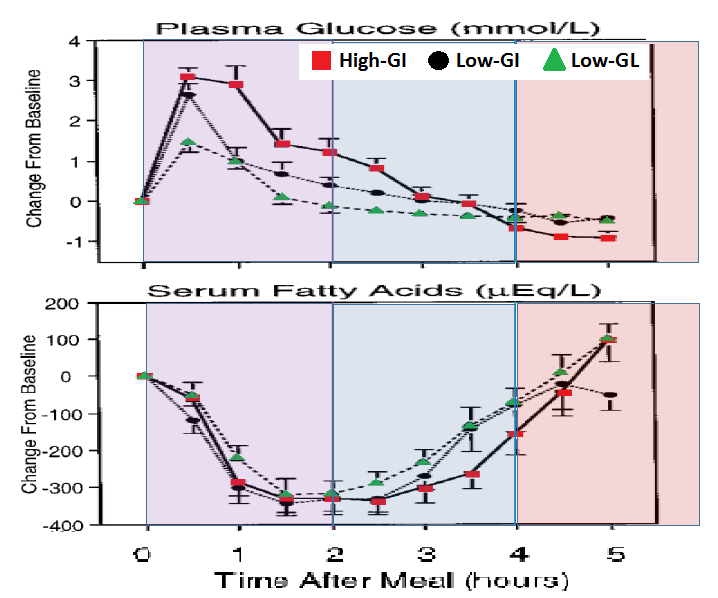
A Continuation of  The Mechanisms of the Glycemic Index: A Fatty Acid Roller Coaster?  .... Quick summary of Ludwig's mechanism for high-GI making us fat v. 2002: High GI carb causes glucose and insulin to spike and fatty acids to plummet early on.  Then glucose plummets resulting in hypoglycemia and counterregulatory hormones kick in.  These bring glucose back or slightly elevated and cause fatty acid levels to rebound to levels reminiscent of a long fast making the person hungry (hypoglycemia) and hungrier (feeling fasted) so they eat more.     The Mechanism of High-GI ~ 2012 by Davis S. Ludwig In 2012, with colleague (often listed as a co-lead investigator) Cara Ebbeling and others, Ludwig published:   Effects of Dietary Composition on Energy Expenditure During Weight-Loss Maintenance .  In  JAMA .  I only mention this study here for two reasons.  First, to demonstrate that the 2002 review paper was not by t...

The Circulating "Food" Supply and The Failed Internal Starvation Hypothesis

Image
There are several recurring themes, mostly from low carb advocates of the "fat burning is best" bent, that keep ... well ... recurring!  Perhaps foremost among these is this concept of "internal starvation".  From Gary Taubes in Good Calories, Bad Calories :   "F or the past century, the conspicuous alternative to the positive-caloric-balance hypothesis has always been, as Pennington, Astwood, and Hilde Bruch suggested, that obesity is caused by a defect in the regulation of fat metabolism. At the risk of repetition, it is important to say this is, by definition, a disorder of fat accumulation, not a disorder of overeating. For whatever reason , the release of fat or its combustion is impeded, or the deposition or synthesis of fat is promoted, as Astwood said, and the result is obesity. That in turn will cause a deficit of calories elsewhere in the body— Astwood’s “internal starvation”— and thus a compensatory hunger and sedentary behavior.

The Mechanisms of the Glycemic Index: A Fatty Acid Roller Coaster?

Image
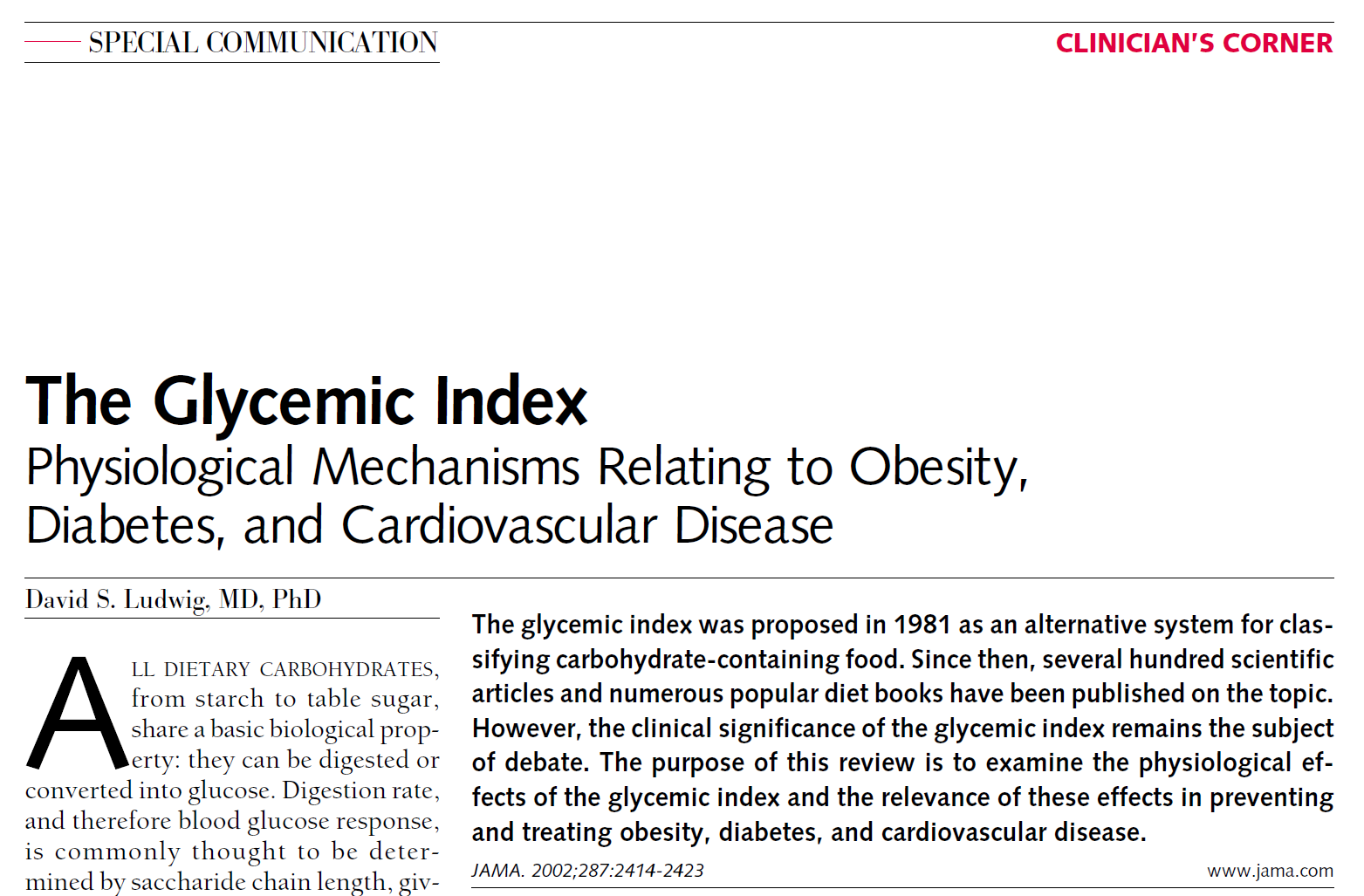
This post will focus on some statements made by a researcher who I've dubbed "America's GI Man", Dr. David Ludwig, in this review: The Glycemic Index: Physiological Mechanisms Relating to Obesity, Diabetes and Cardiovascular Disease , JAMA , 2002. A Note Regarding Definitive Statements in Review Papers As I found myself getting sucked down the Pubmed rabbit hole that is the GI, it was really this paper that took me past that point of no return.  I have taken a screenshot of the top of the PDF format of the article to convey a few things, and at this point I'm beginning to understand how it is that doctors can get sucked into bad paradigms when their "prestigious journals" put out "SPECIAL COMMUNICATION"s from their "CLINICIAN'S CORNER"

The Glycemic Index ~ It Was Supposed to Be About Carbs!

Image
As I have quite a few tangential thoughts going on, in search of a cohesive theme here, I've decided I'd just throw up a few short posts, and perhaps come back and put them together at some later date. The Glycemic Index is credited to Canadian researcher David Jenkins, and originated, near as I can tell, with this paper:   Glycemic index of foods: a physiological basis for carbohydrate exchange . INTRODUCTION :   Recent work has suggested that the carbohydrate exchange lists that have regulated the diets of many diabetics for over three decades may not reflect the physiological effect of foods. Such factors as food form, dietary fiber, and the nature of the carbohydrate have been shown to have a marked influence on the postprandial glycemia and allowances cannot be made for these in lists which take into account only the available carbohydrate content of foods. Currently, very good blood glucose control has been advocated for diabetics to reduce the incidence of lo...

The Glycemic Index, Carbs & Protein, and Weight Loss

Image
Hey all ... just a quick note. It's been one of those weeks and all where I've started like a half a dozen blog posts and gotten distracted or needed to do some "cleanup" on them so I've held them in the draft bin. Lots going on in real life in addition to the online side. But as often happens when I'm writing about a topic, a related paper pops up and something catches my eye. Such was the case when I looked into some of Dr. David Ludwig's work on the glycemic index for background on a post, and another study was mentioned along with his work. Studies such as this one from Ludwig --  High Glycemic Index Foods, Overeating, and Obesity  -- and, frankly, common sense to a degree -- paint high glycemic index foods as "bad" because: The rapid absorption of glucose after consumption of high-GI meals induces a sequence of hormonal and metabolic changes that promote excessive food intake in obese subjects. And this makes sense, and i...