Posts

Showing posts with the label Glycerol 3P

The 2005 Biochemistry of Obesity, Marks' Basic Medical Biochemistry

Image
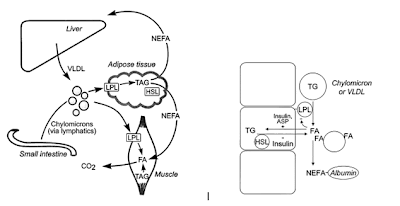
A short "image park" in my ongoing effort to document the state of the textbook science of fat storage, obesity and adipocyte function circa the writing of a three PhD thesis worthy tome.   This from Marks' Basic Medical Biochemistry , 2nd Edition, 2005.  Thus, although activation of hormone-sensitive lipase during fasting results in the release of fatty acids from adipocytes, the release is carefully modulated through glyceroneogenesis and re-synthesis of triglycerides.

Will NuSI clear the bar?

Image
Gary Taubes is out with a new article in Scientific American ... rehashing the same old same old, and essentially getting paid to write a press release for NuSI.   What Makes You Fat: Too Many Calories, or the Wrong Carbohydrates? Rigorously controlled studies may soon give us a definitive answer about what causes obesity—excessive calories or the wrong carbohydrates We get the rehashing of how WWII stopped Bergmann and Bauer's Lipophilia Hypothesis from becoming the working hypothesis for obesity, and yet another primer on calories vs. carbohydrates.  We again are asked to ignore the obvious -- that Americans are definitely eating more, on average, with no concurrent need for those calories, and likely moving a bit less as well.   The obesity epidemic that supposedly was instigated by the low fat craze is blamed on the fact that much of our additional caloric load is in the form of carbohydrates.  This is not supported by one of Gary Taubes' own parado...

Exercise & Fat Mobilization ... and starving cells & hunger

Image
There's no denying it, TWICHOO is down to a broken toothpick where the science is concerned.  (See here for the toothpick reference if you're a newer reader.)   The remaining claim supporting TWICHOO rests on the action of insulin on the fat cell.  Insulin does indeed act to stimulate esterification and suppress lipolysis, favoring deposition and accumulation of triglycerides in fat cells.  They even teach this stuff in some medical schools I'm told!  So these days it's all about how carbs make you hungry and overeat (although overeating is so inane) because they stimulate insulin which traps all your fat calories in your fat starving the rest of your cells of energy.  Now, that part's not true, but let's for the sake of argument assume it is.  What, then, would cause you to lose weight and not be hungry?  Why anything that favors net mobilization of fat stores -- that is stimulates lipolysis and fatty acid release from fat cells.  This wil...

Glyceroneogenesis & The Triglyceride/Fatty Acid Cycle Revisited

Glyceroneogenesis and the Triglyceride/Fatty Acid Cycle     (TAG/FA) JBC Papers in Press, June 4, 2003, DOI 10.1074/jbc.R300017200 Lea Reshef, Yael Olswang, Hanoch Cassuto, Barak Blum, Colleen M. Croniger, Satish C. Kalhan, Shirley M. Tilghman , and Richard W. Hanson The above paper is referenced in Good Calories, Bad Calories , and is a paper I believe one cannot read thoroughly and still believe that dietary carbohydrate is required in order to "fix" fat and become obese.  It has been quite a while since I read it in its entirety.  Doing so in recent days I've noticed even more information in this paper that counters the whole notion that more dietary carb leads to more glycerol-3-phosphate leads to more esterification of fatty acids to the storage triglyceride form.   More specifically, these four paragraphs/excerpts were somewhat drowned out for me in my first reading:

Why Insulin Levels & Lipolysis Do NOT Dictate Weight Loss ~ Part I

Image
I'm really rather amazed that at this point we're still having to discuss this topic.  As a good friend of mine once said to me in an email (paraphrasing):  One would expect these sorts of myths to persist back in the 80's and 90's.  But in this day and age of information availability on the internet, it seems impossible that enough people continue to be influenced by such easily debunked notions.  Low carb Wiener anyone? {grin} In any case, it seems that no amount of demonstrating the lack of any correlation between fasting insulin levels and weight loss will convince some people.  I really would think that the scatterplot (weight loss v. fasting insulin), discussed in this post ,  would be impossible to explain away, and yet many just dismissed it from their minds.  It's that proverbial black swan all the Eades Popperites (or is that all you can eat (Eade) sous vide popper-bites?) constantly seek.  

Flashback! Da Bomb that started it all

Anthony Colpo, bless his carb-loaded heart, l inked recently to the first post of mine that went *semi* viral. Glyceroneogenesis v. Taubes I thought I'd bump that up for those who have just stumbled upon my little neck of the low carb webwoods.  Also, the original link to the lecture no longer is active.  But it is on Youtube and I'll post the links below: Gary Taubes Dartmouth Lecture Part 1 of 7 Part 2 of 7 Part 3 of 7 Part 4 of 7 Part 5 of 7 Part 6 of 7 Part 7 of 7 Oh, listening to this lecture again .... sooooooooo much more material there.... Just two: Pima ate beans and wheat and corn!  Oh my! We need to lock people up in metabolic wards and see what happens when they eat this nutrient or that nutrient.  Oh, double my!   Love you all my dear readers :D

Ketogenic Diet increases Fat Mass and Fat:Total Body Mass Ratio

Image
Ketogenic diet-fed rats have increased fat mass and phosphoenolpyruvate carboxykinase activity This study looked at body weight, fat mass, blood lipid and glucose levels and PEPCK (rate limiting enzyme in glyceroneogenesis pathway for G3P production for esterification of fatty acids - fat deposition) activity in the liver and fat cells.  Two ad libitum diets were compared, a control standard chow and a ketogenic zero carb chow.  This study was in normal, young (30 days old at start) Wistar rats and lasted 6 weeks. The diet compositions are shown below:

Non-esterified fatty acid metabolism and postprandial lipaemia

Image
Non-esterified fatty acid metabolism and postprandial lipaemia Yet another gem from ... who else? ... Keith Frayn! Non-esterified fatty acids (NEFA, or free fatty acids) are an important metabolic fuel. Both the concentration of NEFA and their flux through the circulation vary widely from hour to hour, reflecting nutritional state and physical activity. Inappropriately elevated plasma NEFA concentrations may have a number of adverse effects on both carbohydrate and lipid metabolism. As my regular readers know well, this is a focus of my research. These adverse effects are likely to be most marked in the postprandial period, when NEFA release from adipose tissue is usually suppressed. Although the regulation of NEFA release in the postabsorptive state is well understood in molecular terms, the predominant pathway for release of NEFA in the postprandial state is the action of lipoprotein lipase (LPL) in adipose tissue capillaries on chylomicron-triacylglycerol...

Oh Nevermind ..... (Taubes and G3P)

Poor Gary Taubes is embarrassed by his whole glycerol phosphate debacle, and since that was just too difficult a subject for dummy laypersons to understand anyway, he just left it out of his upcoming book.  So let's just forget about that one folks and move on.  He takes the opportunity to set the record straight in an interview, had time to post two long blog posts rehashing his latest spin on carbs and such, but hasn't addressed this issue in print despite at least one commenter asking about it.  He "hopes" to be able to get to such heady topics at some future point.  I'm not holding my breath! But I think Mr. Taubes should have his feet held to the fire on this issue and not be allowed to get away with a simple "oh nevermind" on a key aspect of his theories. One can listen to his latest (James Kreiger bashing **more on this at the end of this post) interview HERE .  It's a bit of a tough listen with audio difficulties and such, but the issue I w...

GCBC Reference Check ~ Part III of ? ~ Is glycerol phosphate rate-limiting?

In his most recent interview with Jimmy Moore , Gary Taubes did a bit of a mea culpa on the notion that dietary carbs are required to store fat.   He offers up a rather weak description of how he got it wrong for so long in his lectures ("skewed") and claims this wasn't something from the book but rather the lectures. Originally my post here stated that strictly speaking this was true, but upon rereading those sections of GCBC it is quite obviously not.  One could even go so far as to say it is the lynchpin of his hypothesis, but that is open to interpretation.  Still, Taubes repeated in the interview that G3P is "rate limiting" in the esterification process, a claim he made unequivocally  in GCBC.   Here's the relevant paragraph: A single molecule plays the pivotal role in the system.  It goes by a number of names, the simplest being glycerol phosphate.  This glycerol-phosphate molecule is produced from glucose when it is used for fuel in the fat ...

Glyceroneogenesis Is the Dominant Pathway for Triglyceride Glycerol Synthesis in Vivo in the Rat

Glyceroneogenesis Is the Dominant Pathway for Triglyceride Glycerol Synthesis in Vivo in the Rat* OK ... yes, this is a rat study, but the body of work by Hanson's group has demonstrated that the results obtained for the rat correlate well with human metabolism.  These studies utilized radiolabeling "tracer" methods to track the substrate source for G3P.  Three dietary groups were compared: 1.  Controls - regular chow fed (removed 7am study morning) 2.  48 hour fasted (food removed 48 hrs prior) 3.  Lipogenic (high sucrose) diet (5 day sucrose water in addition to regular chow and glucose infusion during testing to "maintain the lipogenic state"). The abstract is long so I'll let y'all readers just read it at the source if you like.  I'll focus this post on excerpts from the discussion of the results. Plasma:   The plasma concentration of triglyceride were not different in the three groups ( Table 1 ). The fraction of plasma triglyceride glycero...

Update: Gary Taubes, Email & My Response

I was recently invited by Jimmy Moore to appear on his podcast in response to some of my recent posts on Gary Taubes' most recent lecture and his interview with Jimmy.  This elicited the following email to me from Gary Taubes.  (Aside:  My email is open to anyone who wishes to use it through my profile here).  At his request, I have included it in its entirety here along with my responses.  Taubes' words are in default font, my responses are in green italics. ************************************************ Hi Carb Sane,    I hope you don't mind me taking the liberty of e-mailing you. Jimmy Moore told me that you might be going on his show,  which prompted me to try to read a few of your latest blog entries. Occasionally, friends have suggested I read and respond to your critiques (attacks?) , but whenever I try I find them tough going. Your descriptions of what I wrote or said or argued never quite seem to mesh with what I actually wrote or s...

Of Thermodynamics, Chemistry, Biology and Biochemistry

The detractors of energy balance theory often say something along the lines that thermodynamics goes out the window in living organisms, the rules don't apply.  Nope.  The existence of the Second Law does not violate the First Law! This simply isn't true, and those who say similar must simply not understand these fields.  Humans are not bomb calorimeters or Carnot cycle/combustion engines .  When Dr. Eades tried to discredit Anthony Colpo a while back, he and his compadre Feinman waxed poetic and evoked nightmares of steam tables in their college thermo courses.

ASP activates Glucose transport in Human Adipocytes

ASP stimulates glucose transport in cultured human adipocytes   (Full Text PDF) Introduction Acylation Stimulating Protein (ASP) is the most potent stimulant of triglyceride synthesis in human adipocytes yet described.1 The rate at which triglycerides are cleared from the plasma appears to be related not only to the functional activity of LPL but also to the capacity of peripheral tissues to store fatty acid as intracellular triglycerides. The ability of ASP to regulate this process may, therefore, be of physiological importance.2,3 As human adipocytes differentiate, they become competent to synthesize and secrete the three proteins necessary to generate ASP. These are the third component of complement (C3), factor B, and adipsin.4 The capacity to produce ASP appears relatively late in differentiation but before the sharp increase in the capacity of adipocytes to synthesize triglyceride.5 Subse...

Glyceroneogenesis v. Taubes

My greatest criticism of Taubes is that despite several years of "exhaustive" research, and a deluge of references in his book, the bulk of his "Adiposity 101" is either unreferenced, or based on decades old physiology texts and papers. In this lecture (Slide 48 at around 46 min in) is his discussion of glycerol-3-P.  Taubes is a master of stating facts ... in a misleading way that (1) leads the listener/reader to incorrect conclusions, and (2) enables Taubes to use the "I never said that" out when challenged. He first quotes a 1970's text on the Fatty Acid Cycle and shows an updated text of similar.  In both he highlights the need for glycerol-3-P to esterify FFA's to triglycerides.  This is true.   However on Slide 48 he presents a bunch of cobbled together "facts" that are either not considered settled science or are taken out of context.  And I note that while he now (2009) lists glyceroneogenesis on his slide, the word ...

Glyceroneogenesis

Glyceroneogenesis and the Source of Glycerol for Hepatic Triacylglycerol Synthesis in Humans Glyceroneogenesis, i.e . the synthesis of the glycerol moiety of triacylglycerol from pyruvate, has been suggested to be quantitatively important in both the liver and adipose tissue during fasting. However, the actual contribution of glyceroneogenesis to triacylglycerol synthesis has not been quantified in vivo in human studies. In the present study we have measured the contribution of glycerol and pyruvate to in vivo synthesis of hepatic triacylglycerol in nonpregnant and pregnant women after an overnight fast.  After a 16-h fast, ∼6.1% of the plasma triacylglycerol pool was derived from plasma glycerol, whereas 10 to 60% was derived from pyruvate in nonpregnant women and pregnant women early in gestation. Our data suggest that glyceroneogenesis from pyruvate is quantitatively a major contributor to plasma triacylglycerol synthesis and may be important for the regulati...