Posts

Showing posts with the label Metabolic Adaptation

The $12M NuSI/Ludwig Study ~ Part V: Intake, REE and TEE Measures

Image
S ummary: Continuing on with discussion of:   Effects of a low carbohydrate diet on energy expenditure during weight loss maintenance: randomized trial Previous posts in this series: Part I: Critique of the Study Design Part II: $12 Million for 12% Weight Loss? Part III: Some "Early" Lessons Part IV: Insulin Resistance Does Not Hamper Weight Loss This post should perhaps have come first, but it has taken a while to look deeply at the data for the primary outcome -- total energy expenditure measured by doubly labeled water -- and related outcomes of intake and resting energy expenditure. In this study, all participants were paid to participate, AND provided free food for ~8 months.  Said food was professionally and meticulously prepped, weighed, measured, individualized to provide each subject with some pretty exact caloric level and macronutrient composition.  The test phase (in other words, the study proper) involved maintaining a consiste...

The $12M NuSI/Ludwig Study ~ Part III: Some "Early" Lessons

Image
S UMMARY Continuing on with discussion of: Effects of a low carbohydrate diet on energy expenditure during weight loss maintenance: randomized trial In Part I , I discussed some issues with methodology, mostly focusing on the reduced Run-In Phase that likely compromised the outcomes irreparably. In Part II ,  I highlighted a serious issue with the Run-In Phase, the purpose of which was to produce a somewhat homogeneous "reduced weight state" to test various diets in maintenance of that state. Ultimately,  randomization to the various test diets occurred after weight loss (PWL) all subjects lost weight on the same 45% Carb / 30% Fat / 25% Protein diet targeting a weight loss of 12% ± 2% initial body weight. The researchers do not appear to have made many adjustments in the weight loss phase to produce a more uniform weight loss.   Rather than 12% ± 2%  (from 10% to 14%)  losses, the actual outcome was roughly 10.5% ± 5% (actual ...

The $12M NuSI/ Ludwig Study ~ Part II: $12 Million for 12% Weight Loss?

Image
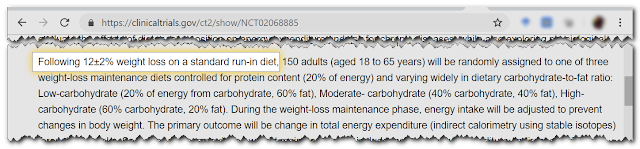
U PDATE:   12/17/2018      Original Posting: 12/3/2018    During the writing of a new installment in this se ries, I revisited the following paper: A randomized study of dietary composition during weight-loss maintenance: Rationale, study design, intervention, and assessment Yes, folks, so full of themselves were these researchers, that they felt the need to write an entire paper (submitted approx. one year in advance of the "real study") outlining their amazing study. Regarding this post, focusing on the OUTRIGHT FAILURE TO IMPLEMENT THEIR STUDY DESIGN AS STATED , I stress the following from the previous paper. ONCE AGAIN, the stated goal of the weight loss run in is 12% ... not 10 or 5 or 15 or whatever ... 12%.  I'm just going to quote the relevant part here (cleaned of references, etc. and formatted for readability, all emphasis mine) Energy intake was restricted to 60% of estimated needs to achieve a target weight loss equ...

The $12M NuSI/Ludwig Study: Part I: Critique of the Study Design

Image
S UMMARY The results of the $12 Million Dollar NuSI-sponsored study, headed up by Dr. David S. Ludwig, are finally out.   Effects of a low carbohydrate diet on energy expenditure during weight loss maintenance: randomized trial While the good doctor is making the rounds touting them as evidence in support of the Carb-Insulin Hypothesis (TWICHOO in these parts), a review of the raw data made available to the public casts grave doubts on his victory lap.  This study built upon the "promising" results of the 2012 study:   Effects of Dietary Composition on Energy Expenditure During Weight-Loss Maintenance    This post focuses on comparisons of Study Design between these two studies, some improvements, and the ultimate failure that renders the primary outcome data suspect, if not outright useless.  (And I don't say that lightly!) Improvements: Study size Length of time on one test diet (20 weeks) vs. 4 weeks crossover on each...

Are the Super-Obese the Ones Who Are Metabolically Adapted?

Image
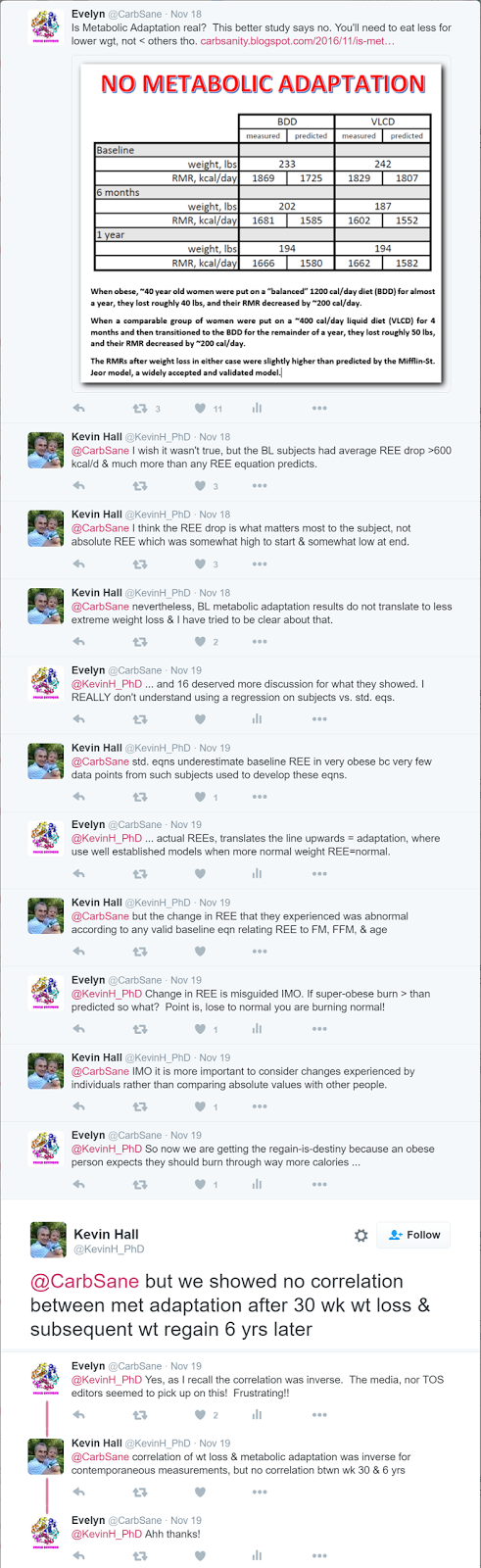
Introduction The current theme of metabolic research seems to have settled on physiological changes, post-weight-loss in the obese, that set the person up for almost assured failure and regain.  It has been reported that the super-obese (usually a term for BMI>40) tend to have REEs that are higher than would be predicted by standard, generally accepted models such as Harris-Benedict or Mifflin-St.Jeor.  This is both what was seen in the Biggest Losers "before" weight loss, and was reported in comments on this blog by Dr. Yoni Freedhoff, who measures REE in the obese he treats.   In order for a super-obese person to fully reverse their obesity, they will need to lose large amounts of weight -- 100, 200 or more pounds.   To do so, most will need to dramatically cut calories to lose at a rate that is motivating enough to sustain a fairly lengthy time period.  Even "fast" weight loss, reported by many, and especially gastric bypass patients, occurs over...

Is Metabolic Adaptation Real? Study 1 of ?

Image
I am ( STILL ) working on a comprehensive post addressing "The Biggest Loser Regain" study and fallout.  But as I was going along the way, I'm finding some gems that really just need posts of their own.  This is one of them.  I'm also going to do my best to clean out the draft bin for the remainder of 2016!     [If you haven't seen the previous entry referencing this topic, here is a link .  If it is some time past the publish date of this current post, this link should be active for the TBLR post.]

Should we worry so much about preserving "Lean Mass" in people who got obese on the SAD?

Image
A few years ago now, researchers led by George Bray of Pennington did a classic overfeeding study, to interesting result.  I blogged on that study in some depth here , but I'll include a brief summary now: Metabolic ward study Determined weight maintaining caloric intake over a period of 13-25 days on a standard diet P/F/C% of 15/25/60% The average maintenance calories for all participants was 2414 cals.  Overfed ~40% of calories or ~950 cal/day for 8 weeks. Carbs in the overfeed were slightly less than absolute amount at baseline, and were 40% of total overfeed calories. Total caloric intake for overfeed averaged 3375 cal/day, where excess calories came from fat and protein only.  The macro ratios of the overfeed diets in P/F/C% were: LP-6/52/42, NP-15/44/41 and HP-26/33/41. Below is the summary table I made for the calories and absolute quantities (grams) of the three macros:

The Latest Metabolic Adaptation Study

Image
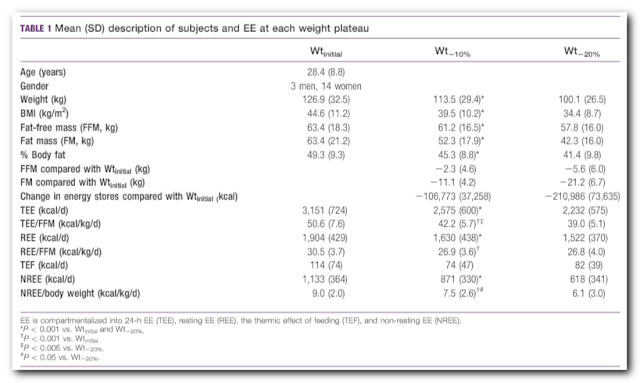
A quick post here just to get it out there, and I'm already a couple weeks behind the curve.  Oddly haven't heard too much about this, or perhaps it's because I've lost the will to deal with the community that would jump on this?  Who knows :-) There is a new NIH funded study out of Columbia (Rosenbaum & Leibel) published this month:   Models of Energy Homeostasis in Response to Maintenance of Reduced Body Weight I'm going to limit this post to just one of the three experiments conducted: In 17 subjects (14 women, 3 men) weight stable energy expenditure and body composition  was determined following a period of 6-8 weeks of weight stability.  They were then put on an 800 cal/day diet until they had reduced their weight by 10% of initial weight.  This took 7-13 weeks, after which their food intake was increased to achieve weight stability at the 10% reduced weight for 6-8 weeks.  Energy expenditure and body composition were measured her...

It's TOTAL Energy Expenditure that Matters, and RMR Doesn't Necessarily Predict It!

Image
Post Overview: In the context of weight loss, maintenance or gain, eventually all roads lead to the acceptance that *calories matter* ... you must be in deficit, balance or surplus respectively. In the wake of the recent The Biggest Loser Regain study , there has been a lot of doom-and-gloom reporting, led by Gina Kolata and Sandra Aamodt  in the New York Times .   I've distilled the results down to the bare bones: Summarized from Table 1 from Fothergill et.al.   14 Contestants (6 Men , 8 Women) The "alarming outcome" was that resting metabolic rate was reduced as might be expected, but seemingly remained suppressed and even further declined despite significant re-gain (70% re-gain/loss for the mean) after 6 years.   However the TEEs -- the TOTAL energy expenditures for the day -- tell a different tale.   These were measured over a roughly two week period by doubly labeled water in free-living conditions. The TEEs remained high at 30 weeks...

Metabolic Lessons from Anorexia Nervosa

Image
I've been poking around some eating disorder research recently due to the recent Elizabeth Licorish-Tara Lipinski kerfuffle (see also the follow-up ). But something else, that's seemingly always a hot topic when calories are discussed, is this concept of metabolic adaptation.  Quite often this gets referred to as having a "damaged metabolism".   I'm just going to use that term (and w/o quotes), and don't mean to imply that it is necessarily appropriate or justified, just that it's easier than explaining it repeatedly.  The damaged metabolism is thought to develop from frequent, chronic, and/or severe calorie restriction.  The mechanism is that the body down-regulates basal metabolic rate such that a 150 lb person who has dieted down from 250 lbs will require fewer calories to maintain that weight compared with a person whose normal, stable weight is 150 lbs.    So I was looking for some additional references about the "hamster wheel" (i...