Posts

Showing posts with the label Knock Out Animal Models

My Gut Feeling on Microflobesity Was Right

Image
This post brought to you by Duck Dodgers' arrogance.  If there ever were an example of what is wrong with science in the Incestral Health Community, it is the phenomenon that is "Duck Dodgers" and his comments here.     A seemingly non-controversial post -- on how the US Dietary Guidelines were never any radical departure from the way humans around the globe have eaten for thousands of years -- went viral, at least in part because of Duck's return.   What rubs me personally the wrong way about this person (or persons, though I've been told it is only one person who posts with that ID in comments here so I operate on that assumption) is his response to any challenge to "How Food Enrichment Made Us Fat, Diabetic, and Chronically Diseased" otherwise known as the "Iron Food Enrichment Hypothesis" .  Despite doubling down on the whole fortification thing at the off-the-grid web rental only around a month ago, this guy comes on here and plays...

Perfect Health Diet Macronutrient Ratios ~ Part II: Omnivores Prefer These Ratios

Image
Summary:    In the Perfect Health Diet books, the claim is made that omnivores prefer a high fat diet along the lines off the PHD macronutrient ratios.  Two studies on mice are cited as evidence in support of a 65% fat diet.  This post discusses those two studies, as well as how the results are more likely to caution against a high fat diet than advocate for it.   NOTE:  This is NOT a comprehensive look at the two studies discussed in the post.  In order to keep the post length managable I've only addressed the points relevant to claims made in the  PHD  books citing these studies.

Interpreting Study Results ~ The Mice Revealed

Image
Recently I shared some "blinded" study results from a real study conducted on two strains of mice, each studied after eating one of two diets.  More correctly these mice are of the same strain, but one set has a mutation in the brown fat cells.  I did this along with some simple -- obvious -- questions, and then a more open ended question regarding interpretation.  I intended for one more installment, but I think it just got tedious, so I'll incorporate that into this reveal post.   So from the first post, here is the data I provided:

Is Glucose Toxic to Cells? Answers from the LIRKO Mouse and More ...

Image
I briefly interrupt Thermodenialgate reports to revisit the LIRKO mouse.  But first, a little fun blast from the past.   A few years ago now I did a series on fat tissue regulation that involved various receptor and gene knockout mice.  I had a little fun making (low graphics tech) characters out of Star Wars Lego figures.   First came C3KO , a mouse deficient in acylation stimulating protein, ASP, production.  Shortly thereafter came Obi No Leptinobi .

Lessons from LIRKO

Image
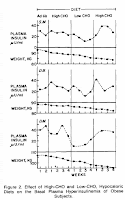
The LIRKO mouse has no insulin receptors in its liver.  It's one pretty sickly mouse.  In most studies it becomes hyperglycemic and hyperinsulinemic very early in life, but by six months or so of age is either normoglycemic or hypoglycemic.  Despite the concurrent hyperglycemia and hyperinsulinemia, the LIRKO remains normal weight, it is even a bit underweight if anything.  This is despite the fact that  circulating free fatty acids (FFA, or my preferred acronym, NEFA)  are suppressed by 40%.  {Here are the two papers I've discussed in previous blog posts: Loss of Insulin Signaling in Hepatocytes Leads to Severe Insulin Resistance and Progressive Hepatic Dysfunction , High Circulating Leptin Receptors with Normal Leptin Sensitivity in Liver-specific Insulin Receptor Knock-out (LIRKO) Mice both links are to free full texts} LIRKO presents two problems for the TWICHOOB: 1.  Chronic hyperinsulinemia does not cause rampant fat accumulation...

Some Suggested Reading ...

In light of other recent events, I present some suggested posts from this blog on the questionable accuracy of the blogging of one Peter Dobromylskyj aka Hyperlipid. 1.  Bloggo Science ~ A Hypothetical Post ~ III: Fasting Insulin & Weight Loss Summary:  The third post in a series (links to I & II within) outlining how Peter deliberately fudged the data from the "infamous" Grey & Kipnis study.  He even told his readership he was doing it and tips his hat to Ancel Keys.  I feel to this day that if anyone can read this series and take Peter seriously after that.  It was done in all seriousness on his part.   2.   Bloggo Science ~ LIRKO Wars Edition Summary:  Peter blogged on the LIRKO mouse with a "cute" quiz about making jam from the urine of this mouse.  One problem, LIRKO doesn't get glucosuria.  Other claims made are also easily dispelled including that this mouse's liver (and other cells) can't process glucose ...

LIRKO vs. TWICHOO X.0

Image
from this study , image from this post It occurred to me as I was thinking again about LIRKO, that this little mouse not only countered TWICHOO 1.0, but it pretty much puts the lid on TWICHOO X.0.  This profoundly hyperglycemic and hyperinsulinemic liver insulin-receptor knockout mouse, is not fat.  Though not statistically significant, the trend is to eat a tad less, be a tad smaller, and pack on fewer fat grams  than controls.  But let's just call it a wash. For any newer readers, TWICHOO stands for Taubes Wrong Insulin-Carbohydrate Hypothesis Of Obesity.  Version 1.0 was that which was put forth in Good Calories Bad Calories .  In this version, Taubes put forth four ways by which the carbohydrate could promote obesity: 1.  Carbohydrates stimulate insulin which stimulates fat storage and/or traps fats in our fat cells so fat accumulates. This was pretty much the "lead singer" of his Barbershop Quartet singing the TWICHOO jingle.  ...

Remember LIRKO? Grey & Kipnis?

Image
So a recent research paper has been making the rounds.  It has a "red meat" title for the die hard TWICHOOB:   Hyperinsulinemia Drives Diet-Induced Obesity Independently of Brain Insulin Production .  This paper was brought up in my comments section as well.   Every time this happens I really do feel like I'm in some sort of nutritional remake Groundhog Day.    I'm a bit backlogged at the moment, but luckily Stephan Guyenet has weighed in with his analysis and included some additional studies in support of his position.   Whenever I think hyperinsulinemia causes obesity,  I'm reminded of the LIRKO mouse.  LIRKO is normal except its liver lacks insulin receptors.  The result is a mouse with raging hyperglycemia and hyperinsulinemia throughout much of its young life until its liver poops out.  I blogged on this mouse here:   Bloggo Science ~ LIRKO Wars Edition .  (Incidentally that post links to an older post by...

Fat Tissue Regulation ~ Part IX: ASP, LPL and the Triglyceride/Fatty Acid Cycle

Image
In this installment, we reunite with our old friend C3KO mouse to learn a little bit more about the role of acylation stimulating protein, ASP, in the regulation of fat tissue (and muscle) from this study:   Differential regulation of fatty acid trapping in mouse adipose tissue and muscle by ASP .  The C3KO mouse was discussed in Part II of this series.  This mouse lacks the gene to produce a protein called C3 (short for Complement 3) which is a precursor for the formation of ASP.  Thus C3KO mice are ASP deficient.  The C3KO is to ASP as a type1 diabetic is to insulin.  These mice are also resistant to obesity.  BTW, hyperASPemia accompanies the hyperinsulinemia and hyperleptinemia of obesity when it's measured. ASP-deficient mice have delayed postprandial triglyceride (TG) clearance and reduced WAT mass. The objective of this study was to examine the mechanism(s) by which ASP deficiency induces differences in postprandial TG clearanc...

Insulin Resistance III: Glucose Uptake and GLUT4's

Image
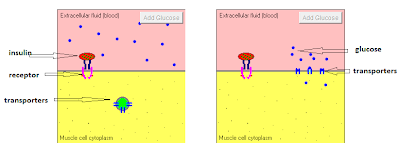
So far with this series, I've discussed the many difficulties involved in discussing and characterizing insulin resistance, IR.  See Part I: A condition in dire need of diagnostic clarity  and Part II: The Complexity of Hormone Resistance Phenomena .    Insulin-mediated glucose transport, or "disposal" from circulation is the major action/phenomenon usually assessed or being discussed when a person (or lab animal) is described as "insulin resistant".   So in this part, I wanted to discuss glucose transport.   This link is a nice tutorial about the action of insulin that includes an animation of ONE of its functions:  glucose transport.  Glucose cannot traverse membranes unassisted.  In essence it must pass through protein "channels" from one side to the other.  There are always glucose transporters, called GLUT's, present in the cell membrane, but they are not always at the exterior surface of the cell to receive glucose.  Insul...

More Bloggo Science

Sigh.  I would normally comment on a person's blog if I read something like this:   Insulin, the Un-dead and coffin nails , but since Peter doesn't want to distract his readership with potentially productive discussions amongst them, I refrain from posting there.  In the article he makes two statements I find rather outrageous: Hyperglycaemia causes insulin resistance. This is not controversial, as far as I am aware. It's not controversial in those circles where it is repeated uncritically.  It's not really controversial that this statement is wrong.    Let's take this together with another statement: Let's summarise. This is very, very important:    Excess insulin causes insulin resistance End summary. This is just day to day internal medicine. You have to pay the mortgage somehow. Only this too is at the very least controversial, and almost certainly not true in most cases.

Insulin Resistance II ~ The Complexity of "Hormone Resistance" Phenomena

It's been a while since Part I of this series ... too many irons in too many fires and all that jazz.  But one research track I went down recently reminded me of this lingering series and I thought I'd finish up this second installment. We hear all the time truisms such as that the acute effects of a hormone differ from the chronic effects, and whenever a hormone is present in excess of normal levels, the term " fill in hormone here resistance" is sure to be close behind.  Now there is no doubt that hormone resistance is a very real phenomenon, but what does it mean, specifically? The concept of insulin resistance, IR, is highly complicated by the fact that insulin has varying actions in various tissues and organs.  I do intend to discuss tissue-specific IR in more depth as this series unfolds.  But for today, I am going to limit the discussion to insulin and the muscle cell.  After all, when general IR is discussed, it is usually systemic or skeletal muscle i...

Of Mice & Men: My Rodent Study Disclaimer

Image
The purpose of this post is to have a sort-of "disclaimer" to link to (if I can remember) whenever I discuss a rodent study here at the Asylum ... A small manifesto if you will, on my feelings on the utility and limitations of rodent studies in relation to human beings.   Also, I look at this post as a way to remind older readers and/or inform newer readers as to my background.  I spent roughly five years in the company of countless rats and mice, working for Big Pharma, and when I speak of rats, I'm not talking about my colleagues ;-)  My job was half analytical chemistry, half metabolism.  I worked on mostly discovery level drug candidates (a level before development) characterizing the absorption, metabolism and routes of excretion of these drugs, mostly antidepressants.  As such I've chopped the heads off of more rats than I care to recollect, opened up countless abdomens of mice to get maximum blood samples from the vena cava, removed/homogenized and analyz...

Bloggo Science ~ FIRKO-ized!

Image
I have long since ceased reading Peter/Hyperlipid's blog for meaningful information.  There are too many examples of him openly manipulating data and misrepresenting science for me to take him seriously anymore.  Still, our blogs share a certain readership and his readers do participate in other internet realms where I linger or participate.   As such, his blog remains on my feed reader.  Peter has been on a FIRKO mouse kick lately and it has caused me to dust off a few posts from the draft bin where this mouse fits into the discussion.  But his latest latest offering on FIRKO (Fat Insulin-Receptor Knock Out) just tripped my epigenetic BSA* gene switch.   *BSA = Bull Sh!t Alert In FIRKO-ise , Peter actually compares a genetically modified mouse to putting a mouse on a ketogenic diet.  Really!  To review, the FIRKO mouse lacks insulin receptors.  As a result, this mouse is resistant to obesity on the usual obesogenic diet for rodents (high fa...

Fat Tissue Regulation ~ Part V: C5L2KO - Meet the New Droid, Kinda Like the Old Droid

Image
It seems that our friend C3KO city mouse has found his country mouse cousin:  C5L2KO.  In keeping with the Star Wars saga, albeit stretching things a bit with this one, I've found the depiction of our new friend! To catch up, C3KO is a knockout mouse lacking the ability to produce Complement 3 (C3) protein which is a precursor for production of acylation stimulating protein, ASP.  Therefore C3KO is ASP deficient.  The result of this genetic mutation is to produce a mouse that is resistant to obesity, and essentially an ASP equivalent of insulin deficiency -- Type 1 diabetes.  If you've not read about C3KO, here are the links to the two relevant installments in this series:    Fat Tissue Regulation ~ Part II: Meet C3KO    Fat Tissue Regulation ~ Part III: C3KO Meets Obi No Leptinobi It is known that fat tissue expresses insulin receptors.  Indeed this has been exploited to more clearly elucidate the roll of insulin acting on fat tiss...

Fat Tissue Regulation ~ Part III: C3KO Meets Obi No Leptinobi

Image
In the previous post in this series, we met the C3KO mouse, a mouse that is  ASP  deficient.  In this post, I'm going to discuss what happens when you take a leptin-deficient ob/ob mouse and also make it a C3KO.  Humor me my fun with Star Wars characters ;-) It turns out I had discovered this study and blogged on it over a year ago:   Acylation-stimulating Protein (ASP) Deficiency Induces Obesity Resistance and Increased Energy Expenditure in ob/ob Mice    ( Xia, Sniderman & Cianflone).

Fat Tissue Regulation ~ Part II: Meet C3KO

Image
I've shortened the title of this series from The Full Physiological Regulation of Fat Tissue to allow for some descriptions of each installment without generating 30 word blog post titles.  Yes, I did consider TFPRFT {cheeky grin} but thought the wiser of that one!  Allow me to introduce you to C3KO   (note my high tech graphics skills!  LOL) No, C3KO is not a character in Star Wars Episode MMXI*:  Battle for the Adiposity Galaxy .  Rather, there is a protein known as Complement 3, C3 for short.  The complement system is an important one in the functioning of our immune systems and has long been recognized for mediating inflammation .  In studying the role of this protein in physiology, researchers created a C3 knockout mouse -- one that does not produce C3.  This mouse is sometimes called C3KO**