Posts

Showing posts with the label Oral Glucose Tolerance Test (OGTT)

Insulin Secretion and the Corrected Insulin Response (CIR)
Image
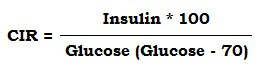
I'm working on a post about hyperinsulinemia and obesity in humans.  It may well turn into several posts.  But in one study I will be discussing they identified hypersecreters according to something called the corrected insulin response, CIR.  Sometimes this is further "standardized" as the CIRgp which is evaluated at the peak glucose reading.  The CIR is value calculated following a standard OGTT.  If you have data from your OGTT, you can calculate your own and determine how you rank. The CIR was developed by Sluiter and colleagues as outlined in:   Glucose Tolerance and Insulin Release, A Mathematical Approach I. Assay of the Beta-cell Response After Oral Glucose Loading .   From the dose-response relations between glucose and insulin after oral glucose loading, a reproducible parameter for beta-cell response was deduced. The main advantage of this parameter lies in its independence from the initial or reached glucose level....

Blood Sugar 140: Do Postprandial Spikes Glycate?

Image
I've got at least one more post in this series directly relating to the neuropathy study  to which concerns over BG levels over 140 mg/dL and nerve damage can be traced. This post is actually going to be rather short.  In the study, they found that half of those with neuropathy were diagnosed with IGT having a BG level over 140 mg/dL at the 2 hr mark on an OGTT.  An additional 18% were diabetic and 32% normoglycemic.  So the incidence of IGT was roughly three times as prevalent in this neuropathic population as in the general population.  Further, the IGT group had more painful sensory symptoms than the normoglycemic group.  But here's the thing:

Blood Sugar 140: Context is Everything II: The OGTT

Image
In the last installment , I discussed the context of blood glucose readings over 140 mg/dL in diabetics vs. non-diabetics.  In this installment I'm going to discuss it in the context of an Oral Glucose Tolerance Test, OGTT.   The crux of this post is that the results of this study do not justify the Ruhl/Jaminet/(and I'll add Kresser) takeaway message vis a vis diabetes complications and "spikes" in blood glucose.   The fact that 50% of the neuropathy subjects to whom OGTT's were administered had 2 hr. glucose levels over 140 (e.g. diagnosed as Impaired Glucose Tolerance, IGT) simply does not support:  Nerve Damage Occurs when Blood Sugars Rise Over 140 mg/dl (7.8 mmol/L) After Meals as stated on Ruhl's site and in Perfect Health Diet (Kindle Locations 712-716).  ( This seems to have been repeated by Chris Kresser as well ). What is an OGTT?  The most common form is conducted in the fasted state, at least 8 hrs, studies seem to favor 10 or ...