Posts

Showing posts with the label Metabolic Advantage

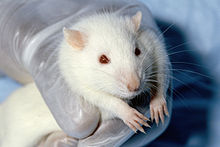
Why We Get Fat ... Lessons from a Cafeteria Rat
Image
BUMP! In addition to blogging on several topics raised during Stephan Guyenet and Gary Taubes recent appearance on the Joe Rogan Experience podcast , I've decided to bump some of the past content on this blog relevant to some topics discussed and/or research studies mentioned.  I'll include a little commentary with each. At around the 12 minute mark, Stephan makes a great opening play, and then gets distracted or flustered into fumbling the football.  Stephan asks what it is about the food environment, etc. that causes obesity, and distills it down to the simplest of questions (paraphrase): Q:  What is the most fattening diet on the planet? A:  Human junk food. Nail.  Head.  Boom.  He then calls out some numbers from the research summary he posted on his blog in advance of the podcast .   The study I discuss in this blog post is the one included in "#52" that he's discussing in the podcast.    Joe seemed perplexed by thi...

The $12M NuSI/Ludwig Study ~ Part V: Intake, REE and TEE Measures

Image
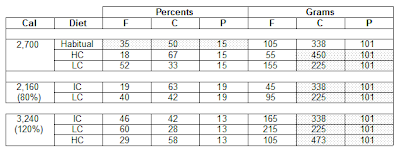
S ummary: Continuing on with discussion of:   Effects of a low carbohydrate diet on energy expenditure during weight loss maintenance: randomized trial Previous posts in this series: Part I: Critique of the Study Design Part II: $12 Million for 12% Weight Loss? Part III: Some "Early" Lessons Part IV: Insulin Resistance Does Not Hamper Weight Loss This post should perhaps have come first, but it has taken a while to look deeply at the data for the primary outcome -- total energy expenditure measured by doubly labeled water -- and related outcomes of intake and resting energy expenditure. In this study, all participants were paid to participate, AND provided free food for ~8 months.  Said food was professionally and meticulously prepped, weighed, measured, individualized to provide each subject with some pretty exact caloric level and macronutrient composition.  The test phase (in other words, the study proper) involved maintaining a consiste...

The $12M NuSI/Ludwig Study ~ Part IV: Insulin Resistance Does Not Hamper Weight Loss

Image
       C ontinuing on with discussion of: Effects of a low carbohydrate diet on energy expenditure during weight loss maintenance: randomized trial No summary for this post.  Here are links to earlier parts in this series: Part I: Critique of the Study Design Part II: $12 Million for 12% Weight Loss? Part III: Some "Early" Lessons :   In this most recent post, I discussed the relationship between measures of insulin (both fasting and 30 minute OGTT response) and weight loss during the Run-In Phase.  

The $12M NuSI/Ludwig Study ~ Part III: Some "Early" Lessons

Image
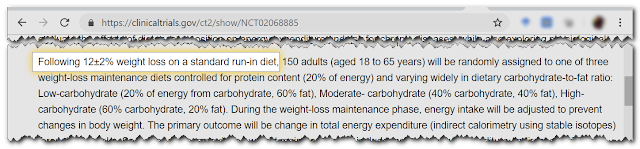
S UMMARY Continuing on with discussion of: Effects of a low carbohydrate diet on energy expenditure during weight loss maintenance: randomized trial In Part I , I discussed some issues with methodology, mostly focusing on the reduced Run-In Phase that likely compromised the outcomes irreparably. In Part II ,  I highlighted a serious issue with the Run-In Phase, the purpose of which was to produce a somewhat homogeneous "reduced weight state" to test various diets in maintenance of that state. Ultimately,  randomization to the various test diets occurred after weight loss (PWL) all subjects lost weight on the same 45% Carb / 30% Fat / 25% Protein diet targeting a weight loss of 12% ± 2% initial body weight. The researchers do not appear to have made many adjustments in the weight loss phase to produce a more uniform weight loss.   Rather than 12% ± 2%  (from 10% to 14%)  losses, the actual outcome was roughly 10.5% ± 5% (actual ...

The $12M NuSI/ Ludwig Study ~ Part II: $12 Million for 12% Weight Loss?

Image
U PDATE:   12/17/2018      Original Posting: 12/3/2018    During the writing of a new installment in this se ries, I revisited the following paper: A randomized study of dietary composition during weight-loss maintenance: Rationale, study design, intervention, and assessment Yes, folks, so full of themselves were these researchers, that they felt the need to write an entire paper (submitted approx. one year in advance of the "real study") outlining their amazing study. Regarding this post, focusing on the OUTRIGHT FAILURE TO IMPLEMENT THEIR STUDY DESIGN AS STATED , I stress the following from the previous paper. ONCE AGAIN, the stated goal of the weight loss run in is 12% ... not 10 or 5 or 15 or whatever ... 12%.  I'm just going to quote the relevant part here (cleaned of references, etc. and formatted for readability, all emphasis mine) Energy intake was restricted to 60% of estimated needs to achieve a target weight loss equ...

The $12M NuSI/Ludwig Study: Part I: Critique of the Study Design

Image
S UMMARY The results of the $12 Million Dollar NuSI-sponsored study, headed up by Dr. David S. Ludwig, are finally out.   Effects of a low carbohydrate diet on energy expenditure during weight loss maintenance: randomized trial While the good doctor is making the rounds touting them as evidence in support of the Carb-Insulin Hypothesis (TWICHOO in these parts), a review of the raw data made available to the public casts grave doubts on his victory lap.  This study built upon the "promising" results of the 2012 study:   Effects of Dietary Composition on Energy Expenditure During Weight-Loss Maintenance    This post focuses on comparisons of Study Design between these two studies, some improvements, and the ultimate failure that renders the primary outcome data suspect, if not outright useless.  (And I don't say that lightly!) Improvements: Study size Length of time on one test diet (20 weeks) vs. 4 weeks crossover on each...

The Latest Metabolic Adaptation Study

Image
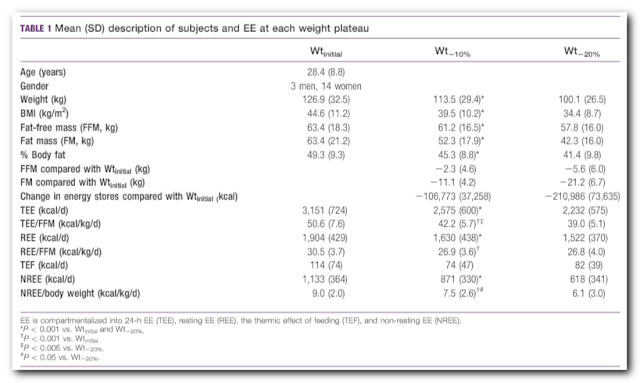
A quick post here just to get it out there, and I'm already a couple weeks behind the curve.  Oddly haven't heard too much about this, or perhaps it's because I've lost the will to deal with the community that would jump on this?  Who knows :-) There is a new NIH funded study out of Columbia (Rosenbaum & Leibel) published this month:   Models of Energy Homeostasis in Response to Maintenance of Reduced Body Weight I'm going to limit this post to just one of the three experiments conducted: In 17 subjects (14 women, 3 men) weight stable energy expenditure and body composition  was determined following a period of 6-8 weeks of weight stability.  They were then put on an 800 cal/day diet until they had reduced their weight by 10% of initial weight.  This took 7-13 weeks, after which their food intake was increased to achieve weight stability at the 10% reduced weight for 6-8 weeks.  Energy expenditure and body composition were measured her...

NuSI Study Debunks Taubes

Image
I just came back from a trip to Kansas City to meet the public (grin) and was immediately bombarded from several sides with the above video.   Nutrition Wonk has transcribed the talk so head on over to see that and the poster!

Nutritional Ketosis is an Oxymoron II: The Last Ketotic Gasp

Image
gratuitous image of the Drs. Eades, early 2015 A little while back I wrote  Nutritional Ketosis is an Oxymoron .  I was taken to task a bit in comments for the inappropriate use of oxymoron, but I'm going to plead for leniency in the spirit of the use of the term.  The crux of that post was that the terms nutritional (as in being in a calorically sufficient, weight stable state) and ketosis are metabolically contradictory.  This is perhaps evidenced in no more profound manner than the extremes required to produce and sustain such a state, and the ease with which it is abolished. Ketowars rage on as the standard bearer appears to be imploding on the sidelines ...  I got into a discussion on Twitter with Dr. Eades about a side issue, and here you go ... SUMMARY: Starvation ketosis is distinctly different from nutritional ketosis. No human populations in sustained nutritional ketosis (not even the Inuit). Dietary reasons why the Inuit weren't in nu...

NuSI ... or Just Do It!

Image
Imagine if you will, that a decade or more ago someone told you that if you really wanted to build your journalism career tearing down scientists, you needed to look at diet and nutrition research.  You picked up a copy of Atkins and lost a couple of pounds.  You began cultivating your schtick that simple obesity (the kind of the epidemic) was not about overeating or sedentary behavior, it was something else.  And you received three-quarters of a million dollars to research and write a book.  The book was a best seller and garnered you a cult following in certain circles and you were off to the races giving talks around the globe.   There were doctors and others who bought into your hypothesis, spreading the word as fact and growing the movement.  But a following from one segment of the population remained elusive:  scientists.   Rather than address the reasons why (serious holes in your hypothesis), you double down and trash scientists more open...

High Protein Diet Induces Sustained Reduction in Ad Libitum Intake Despite Diurnal Leptin Compensation

Image
I've written several hundred posts on this blog.  There are some, especially from early on in 2010, that I would really like my readers to see, and I sure don't expect folks who are just finding this blog now to go back and read everything to find some that I feel are key.  I refer to this study quite often because I think for those finding themselves gaining a little bit each year and not wanting to hop on some "diet rollercoaster", there is merit to -- especially for us women -- upping the protein as a percentage in the diet.  So when I was compiling graphics for the 24 Hour Leptin Profiles post , this study was the first I knew to go to for a graphic.  So, I'm bumping the original, adding a little emphasis to the text but not changing it, and I'll add some commentary on leptin at the end.   Original Publish Date:  4/30/10 A high-protein diet induces sustained reductions in appetite, ad libitum caloric intake, and body weight despite compensato...

Grey & Kipnis ~ Hyperinsulinemia and Diet Paper

It appears that the website that formerly hosted the full text PDF of the Grey & Kipnis study I cite quite frequently here has been taken down.  I'm sad to see this. I've linked to that hosted copy so many times it would be impossible to go back and change them all at this point.  Instead I'm posting this up if anyone ever needs to find the reference in an older post, and I'll use my new Google docs host link in all future posts.   Here it is: Effect of Diet Composition on the Hyperinsulinemia of Obesity

The Essential Carbohydrate?

I would ask each and every reader to try as best you can to check their nutritional biases at the door here as best you can  and let's just talk semantics.   What does essential mean?   Something that is essential is something that we cannot do (or in the nutritional context live) without.  By this definition, it is clear that yes, for most humans, carbohydrates are non essential.  However, even this is too simplistic, because without looking very far, we can identify a group of humans for whom carbohydrates are "deadly" essential.  As in imminent death kind of essential.  Relatively rare as is their number, I'm talking about people with glycogen storage/breakdown disorders. Now, let's look at the other macronutrients.  Well, we cannot live without protein.  Therefore it is essential.  No argument.   However, proteins are comprised of 21 distinct building block amino acids of which only 8 are actually identified as *essentia...

Chris Masterjohn on Cherry Picking (and the Metabolic Advantage of Fructose)

... at least in rodents ;-) Let Us Honor Ancel Keys, Our Patron, As We Cherry Pick Studies to Bash Fructose (Revised and Extended) Hats off to you Chris!

Metabolism v. Fat Burning

I was reading  Alcohol Revisited on Low Carb  by Dana Carpender and something she said jumped out at me: No doubt, however, that alcohol can be fattening, not only because of the calories it contains, but because it slows metabolism - to quote a medical journal article I read, "Alcohol profoundly inhibits lipolysis." In English this means that alcohol slows fat-burning to a crawl. Like carbs, your body burns alcohol preferentially. Don't expect to burn any fat until you've burned through all your alcohol calories.  First of all, Carpender makes the all-to-common mistake of equating lipolysis with actual fat-burning.  As I summarized in Lip-ocabulary  , lipolysis is the breaking apart of triglycerides to glycerol and free fatty acids.   This occurs constantly in our bodies, inside the fat cells by hormone sensitive lipase (HSL) to release FFA's continually as part of the triglyceride/free fatty acid cycle , and in the capillary beds by lipoprotein lipase (L...

Metabolic Advantage, Obesity and Eric Jequier

Image
Since I had the whole metabolic advantage thing on my mind writing my last post, and "Anonymous LC Author" mentioned Feinman and Jequier, I was reminded of something that's bothered me for a while now regarding citations of Jequier's work.  A calorie is a calorie violates the second law of thermodynamics  argues for the potential of a metabolic advantage in low carbohydrate diets.   Oddly enough, they ultimately make a first law argument for the MA, but that's a subject for another day. It was this paper that introduced me to the work of Eric Jequier after which I stumbled upon the subject of my most popular post to date, Nutrient Fates after Absorption  referencing this Jequier paper:   Nutrient effects: post-absorptive interactions .  But the Feinman & Fine paper cites a different Jequier paper to which the TEF values of macronutrients can be ubiquitously traced in LC circles.  That paper being:   Pathways to Obesity .   S...

Effects of consuming a high carbohydrate diet after eight weeks of exposure to a ketogenic diet

Image
Thanks to Leon for finding this :) Effects of consuming a high carbohydrate diet after eight weeks of exposure to a ketogenic diet Basically they took two groups of rats and fed them (ad libitum) either a ketogenic diet (KD) or regular chow (CH) for 8 weeks.  Then they switched the diet of the KD group to CH (KD:CH) and continued to feed the rats for an additional 8 weeks.  As this was a rat study, the rats gained weight/grew for the entire 16 week duration of the study.   The diets:  KD = 5% carb/15% protein/80% fat             CH = 60% carb/23% protein/17% fat Now I'm not a rat, but I do find these results both interesting and a bit surprising.  Here are the graphics for caloric intake and weight: caloric intake:  Surprise #1:  The KD rats consumed pretty consistently fewer calories (although the difference is not noted with an * for statistical significance) for the first 8 weeks and yet gained consistently more...

Of Thermodynamics, Chemistry, Biology and Biochemistry ~ Feinman Reply

In response to, this post : Fred Hahn  said... I am posting this comment on behalf of Dr. Richard Feinman, professor of cellular biology at SUNY Downstate.  "I never had to go through steam tables but I still teach bioenergetics in biochemistry courses where we think thermodynamics has a lot to do with human metabolism.  Like most chemists and even some physicists, I would be willing to admit I don't understand the field that well but if you have a problem, feel free to write to me directly.  I think it is touching that people get excited about thermodynamics but I expect polite discourse.  Richard Feinman  Professor of Cell Biology  SUNY Downstate Medical Center  feinman@mac.com Here's the discussion at Eades' blog that resulted in my steam table comment: Jim B, March 6, 2010 at 9:41 pm In the last year, or so, I have experienced a re-education on thermodynamics. In the last 20 years or so, there has been a mojor change in the way the sub...

Brown Fat and the MYTH of Diet-Induced Thermogenesis

Brown Fat and the Myth of Diet-Induced Thermogenesis INTRODUCTION:  The concept that brown adipose tissue (BAT) is a thermogenic tissue initially came from morphological changes in the tissue when animals were exposed to the cold (Smith and Horwitz, 1969). The physiological basis for the enormous capacity of BAT for heat production during cold exposure awaited the ingenious application of radiolabeled microspheres to measure blood flow in BAT and other tissues (Foster and Frydman, 1978). That production of heat occurred by uncoupling mitochondria was firmly established with the elegant experiments of Nicholls on physiology of BAT mitochondria and Ricquier’s identification of a unique cold-inducible protein in the mitochondria of BAT (Nicholls and Locke, 1984). The presence of large amounts of differentiated BAT in human neonates and species like sheep that require active thermogenesis at birth to protect the n...

Before The New Atkins

Westman, Volek and Phinney were among the contributers (and Westman headlined) the following, partially Atkins Foundation funded, review: Low-carbohydrate Nutrition and Metabolism I can't recommend reading this highly enough. I've listed the references in a separate post , numbered (the formatting farkled the last few but I'll let you count ;) ) For a non-gimmicky discussion of how low carb diets REALLY work for weight loss, this is where it's at!