Posts

Showing posts with the label Type II Diabetes

Swan Song

Image
[no I'm not retiring the blog] TLDR:  Rather than dragging things on by dismissing more black swans, Gary Taubes could eat crow and go quietly into the night. After a long hiatus from any meaningful new content, and monumental blows to TWICHOO (Taubes Wrong Insulin Carbohydrate Hypothesis Of Obesity -- c'mon, it has a much better ring to it than the Ludwigian version), , Gary Taubes has gotten back to blogging a bit.* He has apparently been reading (in fits and starts, in other words, probably not really reading) obscure books about obscure cultures from long, long ago.  Mind you, that in five years plus of arduous and comprehensive research put forth in Good Calories, Bad Calories , there was no mention of the Yahgan people he's about to discuss.   One wonders why not.  Heck, this is right in his time period of excellence for nutritional research and reporting!  ( Uttermost Parts of the Earth , this is to a 2007 version of a book Taubes...

Dietary Energy Density and Incidence of Diabetes in the Women's Health Initiative

Image
Summary: In the Women's Health Initiative, a 2017 analysis of the energy density of baseline diets, stratified to quintiles, revealed several correlative components of an energy dense diet (comparing the top quintile (Q5) to the bottom (Q1).  The energy density, in kcal/gram of food, nearly doubled in Q5 vs. Q1 corresponding to a nearly 50% increase in caloric intake.  The dietary components correlating with this are: Fat:  Fat content is by far and away the greatest contributing factor to consuming an energy dense diet.   Absolute intake more than doubled (2.5X) from Q1 to Q5, and comprised roughly 90% of the increased caloric intake. Animal Protein:  As protein intake from plant sources remained relatively constant, animal protein intake increased by 40% resulting in an increase in total protein of 25%.  Therefore animal foods are a considerable contributor to increased energy density of the diet. Added Sugars:  Added sugar comprised 11...

Insulin Treatment in Diabetes ~ Why Does It Often Cause Weight Gain?

S ummary: Diabetes, whether Type 1 or Type 2, is a dysfunctional, wasteful metabolic state.  As a result, an uncontrolled diabetic either uses or loses more energy than their non-diabetic selves would otherwise use.  As such, the untreated diabetic is essentially "underweight" compared with the body weight that the same energy intake would produce were they not diabetic. There are differences in endogenous insulin production between the two types of diabetes.  In Type 1, there is effectively no insulin production.  In Type 2, there is usually elevated basal insulin production, but a relative deficiency in acute insulin secretion, specifically an impaired early insulin response to glucose (GSIS).  The absolute or relative insulin deficiency results in the following to a greater or lesser degree: Excessive lipolysis resulting in an increased cycling of the Triglyceride/Fatty Acid cycle.   Impaired suppression of glucose production in t...

Diabetes Un-Funged

Image
The Noakes Foundation has put out a new book entitled Diabetes Unpacked * , edited by Dr. Zoe Harcombe PhD.   It is a compilation of chapters written by a who's who of the low carborati.  This installment deals with Chapter 3 by Dr. Jason Fung, a nephrologist masquerading as an obesity specialist and diabetologist.  He has no formal training in either, and his grasp of some pretty basic physiology is tenuous at best.  That latter "charge" can be backed up by fact checking (or attempting to fact check that which isn't simply Fung POOP (Pulled Out Of Posterior) ) any of his various blog articles, books, podcasts or YouTube videos.   * That's my Amazon affiliate link This post will be an evolving one of sorts that I'll bump if and when content is added.  I've avoided giving Fung much "ink" here, frankly because I never thought anyone would take him seriously enough to deserve it.  Clearly I was wrong.  There's apparently no lim...

β-Cell lipotoxicity in the pathogenesis of non-insulin-dependent diabetes mellitus of obese rats: Impairment in adipocyte-β-cell relationships

Image
BUMP NOTICE:  I'm bumping this post due to some recent discussions on social media regarding the reversibility of Type 2 Diabetes and the role of low carbohydrate diets in the growing "curing diabetes" paradigm.  Recently Dr. Roy Taylor (the investigator I most closely associate with the crash diet, though this is an extensive group) and colleagues, who implemented a "crash diet" to cure diabetes -- by reducing pancreatic and hepatic (liver) fat concurrently with rapid weight loss -- published the following in BMJ:   Beating type 2 diabetes into remission .    The criteria are non-diabetic markers for a period following reversal of the progression.  Here is where various low carbohydrate interventions "fail", as many are able to maintain normoglycemia only by avoiding carbohydrates.  The question remains if this is effectively the same as other reversals.  I contend it is not, as normal pancreatic function -- specifically GSIS -- has not ...

Bump: The Diabetes "Crash" Cure & Pancreatic Fat

Bumping Again! New Article in BMJ:   Analysis: Beating type 2 diabetes into remission * The original posting of this was shortly after the first papers published on the success of a very low calorie diet -- essentially a 6-800 calorie protein-sparing-modified-fast, protein shakes + non-starchy veggies -- in curing diabetes in relatively short order.  You may also be interested in the following posts: The Diabetes "Crash" Cure Revisited  (a follow-up to this one) Diabetes "Crash" Cures: VLCal vs. VLCarb Check Featured Comment (if any) for further updates from me. *In light of commentary below, I'll add that I am not a fan of using the term remission here.  Cancer does seem to strike at random most times and recurrence seems to be equally random.  At best we have few if any ways to predict who will see cancer return etc.  But Type 2 diabetes doesn't work that way in most.  The source of the beta cell dysfunction is pretty well k...

Podcast Appearance Tomorrow: Superhuman Radio

Image
Hello inmates!  I'll be appearing on Superhuman Radio with Carl Lanore tomorrow, August 10, at 12 noon EST. You can listen live HERE You can always listen to rebroadcasts, and I'll post a link once the podcast is "in the can". Our topic will be  A New Perspective on Type 2 Diabetes.   This was inspired by a meme on Carl's Facebook wall and my response that carbohydrates are neither the cause of diabetes or the the direct cause of the associated hyperglycemia.   Basically challenging the notion that diabetes is a disease of carbohydrate intolerance. Should be good!

Disabilesity ~ Part I: Intro and My Own Journey

Image
This post was inspired by my own "journey" through what I'm going to call  disabilesity.   It got insanely long and cumbersome, so I'll break it up into parts: Intro and My Own Journey of Disabilesity The Forgotten Disabilesity Epidemic How the Obesity Industrial Complex does a disservice to those at risk or suffering from Disabilesity It has been my observation for a while now that various interests I shall refer to collectively as the Obesity Industrial Complex, are only marginally interested in *fixing* any problems attributable to the obesity epidemic in affluent countries.  Instead, for various reasons and in varying ways, the different factions seem more intent on maintaining some level of the status quo for profit, relevance, notoriety or some combination of the above.

Insulin Doesn't Regulate Fat Mass

Image
Sixteen post bumps for 2016 ... No. 4 While I'm way beyond behind in my post bumping for the new year, I still plan to finish out a total of sixteen at some point. This one doesn't need much in the way of summary, but quick points: In terms of energy homeostasis, the main role of insulin in the body is as a signaling molecule in the regulation of the circulating levels of energy substrate, the two primary ones being glucose and free fatty acids. This post models this for just the fatty acids using a room temperature/thermostat feedback analogy. In the case of fatty acids, circulating levels are controlled mainly at the release point from the fat tissue.   The role of insulin is to keep total amount of circulating free fatty acids at appropriate levels, and not to regulate the amount of fatty acids stored in the fat cells, and thus overall fat tissue mass. Original post date: 12/13/14 Insulin doesn't regulate fat mass.  This is a bold statement.  M...

What is Diabetes?

Image
Sixteen Post Bumps for 2016 ...  No. 2 Update Notes & Summary This post discusses the section entitled  INCREASED PROINSULIN AS THE MAIN BETA CELL SECRETORY DEFECT in the following 2007 article:   PROINSULIN, PROAMYLIN AND THE BETA CELL ENDOPLASMIC RETICULUM: THE KEY FOR THE PATHOGENESIS OF DIFFERENT DIABETES PHENOTYPES .     This is but one of the papers that turned up as I was delving deeper into the progression of Type 2 diabetes and what it really involves.  It was this work that began the research and blogging journey into sorting out what insulin resistance is, if indeed it does exist as it is commonly "understood" from the standpoint of peripheral tissue glucose metabolism.   In the words of the authors of the paper: ... for three decades, the beta cell dysfunction has been shaded by the theoretical construction of peripheral insulin resistance . These researchers have access to roughly 170,000 records of everyone diagn...

The Cause of Hyperglycemia in Type 2 Diabetes

Image
Sixteen Post Bumps for 2016 ...  No. 1 Post Summary The main role of insulin in the body is to inhibit processes that release energy substrates into circulation on an otherwise "always on" continual basis.  Insulin plays a stimulatory role in the clearance of glucose from circulation, but this is secondary to its inhibitory role, and may not even be physiologically important.  The generally accepted progression of "insulin resistance" -- beginning with impaired uptake of glucose in response to insulin stimulation, leading to a "backing up" of glucose into circulation, and requiring more and more insulin to clear the glucose -- is almost certainly incorrect. Radiolabel studies have demonstrated that in both T1 and T2 diabetics, glucose uptake is not impaired , and indeed may even be greater than normal. Hyperglycemia is due to  relative insulin deficiency even if overall insulin levels are high .  This deficiency is due to failure of the pa...

On Therapeutic Treatments and Outcomes

Image
This Blog's been awfully quiet and boring lately! This post is another backgrounder for the upcoming post revisiting ketogenic diets and the treatment of cancer:   Ketones are NOT the End of Cancer. Tim Ferriss & Dominic D'Agostino Should Be More Responsible    (link will work when published).    The whole topic of ketone therapy for epilepsy provides a great example with which to discuss various concepts of therapies, and what can or cannot be extrapolated to non-therapeutic contexts.

Revisiting the Fatty Diets & Diabetes Study ~ How to Make Mickey Fat or Fattier

Image
High Fat Diets!  I'm going to continue bumping up some of the hundreds of blog posts I've written on studies that support the role of dietary fat in obesity and diabetes.   As I do this I'll make some formatting changes for ease of reading, may fix a typo or awkward wording here or there, but won't alter the content meaningfully.  Instead, I'll insert Ed. Notes where I feel an update or clarification is needed. ORIGINAL POST 8/31/2011 In her piece over at MDA on the How Fatty Diets Cause Diabetes , Denise Minger spent a bit of time discussing the strain of mouse used in the study.  That being the not-uncute fella you see pictured here:  A C57BL/6J mouse.   Denise describes these mice as:   "uber-susceptible to obesity, high blood sugar, insulin resistance, leptin resistance, and all that other fun stuff plaguing modern humans."   This didn't really square with my memory from when I blogged on a study involving this crit...

Insulin Resistance ~ Taubes v. Frayn aka Adiposopathy 101

Image
I thought in the interim of doing something more formal, I'd bump this post from October of 2010.  Keith Frayn, for newer readers, is recently retired prominent Oxford scientist who wrote one of the books Gary Taubes likes to use pictures from these days in his lectures (you're welcome Gary, if only you'd read the book more thoroughly).     Metabolic Regulation.    {as textbooks go this one is relatively economical though I probably wouldn't recommend it unless you've got some scientific background in the subject ... or a lot of patience, because it should be manageable if tackled in smaller doses } He lays out the basics of Adiposopathy - pathological fat - sick fat - though doesn't use the term.  The evidence for this is overwhelming, and although this is just an outline of sorts, it only needs some clarifications and fleshing out with evidence of various components and the mechanisms involved.  In that regard, much progress has been made enfor...

Interpreting Study Results ~ The Mice Revealed

Image
Recently I shared some "blinded" study results from a real study conducted on two strains of mice, each studied after eating one of two diets.  More correctly these mice are of the same strain, but one set has a mutation in the brown fat cells.  I did this along with some simple -- obvious -- questions, and then a more open ended question regarding interpretation.  I intended for one more installment, but I think it just got tedious, so I'll incorporate that into this reveal post.   So from the first post, here is the data I provided:

Insulin Secretion in the Progression of Type 2 Diabetes ~ First/Early Phase

Image
Random Bump: There has been some discussion of diagnosing diabetes type going on in my comments of late and I thought this might be a good post to bump in response.  It's pretty specific, but contains links to some background blogging. I think it would be safe to say that I'm of the belief -- and the scientific evidence seems overwhelming in support -- that peripheral insulin resistance is either non-existent or plays a minor role in T2 diabetes.   Nonetheless, the concept of IR remains, but for the most part is diagnosed using a fasting HOMA-IR score based on fasting insulin and glucose levels.  This is considered a measure of hepatic IR, but even here appears to be a flawed measure.    The "swamped insulin receptor" model is flawed.  Not saying it doesn't perhaps play a role, but glucose uptake is not the first defect nor the main determinant of elevated circulating glucose.   The WHO even classified Type 2 Diabetes as such (1999): ...

The Frassetto High Carb Paleo Diet in Diabetics - Part I

Image
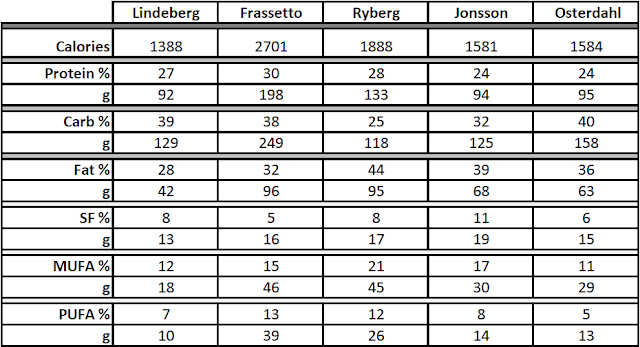
New Study!!! Metabolic and physiologic effects from consuming a hunter-gatherer (Paleolithic)-type diet in type 2 diabetes U Masharani, P Sherchan, M Schloetter, S Stratford, A Xiao, A Sebastian, M Nolte Kennedy and L Frassetto Why Frassetto Paleo? The first thing I do when I see a new paleo diet study is try to find out WHAT the diet actually was.  So even before I got the full text, I saw the "group" author and the description of the ramped up diets and knew it was her brand of paleo.  Here's a summary from  this post , which has links to individual posts I've done on the other various studies.  

Jimmy Moore in the Diabetes Summit - "Doctor" Mowll Nods Along As He Gets Free Fatty Acids All Wrong

Image
Here's your link:   Jimmy Moore Low Carb Controversy (available until 10am EST Friday 3/27/15) Paraphrased Highlights & Commentary

Dr. Roy Taylor's Diabetes Summit Presentation

Image
I received some fanmail yesterday -- it was a nice email!! -- encouraging me to share Dr. Roy Taylor 's  presentation at the 2015 Diabetes Summit -- of Newcastle Diet aka "crash diet" for reversing diabetes.   It's too bad he ended the talk encouraging the host to keep spreading good information ... sadly his is a rare inclusion in this event. HURRY -- I thought these would be available through Thursday Noon, but it's saying 3 hours :(  -- hopefully they'll extend that.  SORRY!! This summit is the second annual event put on by the director of Sweet Life Diabetes Centers, a chiropractor turned nutrition expert and other things, Brian Mowll DC.  Last year he co-hosted the event with Jimmy Moore, and I dubbed it the Reversing Diabetes Knowledge Summit .   There are more of the same chiropractors, naturopaths, and such spreading their views on how you basically should eat a very low carb diet and avoid this or that bad food that is killing your pa...

The Glycemic Index ~ It Was Supposed to Be About Carbs!

Image
As I have quite a few tangential thoughts going on, in search of a cohesive theme here, I've decided I'd just throw up a few short posts, and perhaps come back and put them together at some later date. The Glycemic Index is credited to Canadian researcher David Jenkins, and originated, near as I can tell, with this paper:   Glycemic index of foods: a physiological basis for carbohydrate exchange . INTRODUCTION :   Recent work has suggested that the carbohydrate exchange lists that have regulated the diets of many diabetics for over three decades may not reflect the physiological effect of foods. Such factors as food form, dietary fiber, and the nature of the carbohydrate have been shown to have a marked influence on the postprandial glycemia and allowances cannot be made for these in lists which take into account only the available carbohydrate content of foods. Currently, very good blood glucose control has been advocated for diabetics to reduce the incidence of lo...