Posts

Showing posts with the label Hepatic fat

Bio-HACK-ing Chronicles Ep.2: Maybe Jimmy Moore Has Hepatic Encephelopathy

Image
No ... this blog will not become all Jimmy Moore, all the time.  I do have some posts in the works that just need some polish ... including one on the study Ted Naiman bases his 3:1 ratios of grams protein to fat that Jimmy was following.  That said, I can't help but put together a few comments on the Drama Llama supreme's latest n=1. This Episode's n=1 bioHACK:    7 days of "Carnivore" , High Protein (mostly meat) 3:1 grams protein:grams fat.    1.5 grams of protein per pound of lean body mass equaled 270 g protein:90 g fat.   (if you use 40% body fat, that puts his current weight at 300 ... ) RESULT:   Fail.  If you listen at the 43 minute mark of this episode of The Keto Savage podcast , you'll see that it was Jimmy's every intention for this TO fail. The purpose of biohacking is SUPPOSED to be about seeking out ways to improve one's overall health ... to achieve meaningful goals.  This nonsense o...

Bump: The Diabetes "Crash" Cure & Pancreatic Fat

Bumping Again! New Article in BMJ:   Analysis: Beating type 2 diabetes into remission * The original posting of this was shortly after the first papers published on the success of a very low calorie diet -- essentially a 6-800 calorie protein-sparing-modified-fast, protein shakes + non-starchy veggies -- in curing diabetes in relatively short order.  You may also be interested in the following posts: The Diabetes "Crash" Cure Revisited  (a follow-up to this one) Diabetes "Crash" Cures: VLCal vs. VLCarb Check Featured Comment (if any) for further updates from me. *In light of commentary below, I'll add that I am not a fan of using the term remission here.  Cancer does seem to strike at random most times and recurrence seems to be equally random.  At best we have few if any ways to predict who will see cancer return etc.  But Type 2 diabetes doesn't work that way in most.  The source of the beta cell dysfunction is pretty well k...

Where do triglycerides come from? Part I (Updated)

Image
This post contains sufficient updates from the original (dated 5/11/11) that I consider it more of a fully updated version vs. a bump.   This began with my intent to link to this post in an upcoming discussion of triglycerides, when I noticed that Dr. Ronald Krauss was amongst the authors.   This study originally caught my eye because of    Marc Hellerstein 's name, he of  DNL not a major pathway in humans fame , that I've  blogged on  previously. Now I have excerpted copiously from the discussion because the authors make several points relevant to the discussion of what comprises a healthy lipid profile.  As part of updating, I am breaking those excerpts up a bit more and adding some/more emphasis and additional commentary.

The New Paleo Diet Study: Just the Fats Ma'am

Image
A Palaeolithic-type diet causes strong tissue-specific effects on ectopic fat deposition in obese postmenopausal women I don't know that this study is worth three posts -- grin -- but I decided to break it up anyway.  I blogged on the diet itself here , and the weight loss here .  This post will address the impact on ectopic fat.  So first, I want to mention the "misleading title" peeves.  Ectopic fat is defined in the abstract: Ectopic fat accumulation in liver and skeletal muscle may be an essential link between abdominal obesity, insulin resistance and increased risk of cardiovascular disease after menopause. Here's the relevant synopsis of the results: Liver triglyceride levels decreased by 49% whereas IMCL [intramyocellular lipid] levels in skeletal muscle were not significantly altered. Which apparently garnered the conclusion: A modified Palaeolithic-type diet has strong and tissue-specific effects on ectopic lipid deposition in postmenopau...

Review & Critique: The Skinny on Obesity ~ Part II Sickeningly Inaccurate

Image
Previously:   Intro & Part I The second installment of the University of California production, The Skinny on Obesity, featuring Dr. Robert Lustig and colleagues is entitled Sickeningly Sweet .  I've embedded the video at right.  I've entitled this installment of my Review & Critique Sickeningly Inaccurate.  That is, frankly an understatement about the information presented in this episode.  This video epitomizes what's wrong with many of the "anti-establishment" nutritional experts.  You do not counter bad science with more bad science.  This is what Lustig does here.  And it's not controversial -- at least there's some evidence supporting the lipid hypothesis -- but the "science" here is counter to known basic biochemistry and in opposition to the vast majority of the evidence of metabolism such as de novo lipogenesis.

Conjugated Linoleic Acid (CLA) ~ Good or Bad?

While I was looking at something unrelated (except that it was a fatty acid), the following popped up in my search:   Weight loss supplement - conjugated linoleic acid - shows nasty side effects .  Conjugated linoleic acid (CLA) first came to my attention, other than hearing about it as a supplement from time to time, during a discussion on trans fats and trans fat content of certain foods.  CLA is a trans fat, it's just not an unnatural nasty chemical we associate with the term these days.  It's found in meat of grassfed animals in particular, milk/dairy from same animals and eggs.   If you do a search on CLA and trans fat you'll turn up all manner of reports how it's the "good" or "healthy" trans fat.  In addition to some anti-cancer claims, it's also touted as the "belly busting" trans fat.  Sign me up!   But, not so fast according to the article, which references two studies: (2007, nothing new here, just thought I'd pass ...

Ketogenic Diets & Fatty Liver

Image
Non-Alcoholic Fatty Liver Disease:  NAFLD.  Along with diabetes, a disease on the rise in the US and around the globe where the obesity epidemic is rearing it's ugly head.  Near as I can tell, Peter/Hyperlipid subscribes to a "damaged liver" hypothesis of obesity and diabetes.  That the liver gets damaged, throws your insulin and glucose outta whack, and then you get fat.  There can be no doubt that damage to the liver is an integral part of the metabolic syndrome(s) and the insulin resistance that underlies it.  So the question is, do we take it seriously in all contexts?  Or do we try to explain away inconvenient results when it is one's favored advocated diet that might possibly be a culprit? Sadly, Peter seems bound and determined to spin ever more far-fetched mechanisms with which to explain away inconvenient results.  Having nothing to do with fatty liver, Peter found himself unable to backtrack on his definitive statement that it was fasti...

Visceral Fat & Hepatic Fat -- Not one and the same

Image
It seems that any time the discussion of fatty livers developing on ketogenic diets comes around, a spate of confusing discussions tend to ensue.  One of the confusing issues is that ketogenic reducing diets are effective at reducing hepatic fat levels.  However, these studies usually start with a fatty liver and with weight loss comes hepatic fat loss.  If there's a study out there where obese people are simply transitioned from a SAD to an equi-caloric ketogenic diet (85+% fat) demonstrating any change in liver fat accumulation, I'm not aware of it.  However I believe the evidence of rodents on such diets is at least enough to be concerned that the change, if any, would be for the worse, not the better.   A lot of lean people also think, I can't have a fatty liver because I don't have a pot-belly so I don't have visceral fat.  One of the reasons I thought the Eades' 6 Week Cure for the Middle Aged Middle  book was such a disaster is that the first ...

Bloggo Science ~ FIRKO-ized!

Image
I have long since ceased reading Peter/Hyperlipid's blog for meaningful information.  There are too many examples of him openly manipulating data and misrepresenting science for me to take him seriously anymore.  Still, our blogs share a certain readership and his readers do participate in other internet realms where I linger or participate.   As such, his blog remains on my feed reader.  Peter has been on a FIRKO mouse kick lately and it has caused me to dust off a few posts from the draft bin where this mouse fits into the discussion.  But his latest latest offering on FIRKO (Fat Insulin-Receptor Knock Out) just tripped my epigenetic BSA* gene switch.   *BSA = Bull Sh!t Alert In FIRKO-ise , Peter actually compares a genetically modified mouse to putting a mouse on a ketogenic diet.  Really!  To review, the FIRKO mouse lacks insulin receptors.  As a result, this mouse is resistant to obesity on the usual obesogenic diet for rodents (high fa...

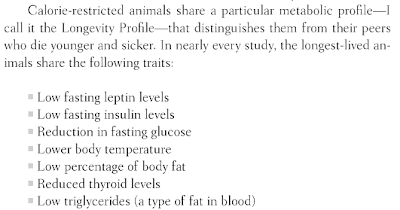
Chill out, live longer? How do VLC & caloric restriction factor in?

Image
I've been working on a related post when I came across an interesting study that I thought was worth a blog  post on by its own and was more timely for other studies I've been looking at more recently. A sidebar of looking into the claims of L.Ron Rosedale is that he's really all about longevity and believes his diet will deliver on that promise.  What I'm about to say may shock  some of you, but, there's some evidence out there that he might just be right!   The Catch 22, however, is that where he's correct it flies in direct conflict to the claims and theories espoused by the other ardent evangelists of carbohydrate restriction.   Any research into aging and longevity these days inevitably lands one into a sea of studies on teeny tiny worms known as C. elegans .   I have some stuff in the pike on these worms, but basically, two ways of  "naturally" extending the lifespans of wild type C. elegans are (1) growing them under lower temperature...

Is MightyMeta Mouse Relevant to Real Humans?

In my last post , I discussed a study demonstrating that mice on a ketogenic diet ate the same number of calories as both mice on standard chow and the obesogenic high fat+sucrose diet, but lost body weight comparable to that seen in mice constricted to eating 66% of the standard chow calories.  I dubbed this a metabolic Mighty Mouse of sorts, MightyMeta Mouse.  I don't think we'll have enough installments of this to warrant an acronym -{grin} - I'll just use short nicknames when I tire of typing it out.   In any case, this study seems to validate some of the magical metabolic claims made by those who are able to eat thousands of calories on VLC diets while having been unable to lose or in some cases even maintain weight eating standard CRD level calories.  Well, I did the math in the prior post, and although Mighty does seem to manifest a metabolic advantage of sorts, this would not translate to much for the humans in question.  A couple of hundred calor...

Adiposopathy

Presented without comment on the content per se: Role of the Adipocyte, Free Fatty Acids, and Ectopic Fat in Pathogenesis of Type 2 Diabetes Mellitus This is probably the most exhaustively referenced review article I've ever come across on the etiology of MetS and T2 Diabetes and the role of adipose tissue.  Too extensive to quote w/o copying the whole darned thing, although I may revisit it at some point to do a bullet point summary type post.  

Very Low Carb and Insulin Resistance

In response to my recent post --  Can low carb cause central adiposity?  -- James Krieger posted a link to a recent study indicating I may well be on to something.  So I thought I would post this study separately (I don't have access to the full text on this one). Longitudinal adaptations to very low-carbohydrate weight-reduction diet in obese rats: body composition and glucose tolerance. Longitudinal effects of a very low-carbohydrate (VLC) and a calorie-matched high-carbohydrate (HC) weight reduction diet were compared in dietary obese Sprague-Dawley rats exhibiting impaired glucose tolerance and insulin resistance. Obese rats were divided into weight-matched groups:  (i) VLC rats consumed an energy-restricted 5% carbohydrate, 60% fat diet for 8 weeks, (ii) HC rats consumed an isocaloric 60% carbohydrate, 15% fat diet, and (iii) HF rats consumed a high-fat diet ad libitum. HC and VLC rats showed similar reductions in body fat and hepatic lipid at the midpoint of ...