Posts

Showing posts with the label Chylomicrons

Where did the fat in this blood come from? ~ An Ead-iotic Analysis
Image
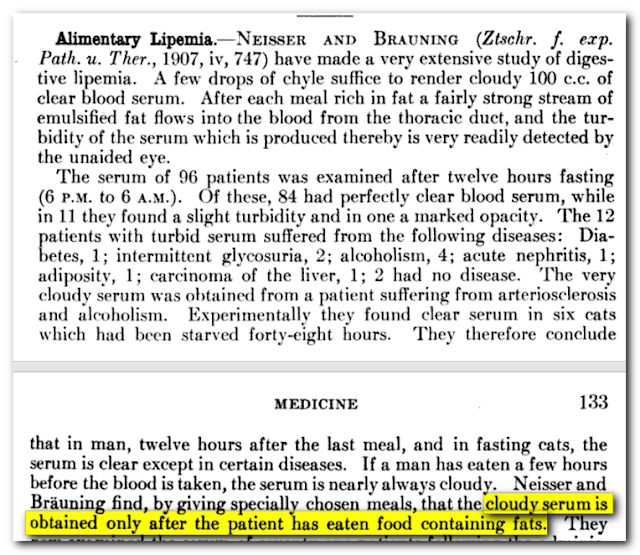
NOTE  (8/7/2018):     I've edited this post, originally written/published 5/5/2011, to omit the no longer relevant back story and broken links.  I had referred to a discussion on Jimmy Moore's now-long-defunct LLVLC Discussion Board that made me aware of the Eades' post discussed. SUMMARY:  Fat in the blood following a fatty meal is almost entirely due to the fat in the meal. ~~~~~ Several years ago, Dr. Michael Eades wrote the following post:   ABC’s big meal propaganda .  Sadly, the video is no longer available.  It involved subjects consuming a GIGANTIC meal of 6000 calories, after which blood was drawn two hours later.  This "after" blood was very cloudy, and the technician holds this up and identifies the source of the cloudiness as fat.  The meal was deep fat fried mac&cheese, a bacon cheese burger quesadilla and fries and an ice cream smothered giant cookie.  Yes, high in fat and carbs, but favoring the s...

Here's an Experiment I'd Like to See

Image
Ahh, well Jimmy Moore has posted his 90 day update on his nutritional ketosis experiment.  While he's refusing to divulge his menus until the 180 day experiment is complete (wanna bet he writes a book about the experience and stupid people will buy it?) he did finally post a typical meal complete with "recipe" and pictures. Why anyone is even interested in mimicking his foods is beyond me, but that's besides the point. Here's a "meal", I've added Charles' calorie estimates from nutritiondata.com direct image link

Fat Tissue Regulation ~ Part IX: ASP, LPL and the Triglyceride/Fatty Acid Cycle

Image
In this installment, we reunite with our old friend C3KO mouse to learn a little bit more about the role of acylation stimulating protein, ASP, in the regulation of fat tissue (and muscle) from this study:   Differential regulation of fatty acid trapping in mouse adipose tissue and muscle by ASP .  The C3KO mouse was discussed in Part II of this series.  This mouse lacks the gene to produce a protein called C3 (short for Complement 3) which is a precursor for the formation of ASP.  Thus C3KO mice are ASP deficient.  The C3KO is to ASP as a type1 diabetic is to insulin.  These mice are also resistant to obesity.  BTW, hyperASPemia accompanies the hyperinsulinemia and hyperleptinemia of obesity when it's measured. ASP-deficient mice have delayed postprandial triglyceride (TG) clearance and reduced WAT mass. The objective of this study was to examine the mechanism(s) by which ASP deficiency induces differences in postprandial TG clearanc...

Physician Phollies ~ II: Dr. William "Wheat Belly" Davis

Image
Next up in our "how can he/she even say that?" series of blatantly erroneous things said by practicing physicians in furtherance of the carbophobic agenda ... I bring you, an Asylum favorite, Dr. William "Wheat Belly" Davis.  In the most recent post on his WB blog , Wheat Belly trips over himself trying to implicate wheat, specifically, in the diabetes epidemic.   But can we blame diabetes on wheat? Yes, absolutely, as much as you can blame poor oral hygience for toothlessness in West Virginia. Wow!  Gratuitous slam on WVa's aside, Dr. Wee Bee goes on  to list all the ways wheat causes diabetes: –Any food that increases blood sugar to high levels (i.e., high glycemic index) also increases insulin to high levels. Repetitive high insulin leads to insulin resistance, which leads to visceral fat deposition, more insulin resistance, inflammation, etc., eventuating in diabetes. –High blood sugar, such as that resulting from eating two slices of whole wheat bre...

Fat Tissue Regulation: Part IV ~ How Acylation Stimulating Protein Works

Image
Lipases are a tricky bunch of enzymes when one is looking to the action of an enzyme to extrapolate to overall regulation of fat mass.    What do lipases do?  They are enzymes that facilitate lipolysis, which is the breaking apart of triglycerides into glycerol and three fatty acids.  We have digestive lipases that break dietary triglycerides down so that they can be absorbed, but once absorbed they are packaged again back into triglycerides for transport to cells.  These triglycerides are packaged in chylomicrons.  There are lipases both in circulation and attached to all of our different cells, called lipoprotein lipases (LPL's) that break down triglycerides to free up fatty acids.  Those associated with the cells are doing so to facilitate uptake of the fatty acids.  Here's where it gets tricky, because lipases associated with, say, muscle cells, are acting to bring fatty acids into the cell to be oxidized for energy.  But the lipases asso...

Of Microscopes and Myopic Hypotheses

Image
Surely somewhere somehow in your life you've used a microscope.  If this was in grade school, perhaps the teacher set it up for you, but most do not escape high school or college, even as non-science types, without using one at some point.  Here is your basic microscope you might encounter in a biology or forensic chemistry lab or such.    The light shines up from the bottom, through your sample, up through the objective lens that magnifies the image and through the eye tube to your eye.  The eyepiece usually adds additional magnification (10X).  A choice of three objective lenses that can be "dialed in" is quite common.  Note the different lengths of these.   The shortest lens is the lowest magnification lens and is often called the low power objective.  As lens length increases so does the magnifying power of the lens.  The technique for using the microscope is pretty universal and begins with something that sounds rather silly: ...

CICO vs. Regulation of Fat Tissue ~ Questions for Gary Taubes

Image
In an interview with Andreas Eenfeldt  (some time in 2010, uploaded by Eenfeldt 3/15/11), Gary Taubes makes the following statement (~3 minute mark is a good place to start): Look it's 2010 we have a disorder of excess fat accumulation, and people are saying that the actual physiological regulation of fat tissue is irrelevant.  One point Stephan made in his retracted response to Gary's recent blog post needs to be addressed.  So I'll  do so here.   Folks have been letting Taubes get away with this for a very long time, and that is his indiscriminate use of the word "regulation".   The core principal of TWICHOO  (Taubes Wrong Insulin-Carbohydrate Hypotheses of Obesity)   is that insulin is the primary regulator of fat tissue metabolism, and thus fat mass.  He's actually ratcheted that up a notch so that in his view insulin acts as virtually the sole regulator.   I'm going to use a computerized multi-fuel furnace with a fuel tank system ...

Where do triglycerides come from? Part III

Image
If you haven't done so already, you may want to read Part I and Part II first.  Part II, especially, discusses the sources of fatty acids for VLDL triglycerides manufactured by the liver and two secretory pathways - an immediate one and a delayed one.  In this part I'll discuss the results of that study: Delayed secretory pathway contributions to VLDL-triglycerides from plasma NEFA, diet, and de novo lipogenesis in humans This group uses different radioactive tracers to identify the source the fatty acids in VLDL-triglycerides.  This study differed from the study in Part I in that it looked at prolonged triglyceride levels - fasting and postprandial - rather than just fasting.  For one week prior to the study all subjects were provided a standard diet (outpatient basis) of 50% carb, 35% fat, 15% protein*, at weight maintaining levels.  I would note that this would mean the obese study groups were likely ingesting significantly more than the lea...

Absurdium lo carbicus

Image
The image below is currently featured on a low carb blogger's blog.  It's not the first time I've seen it, indeed I know for sure one other blogger who has featured this picture.  This graphic embodies what is wrong with the "LC movement" these days.

Glucose and NEFA: From Dysfunctional Metabolism to Toxicity

Image
This post started out as a comment in response to Paul Jaminet's mention of a post on this blog in his Around the Web   post yesterday.  It got rather long so I decided to move it here.  In the interest of more rapid publication, I'm not going to be doing a whole lot of referencing in my discussion here, but if you're interested in a particular statement please indicate so in the comments section and I'll try to track down the reference(s) I have in mind.  Paul writes: Every once in a while someone writes to ask me if they should fear a high-fat diet because of CarbSane’s writings on lipotoxicity. I reply that lipotoxicity only appears after metabolic syndrome has developed and, while it may drive the transition from obesity to diabetes, it is not a cause of obesity, and not a danger to people who don’t have metabolic syndrome. Also, the implications for diet are not obvious, since carb intake suppresses NEFA clearance from the blood and enhances glucotoxicity. The l...

Where do triglycerides come from? Part II

Image
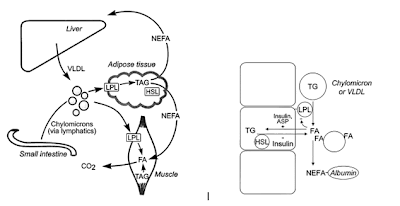
Part I Low carb dogma would have us believe that the triglycerides pumped out by our livers are not from the fats in our diet but the carbohydrates.  And specifically that they are formed from fatty acids derived from de novo lipogensis - DNL - aka excess carbs converted to fat.    As was discussed in Part I , in a whole food carbohydrate diet, DNL is not a major contributor to VLDL-triglycerides.  So, now, we have additional work from the Hellerstein's research group at Berkley.  More specifically, a 2006 paper: Delayed secretory pathway contributions to VLDL-triglycerides from plasma NEFA, diet, and de novo lipogenesis in humans  I'm going to discuss the paper and the results thereof in Part III, but for this installment I wanted to show and discuss a nice graphical overview of VLDL-TG sources from this more recent paper:

Insulin Wars IV.2a: The Discussion with Todd Becker/Getting Stronger continues

Image
If you haven't read the discussion thus far, or just to recap, here are the links: Insulin Wars IV: Todd Becker of Getting Stronger blog Insulin Wars IV.1: Todd Becker of Getting Stronger blog responds More Todd Becker (Getting Stronger blog) on Insulin  (this last one links to his piece on his blog) {Todd quoted the relevant prior exchanges in his email, so most can probably follow along just with this post} I've been putting off posting this for too long, mostly because in its entirety it is very lengthy (15 pages!) and I haven't had the length of uninterrupted time to devote to a thorough point by point response to the entire email.  So I decided to break this installment (IV.2) up into parts (a,b..., however many) so we can keep this discussion alive and continuing.  I'm also likely to address some topics out of order from Todd's email response.   Eventually it will all get up here :-)  I very much appreciate all the hard work Todd put into his response...

Non-esterified fatty acid metabolism and postprandial lipaemia

Image
Non-esterified fatty acid metabolism and postprandial lipaemia Yet another gem from ... who else? ... Keith Frayn! Non-esterified fatty acids (NEFA, or free fatty acids) are an important metabolic fuel. Both the concentration of NEFA and their flux through the circulation vary widely from hour to hour, reflecting nutritional state and physical activity. Inappropriately elevated plasma NEFA concentrations may have a number of adverse effects on both carbohydrate and lipid metabolism. As my regular readers know well, this is a focus of my research. These adverse effects are likely to be most marked in the postprandial period, when NEFA release from adipose tissue is usually suppressed. Although the regulation of NEFA release in the postabsorptive state is well understood in molecular terms, the predominant pathway for release of NEFA in the postprandial state is the action of lipoprotein lipase (LPL) in adipose tissue capillaries on chylomicron-triacylglycerol...

Insulin Wars IV.1: Todd Becker of Getting Stronger blog responds

Image
I received an email from Todd Becker of Getting Stronger blog who tried to add his comments/responses to my review of his contribution on Jimmy's blog regarding James Kreiger's Insulin Series. Here is a link to that installment:   Insulin Wars IV: Todd Becker of Getting Stronger blog I did my best to retain the emphasis/formatting from Todd's email.  So, with apologies in advance if any of my responses are repetitious of my initial post, without further adieu: Todd writes: Hi CarbSane, Congratulations on your articulate, informative and passionate podcast interview on Jimmy Moore’s site. Small world: I’ll be a guest on his podcast in a few weeks. Your interview inspired me to look at your blog, where lo and behold I found your critical review of my analysis of James Krieger’s views about insulin, which I wrote for Jimmy’s blog. I appreciate the time and thought that went into your analysis, and I’ve learned several interesting things from your site. But if you would...

The ASP pathway and regulation of postprandial metabolism ~ Part I

The acylation-stimulating protein pathway and regulation of postprandial metabolism By regulating the rate of adipocyte triacylglycerol synthesis, the acylation-stimulating protein (ASP) pathway plays a critical role in postprandial triacylglycerol clearance (Baldo et al. 1993) I came across this one following the trail of, who else?, Keith Frayn.  Thank you Gary Taubes for inadvertently introducing me to this fountain of truth of the science of fat metabolism.  I was going to make this the lastest install in Frayn v. Taubes series, but I think that does an injustice to Frayn, not to mention Allan Sniderman, Katherine Cianflone, Lucinda Summers, and Barbara Fielding (the first four authors of this article). I'll do my best at a bullet point summary of the research cited in this review and the conclusions of the authors.  Indented italics will be direct quotes from the article.  Note:  triacylglycerol = triglyceride

Insulin Wars IV: Todd Becker of Getting Stronger blog

Image
Okey Dokey, I made a big boo boo and edited the original of this post to create another post in this series by changing the title.  Result?  The original disappeared.  Won't be doing that again!  Live and learn some more :-)  Anyway, luckily I had the post open in another browser window so I didn't lose it.  Phew!!  C&P'd the existing comments too.  Hope I didn't lose any!  Sorry if I did :-( Friday, December 17, 2010 Insulin Wars IV: Todd Becker of Getting Stronger blog I thought I would share some thoughts on some of the responses of LC "experts" to James Krieger's excellent series on insulin.  For any who missed them, here are the links    “Insulin…an Undeserved Bad Reputation” ,   Part 2 , Part 3 ,   Part 4 ,  Part 5 . Jimmy Moore asked an array of people in LC circles for their thoughts  HERE The subject of this installment is Todd Becker of Getting Stronger blog.

Chylomicrons and HDL

Another one of those mostly bookmark posts with no commentary Metabolic Fate of Chylomicron Phospholipids and Apoproteins in the Rat The researchers injected radiolabeled chylomicrons into rats to determine the fate of the components.  The results: Catabolism of chylomicrons is associated with a rapid transfer of phospholipid, apoA-I, and possibly apoA-IV into HDL. Chylomicron phospholipid appears to give rise to vesicles which are probably incorporated into preexisting HDL. Chylomicron surface components may be an important source of plasma HDL.

What to think when "experts" get it wrong ... repeatedly??

Image
So let me start by saying that I've gleaned a lot of useful information over at Dr. Davis' Heart Scan Blog .  But one thing I've noticed is that he rarely responds to comments left at his site.  Now, obviously, he's under no obligation to do so, but when the comments are corrective in nature, not doing so leaves the impression that he didn't even bother to read the comments and/or take them under advisement. The first time I noticed this was in this post .   Carbohydrates in the diet trigger formation of small LDL particles. Because carbohydrates, such as products made from wheat, increase triglycerides and triglyceride-containing lipoproteins ( chylomicrons, chylomicron remnants , VLDL, and IDL), LDL particles (NOT LDL cholesterol) become triglyceride-enriched. Triglyceride-enriched LDL particles are "remodeled" by the enzyme, hepatic lipase, into triglyceride-depleted, small LDL particles.  I'll leave the rest of that alone and deal with just the ...

So I'm reading some GCBC again ...

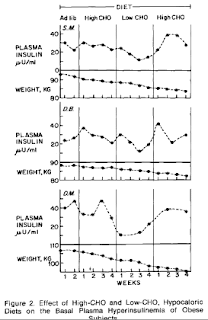
... and on p. 408 of my Sony ebook version (this will not coincide with the hard copy, but it is after the glycerol 3P section), Taubes writes: By the mid-1960's, four facts had been established beyond reasonable doubt:   (1) Carbohydrates are singularly responsible for prompting insulin secretion. (2) Insulin is singularly responsible for inducing fat accumulation. (3) Dietary carbohydrates are required for excess fat accumulation. (4) Both Type 2 diabetics and the obese have abnormally elevated levels of circulating insulin and a "greatly exaggerated" insulin response to carbohydrates in the diet ... Note the wording "facts".  Kinda hard to use the weasely "it's a hypothesis" defense for all the misinformation when one words things this way.  But let's consider these in order: (1) We know this isn't true, protein elicits an insulin response.  Furthermore fats have been shown to at least amplify insulin responses by, for example, stimu...

ASP action in vivo in humans

Coordinated release of acylation stimulating protein (ASP) and triacylglycerol clearance by human adipose tissue in vivo in the postprandial period This paper demonstrated ASP actions in vivo for humans in the postprandial (post-meal) period.  ASP levels were measured locally to the adipocytes  (venous output side) and systemically in the arterially "supply" side.  This was important because many who would dismiss the action of ASP look at systemic ASP levels and claim no connection.  However, this paper demonstrated otherwise: Abstract  The objective of this study was to determine whether Acylation Stimulating Protein (ASP) is generated in vivo by human adipose tissue during the postprandial period.  After a fat meal, samples from 12 subjects were obtained (up to 6 h) from an arterialized hand vein and an anterior abdominal wall vein that drains adipose tissue. Veno-arterial (V-A) gradients across the subcutaneous adipose tissu...