Posts

The New Paleo Diet Study: Just the Fats Ma'am

Image
A Palaeolithic-type diet causes strong tissue-specific effects on ectopic fat deposition in obese postmenopausal women I don't know that this study is worth three posts -- grin -- but I decided to break it up anyway.  I blogged on the diet itself here , and the weight loss here .  This post will address the impact on ectopic fat.  So first, I want to mention the "misleading title" peeves.  Ectopic fat is defined in the abstract: Ectopic fat accumulation in liver and skeletal muscle may be an essential link between abdominal obesity, insulin resistance and increased risk of cardiovascular disease after menopause. Here's the relevant synopsis of the results: Liver triglyceride levels decreased by 49% whereas IMCL [intramyocellular lipid] levels in skeletal muscle were not significantly altered. Which apparently garnered the conclusion: A modified Palaeolithic-type diet has strong and tissue-specific effects on ectopic lipid deposition in postmenopau...

The New Paleo Diet Study: The Weight Loss

Image
I've written previously about the diet used in the latest paleo diet study. In this post I want to address the results.  Here's the study:   A Palaeolithic-type diet causes strong tissue-specific effects on ectopic fat deposition in obese postmenopausal women .   In this post I am going to address the weight loss (and change in intake) only. On the "con"side we have the following: Small, n=10 No control group Short - 5 weeks On the "pro" side, there appear to be (see small type below) significant controls in place to ensure compliance, accurate reporting of intake, etc. Summary:  This group spontaneously decreased caloric intake by an average of 25% with a mean weight loss of 4.5 kg in 5 weeks.  That works out to 2 lbs per week weight loss ... a decent clip.  Two things I would like to highlight:

The New Paleo Diet Study: Paleo-type-style-ish Diets vs. "Paleo"

Image
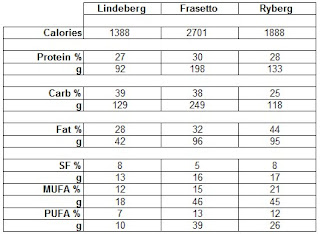
There's a new Swedish paleo diet study out: A Palaeolithic-type diet causes strong tissue-specific effects on ectopic fat deposition in obese postmenopausal women .   The title sounds promising, but my first reaction to it, sadly, not so much about the potential findings, but, what exactly is this paleo- TYPE diet??  It would appear to be based loosely on Cordain's original Paleo Diet (I hear that's trademarked).   This was a small study, 10 women, no control group, lasting only 5 weeks.  There were some benefits including around 10 lbs average weight loss and almost 50% reduction in liver fat.  This shall be for another blog post.  But what diet was tested?  Here's the diet description from the full text: Participants were given prepared meal portions that were intended to provide an average intake of about 30 energy percentage (E%) protein, 40 E% fat (mostly unsaturated) and 30 E% carbohydrates for breakfast, lunch and dinner, together with...

Too funny not to post a blog on

Image
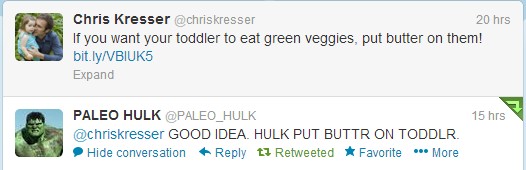
No idea who @PALEO_HULK is, but this is hysterical:

What's wrong with food in the Incestral Health Community

Image
A little trifecta for you here of things are responsible for the evolution of the term "paleotard" through neolithic times and flourishing in the present.  Some examples of dietary dogma to chew on the next time you consider what foods are *OK*  to eat. Mark Sisson First up, the man himself, the guy with the advice column "Is it Primal?"  I've read these for years now and they seem to get evermore ridiculous.   I vividly recall reading my first installment before the IIP roundups became more the rage, a "Dear Mark" about buckwheat.    At first glance, buckwheat certainly looks promising . Unlike grains, it’s not a grass, but rather a flowering pseudocereal. The triangular seed from the buckwheat plant, called a groat, is harvested and can be milled into flour or used whole in cereals. Seed? Seeds work, right? Not necessarily. While I love most seeds for their high fat content and protein, they do have to be low in carbs to pass the test. ...

Empty Calories

Image
How many times a day does a regular about the nutrition internets hear this term?  One, two ... a dozen?  In this community, it is often carbohydrates that are slapped with this tag.  I find it ridiculous to label a class of molecules as "empty" with no mention of the context in which they are found and consumed.  It is also rather warped that most of the residents of relatively wealthy countries view calories for the sake of the life sustaining energy -- so that the body doesn't have to cannibalize itself -- in a negative light.   Does anyone really think paleolithic humans thought about whether their food came with an appropriate density of vitamins and minerals?  Of course there would have been little opportunity for them to consume such foods ... those are processed/refined foods.  I also cannot envision our ancestors passing up starchy plants to consume non-digestible fibers, but that's a topic for another day.

ATP, Thermogenesis and Leptin Man's Electrons

Image
A little update on the adventures of a man we call Leptin Man here at The Asylum, Jack Kruse.  I skimmed his latest (6 page!) manifesto , and near as I can figure, his focus is on ATP stores.  His metabolic pathway du jour is the Pentose Phosphate Pathway (PPP).  Among many many words, he writes: TRUTH BOMB:   This pathway has only a few major endpoints, but they are all massively important for human life.  It is designed to optimally restore RNA and DNA synthesis by providing maximum recycling of ATP;  and it allows for optimal formation of bio-energenic substrates to make replenish the mitochondria’s ability to increase  total adenine nucleotides   to re-establish optimal ATP stores from beta oxidation of fats .