Posts

Why We Get Fat ... Lessons from a Cafeteria Rat

Image
BUMP! In addition to blogging on several topics raised during Stephan Guyenet and Gary Taubes recent appearance on the Joe Rogan Experience podcast , I've decided to bump some of the past content on this blog relevant to some topics discussed and/or research studies mentioned.  I'll include a little commentary with each. At around the 12 minute mark, Stephan makes a great opening play, and then gets distracted or flustered into fumbling the football.  Stephan asks what it is about the food environment, etc. that causes obesity, and distills it down to the simplest of questions (paraphrase): Q:  What is the most fattening diet on the planet? A:  Human junk food. Nail.  Head.  Boom.  He then calls out some numbers from the research summary he posted on his blog in advance of the podcast .   The study I discuss in this blog post is the one included in "#52" that he's discussing in the podcast.    Joe seemed perplexed by thi...

Guyenet v. Taubes ~ Topic 1: "Just 10-20 Calories a Day"

Image
U nless you've been living under a "rock" in the world of nutrition, you're aware that Stephan Guyenet "debated" Gary Taubes on the Joe Rogan Experience podcast. It took me several days broken up to watch/listen to the whole thing. In a nutshell, it was Science & Substance (Stephan Guyenet) versus Stories & Slander (Gary Taubes). Rather than summarize, there were several points made that I'd like to address. In no particular order. I'll include this intro with links to prior topics as this series progresses.

The $12M NuSI/Ludwig Study ~ Part V: Intake, REE and TEE Measures

Image
S ummary: Continuing on with discussion of:   Effects of a low carbohydrate diet on energy expenditure during weight loss maintenance: randomized trial Previous posts in this series: Part I: Critique of the Study Design Part II: $12 Million for 12% Weight Loss? Part III: Some "Early" Lessons Part IV: Insulin Resistance Does Not Hamper Weight Loss This post should perhaps have come first, but it has taken a while to look deeply at the data for the primary outcome -- total energy expenditure measured by doubly labeled water -- and related outcomes of intake and resting energy expenditure. In this study, all participants were paid to participate, AND provided free food for ~8 months.  Said food was professionally and meticulously prepped, weighed, measured, individualized to provide each subject with some pretty exact caloric level and macronutrient composition.  The test phase (in other words, the study proper) involved maintaining a consiste...

The $12M NuSI/Ludwig Study ~ Part IV: Insulin Resistance Does Not Hamper Weight Loss

Image
       C ontinuing on with discussion of: Effects of a low carbohydrate diet on energy expenditure during weight loss maintenance: randomized trial No summary for this post.  Here are links to earlier parts in this series: Part I: Critique of the Study Design Part II: $12 Million for 12% Weight Loss? Part III: Some "Early" Lessons :   In this most recent post, I discussed the relationship between measures of insulin (both fasting and 30 minute OGTT response) and weight loss during the Run-In Phase.  

The $12M NuSI/Ludwig Study ~ Part III: Some "Early" Lessons

Image
S UMMARY Continuing on with discussion of: Effects of a low carbohydrate diet on energy expenditure during weight loss maintenance: randomized trial In Part I , I discussed some issues with methodology, mostly focusing on the reduced Run-In Phase that likely compromised the outcomes irreparably. In Part II ,  I highlighted a serious issue with the Run-In Phase, the purpose of which was to produce a somewhat homogeneous "reduced weight state" to test various diets in maintenance of that state. Ultimately,  randomization to the various test diets occurred after weight loss (PWL) all subjects lost weight on the same 45% Carb / 30% Fat / 25% Protein diet targeting a weight loss of 12% ± 2% initial body weight. The researchers do not appear to have made many adjustments in the weight loss phase to produce a more uniform weight loss.   Rather than 12% ± 2%  (from 10% to 14%)  losses, the actual outcome was roughly 10.5% ± 5% (actual ...

The $12M NuSI/ Ludwig Study ~ Part II: $12 Million for 12% Weight Loss?

Image
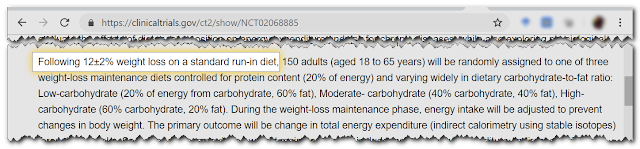
U PDATE:   12/17/2018      Original Posting: 12/3/2018    During the writing of a new installment in this se ries, I revisited the following paper: A randomized study of dietary composition during weight-loss maintenance: Rationale, study design, intervention, and assessment Yes, folks, so full of themselves were these researchers, that they felt the need to write an entire paper (submitted approx. one year in advance of the "real study") outlining their amazing study. Regarding this post, focusing on the OUTRIGHT FAILURE TO IMPLEMENT THEIR STUDY DESIGN AS STATED , I stress the following from the previous paper. ONCE AGAIN, the stated goal of the weight loss run in is 12% ... not 10 or 5 or 15 or whatever ... 12%.  I'm just going to quote the relevant part here (cleaned of references, etc. and formatted for readability, all emphasis mine) Energy intake was restricted to 60% of estimated needs to achieve a target weight loss equ...

The $12M NuSI/Ludwig Study: Part I: Critique of the Study Design

Image
S UMMARY The results of the $12 Million Dollar NuSI-sponsored study, headed up by Dr. David S. Ludwig, are finally out.   Effects of a low carbohydrate diet on energy expenditure during weight loss maintenance: randomized trial While the good doctor is making the rounds touting them as evidence in support of the Carb-Insulin Hypothesis (TWICHOO in these parts), a review of the raw data made available to the public casts grave doubts on his victory lap.  This study built upon the "promising" results of the 2012 study:   Effects of Dietary Composition on Energy Expenditure During Weight-Loss Maintenance    This post focuses on comparisons of Study Design between these two studies, some improvements, and the ultimate failure that renders the primary outcome data suspect, if not outright useless.  (And I don't say that lightly!) Improvements: Study size Length of time on one test diet (20 weeks) vs. 4 weeks crossover on each...